I’m 33% down on last October 
1 Like
Did a screen save for when we start our foray into this.
1 Like
That’s reassuring, as this is our first year. We only generated 362kWh in October and the net fuel cost was about £14. Still, that did include quite a bit of car charging and we turned on the heat pump for heating on 28 September when we returned from the South of France and felt rather chilly.
I wonder whether anyone else is having issues with the Octopus app. We are on intelligent go, and since 1 October it’s been unable to show our year cost to date. It worked perfectly up to 30 September. I’ve raised it with them and they are coming up with all sorts of daft reasons why it won’t work. My argument is that it worked to 30 September and doesn’t work after that, therefore they have broken it. Monthly figures work fine, it’s
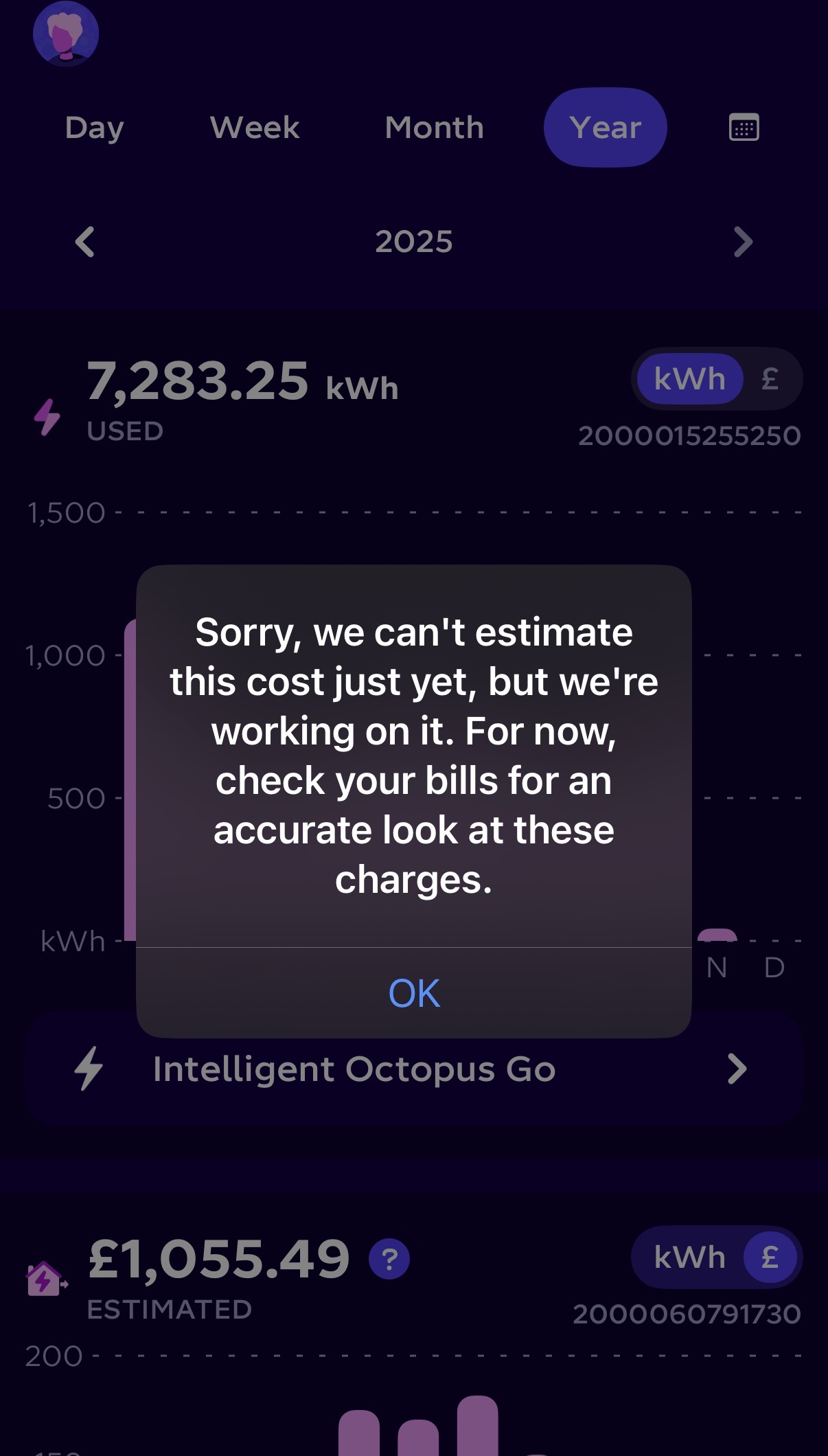
just the annual figure. Very odd.
The refund calculator doesn’t work either. They tell me it’s just a suggestion. I tell them it’s broken.

1 Like
Yep.. I have this.. it seems to occur when your tarif rates have changed over the time period requested to display. At least for me.
Thanks Simon. My thinking is that it didn’t go wrong when I swapped from Cosy to Go in March, or when rates increased in April or July. 2024 is fine and rates changed during the year. It’s gone wrong somehow and I’ve had to resort to a spreadsheet.
1 Like
The Eon app also doesn’t work too well at the moment, missing readings and 1/2 hourly detail. My Smart Meter has had its comms box replaced as 3G wasn’t working but it’s still not completely fixed.
I got my billing changed to 1st of month. No problem here.
Phil
It’s not the billing date.. I have moved that as well no issue, it’s the unit and standing charge rate changes that seem to trip it up when applied to certain tariff types .
I have had an issue when they forced a FW upgrade on my Gas Meter. - result no Gas at all (they did replace the meter the same day within the target 3 hours which was impressive)
They replace the SMET 1 Gas meter with a SMET 2 one , then the gas and electricity meters stopped communicating resulting in no gas readings being recorded
They have ‘supposedly’ reset the comms link
After a week still no Gas reading readings being recorded
Customer Service are very responsive but no use at fixing the issues, each step of this sorry tale has resulted in irrelevant response emails and no fix until I emailed reapeatedly at each stage
1 Like
ok a slightly different matter as you say. Frustrating, as I have no gas supply I can’t suggest anything here. All I can say is that my export and import meters have two separate IDs and are connected by an ethernet cable - and is communicated over the air by the master meter.
That’s nothing! My daughter had smart meters installed a few years ago; the gas meter was dead as a doornail and still is.
After a number of pointless emails she was put on a ‘temporary’ fixed monthly payment, but her supplier refuses to accept that the meter needs fixing. Fortunately the fixed rate was based on a reasonably low estimated usage so the lack of action isn’t really a problem.
I had similar recently, I had no gas and it transpired that when the battery fails it closes the gas valve! It was lucky I realised as I was about to place a call with our boiler engineer as I assumed a boiler daily initially.
The gas meter was replaced with a SMET2 device (previous was first generation). I was informed that the new meter wouldn’t communicate with the electricity meter (SMET1) unless that was replaced as well.
A new electric meter was installed a couple of weeks later and they started communicating almost immediately.
I think your electric meter will need to be replaced as well.
Sorry it is the two new meters which still refuse to communicate with each other
I’m three years in and have, so far, saved about half of the cost of the install (11k).
The rate of savings slowed down when Octopus increased the off-rate from 7.5p, to 8p, to 8.5p.
They also changed the difference between the peak rate of the ‘standard’ tariff and the ‘Go’ tariff, the hours that are off-peak and also the import tariff rate (up from 4.1p to 15p).
So all the modelling I did went out of the window!
I think I’ll be another four years or so until it’s ‘paid for’.
If I was having an install now, I think I’d:
-
have a larger battery- ideally somewhere around 2/3rd of a day’s overall consumption which would ensure I could just about use off-peak charging to time shift everything out of peak time. consumption. I think a 15kWh battery, rather than the 5.8kWh I have.
-
I’m happy enough with the 5kW inverter, but I would over-size the strings on it (currently two around 3kWp each, maybe I’d have gone another 1.5kWp or so on each string) so I had more panels for dull days like today- so I’d have 1.5kW at the moment rather than 1kW.
However, it’s not enough to encourage me to make changes at the moment. I suspect I’ll make changes when I the batteries start to lose capacity; in seven years or so (or if the inverter fails).
1 Like
Commts on your list
-
The ratio between generation on dull and very bright days at different part of the year is significant and far greater than I had anticipated - though a few had pointed this out on this thread, and so the power generation can vary significantly. I have found with my setup I frequently clipped my 5kW inverter when I added four south facing panels in the peak summer months for a few hours around mid day.. This clipping is normally not recommended as it can stress an inverter - though I am confident with my inverter design it won’t damage it - but waste generated energy. So increasing panel out put for dull winter/autumn days - I would ensure at least a 5 to 1 headroom with your inverter for bright mid summer days.
-
Yes power capacity of battery is important - yours does look low - I have 10kWh battery capacity which is fine. I have only exhausted the battery about 4 or 5 times in the last year - and one of those days was Christmas Day. However it’s the peak power draw which has turned out important. My battery peak power draw is only 3.7 or 3.8 kW - which is fine unless simultaneously using high power electric shower or cooking with with hob, and air fryer at the same time for example. In such instances the system takes the additional power from the grid typically at peak times - even though you might have a battery with plenty of charge still. So I would go for a peak current draw matching my inverter capacity if I could if I was to do again.
BTW many systems allow you to daisy chain batteries - but that doesn’t usually address peak power draw.
Wow, a multi-tasking man! 
I am a family man 
We had our solar installed in mid December last year, at the same time as the heat pump. We used Cosy until March, which enabled us to top up the battery in the afternoon 1 to 4pm Cosy time. This year we are sticking with Octopus Go, which costs 7p off peak rather than the Cosy 14p. We have 19.2kWh of batteries and it’s going to be interesting to see how far through the day they will last. This is going to be down to how cold it is, which determines how much power the pump uses, and how sunny it is, which determines the extent to which the solar supports the pump during the day.
If we exclude the amount of power used to charge the car we are about £360 up over the period 1 January to 30 October. So if we can stay within £360 over this month and next we will have run our entire home in 2025 for absolutely nothing, which will be really amazing.
5 Likes