Do you have photos to share? I was thinking of lining the insides of the metal boxes - and do What you’re suggesting as the next step.
1 Like
alternatively use copper tape that is available as a garden slug deterrent for a few pounds, quick ebay search - i lined a switch with it….
1 Like
Yeah but that’s supposed to be like a shield and is conductive and needs to be grounded
1 Like
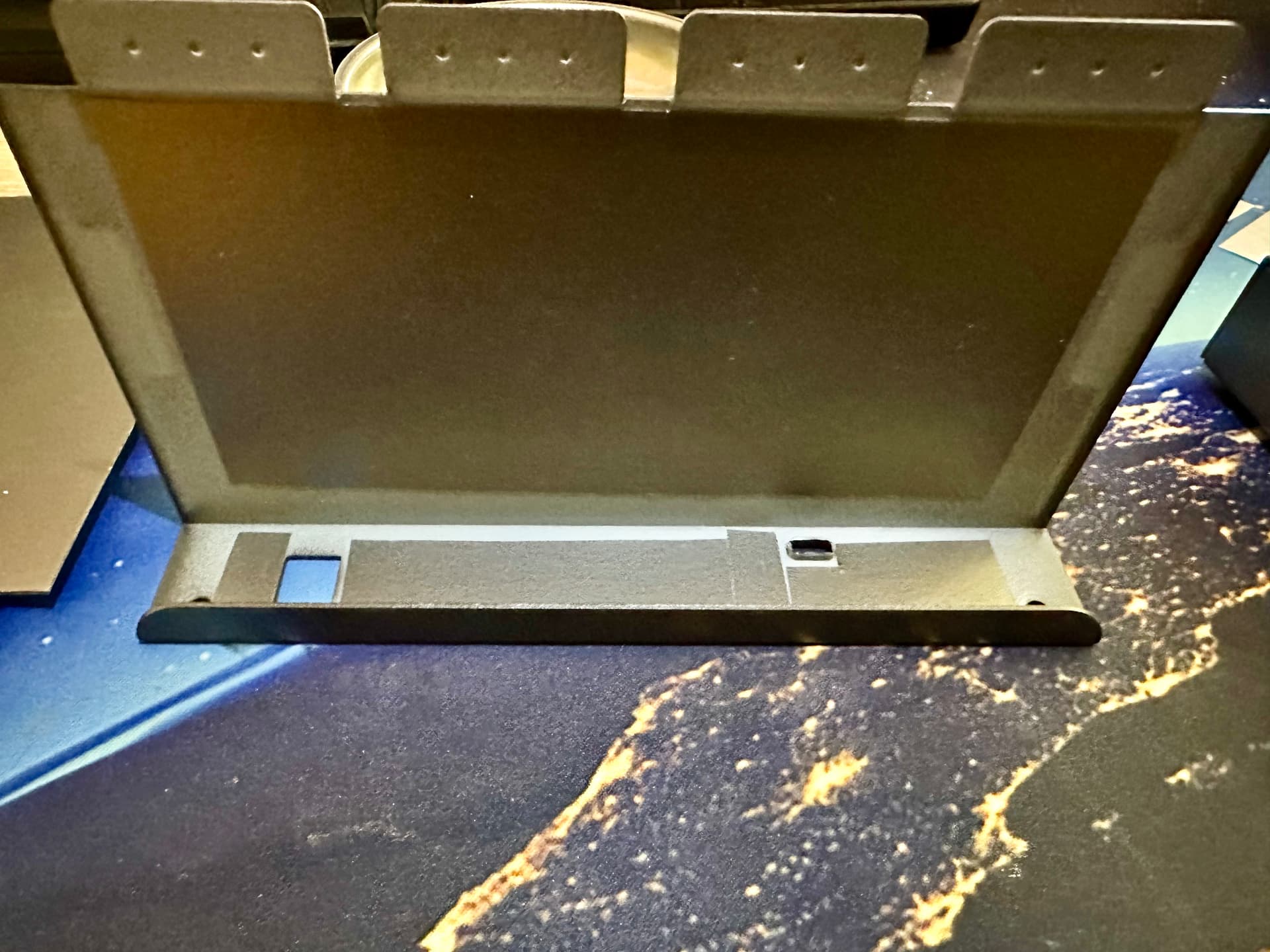

Hifi-dog the special part about the 3M stuff I’m citing is that it doesn’t need to be grounded in order to work. It converts RF/EM energy into small amounts of heat.
So you don’t have to connect panels and sheets like you do the copper tape. But the copper can also be very effective as a faraday cage, as you know. And it’s CHEAP.
2 Likes
For my router I bought a faraday “bag” which I am no longer using. In the system, I have a Stageline K which unfortunately exhibits some breakthrough from a nearby radio tower. I decided to simply place the bag on top of the Stageline and found that I have to turn the volume higher to get any breakthrough. When listening to digital I lay it over the dac and find that the soundstage opens up, with more fine detail coming through, but I’d say less noise as well. Might be worth trying.
3 Likes
Love these tweaks!
1 Like
My understanding is that any emi shielding would be most effective if it is connected to earth, and that would apply equally whether or not insulated, so whilst pieces of insulated shielding would shield it may shield better if earthed. I can think of no reason why that should not apply just as much to the 3M stuff as copper tape or anything else.
Beyond that, different materials will have different degrees of effectiveness at shielding, e.g. across a range of em frequencies. And a continuous (solid) shield made of the shielding material is likely to be more effective than one with any possible gaps (as fabric-based shielding may have, however small).
I think the point of the 3M product is easy shielding where it is difficult to do with other, possibly much cheaper, materials (including copper tape) and not that it would be better - I would be very surprised if it claimed otherwise.
1 Like
A point that might be worth a think … the Netgear Switch in cb01’s post (& all metal cased Netgear with SMPS) has its casing capacitively connected to the switch power supply DC negative. These can be seen in the picture next to each of the x4 PCB attachment screws ( x2 per screw marked with ‘C’ & number )
Attaching a separate power E or other earth ground is something to think about as the standard SMPS supplied with Netgear, and most all wall wart type SMPS that I know of, do not have a power earth (E) connection, DC negative is from AC power N.
Just saying, think about it first.
1 Like
3M calls it an EMI/RFI Absorber.
Emi shielding works by a combination of absorbing and reflecting, depending on what exactly is being blocked. I see no reason whatsoever why 3M’s product would differ fundamentally in its mode of operation compared to metal shielding. The primary value of an inherently insulating material like 3M’s is that being non-conductive it can be positioned in places where it can be challenging to fit metal shielding due to risk of short circuit, such as attaching direct to electronic components (hence that being a target use of their product). It also might be that through specific composition choices they may have a number of variants with different targeted emi shielding characteristics, just as if one was primarily seeking to shield from magnetic fields the best choice of metal would be one with high magnetic permeability such as mu-metal, vs copper which may be best for radiated emi.
@Simon-in-Suffolk may have other information on this from direct experience.
1 Like
You should read 3M’s data sheet on AB7000HF or AB5000HF. It’s interesting. And they specifically characterize it as an “absorber”.
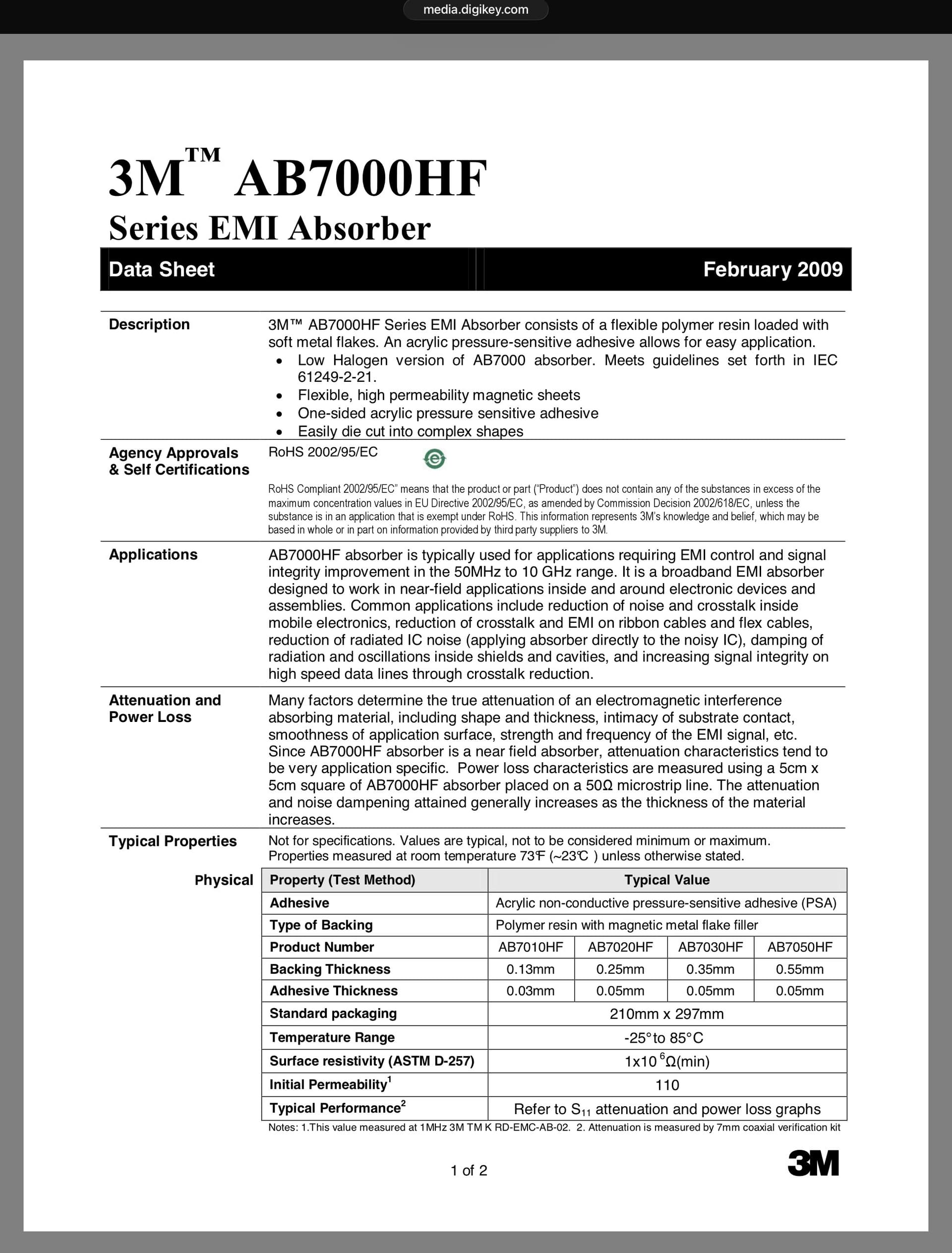
And so, IIUC, is plain metal, at least to some extent or with certain em fields. I wonder if the 3M also reflect - not stated in that datasheet, but that doesn’t mean it doesn’t. Regardless, as I said it has specific uses where it may be better than metal shielding, while in other situations it may be less effective.
1 Like
I don’t think it’s an “either or” proposition. In some industry brochures, 3M highlights using AB7000 on its own and in conjunction with shielding elements. Both are useful, but AB7000HF is certainly more versatile, with many more use cases than mere reflection of EMI/RFI.
As far as being “plain metal”, it appears to me to be a very specific metal alloy slurry, held in permanent suspension by a resin. I don’t know what the functional difference would/may be, but I can confirm that they are not in any way ‘sheets of metal’, as it were.
To address your question about reflections: I would want to define “reflect”. The inverse of the absorption curve maybe a starting pointy for estimating the amount of energy being rejected or reflected. But there’s also the undisclosed amount of energy that would be permitted to permeate the material. Oh and all of this varies based on thickness of application (and multiple layers can be stacked, with additive gains in absoprtion.).
On my turntable there was a recommendation tweak in the manual to connect DC negative (SMPS in) with a wire to signal ground post if having hum issues. I tried it and it became dead silent. So I believe what you say here can have great effect.
2 Likes
Mike this is a great point and I actually tested it with one of my Netgear GS108e’s using an iFi Elite PS which actually has a true earth ground reference.
Bottom line: you’re right, it works.
1 Like
My mention of plain metal wasn’t referring to the 3M product, but the alternative of plain copper, iron, aluminium etc which are the most common materials used in switches and sensitive hifi gear. As for reflecting, in simple terms the definition is the arriving em radiation, whether some or all, hitting the surface and “bouncing off”, neither passing through to the other side nor being absorbed with energy dissipated in thematerial.
I don’t doubt that the 3M stuff has many uses, and for some it may be particularly suited, as I had mentioned - but for others metal boxes or metal tape etc may be just as effective, and in some cases may well be more effective, while being less expensive, as per someone’s suggestion of copper tape earlier in this thread, your response to which prompted mine to you!
No matter - of course it is up to individuals as to whether they want to play with expensive proprietary stuff or inexpensive alternatives - or not bother, finding other ways of maximising sound quality without fussing with switches etc!
1 Like
Yes - so these simply attenuate the EM currents/field strength with minimum reflection on its way to ground - by turning to heat. These are quite common in many sensitive electronic designs and enclosures as well as shielding use cases, though they tend to be specific for certain frequency ranges. The positioning of these also tends to be rather critical and for high frequencies it can require mm accuracy.
Kind of like the EM equivalent of an audio frequencybass sink that you would put in room boundaries.
1 Like
Correct on what they are. I have found placement to be forgiving in all of my use-cases, so far. 3M doesn’t provide significant caveats on placement precision, though precision is always desired and beneficial IMHO. Frequency range and more details here:

2 Likes
I used the AB7050HF for lining the insides. Looking at the data sheet you provided, it make might sense to line the outsides with AB3000 to reject home wifi noise entering the switch.. or maybe after faraday bag …
1 Like