Well, I thought I connected the N50 grounding post to earth at the outlet, by connecting via wire the N50 ground post to the screw that holds the plastic faceplate on (this is in the US). I had always thought this screw connected to metal in the receptacle and ran to ground. But now I wonder.
1 Like
Simon I’m confused. A Creek integrated, and the N50. In the exact same situations, replacing one for the other, the Creek has zero hum, and the N50 lots.
The amps are different designs though.. Naim do it their way for what they believe maximum fidelity - Creek will do it their way for their own reason - perhaps ease of setup is more important - I dont know.
1 Like
Got it.
That was what I was trying to say earlier. Other than this, the N50 is several leagues better, so…
And it’s just the N50 that is like this no other Naim amplifier,that I have tried.
I suspect most of us on this site fall in that category!
2 Likes
AI says this about this screw and if it connects to mains earth.
Short answer: sometimes yes, sometimes no.
In a typical US receptacle, the screw in the middle of the faceplate is threaded into the device yoke (the metal frame of the outlet), not directly into a wire. Whether that screw is actually at earth (ground) potential depends on how the outlet is installed.
Here is the chain of logic.
If the outlet is mounted in a metal electrical box and that box is properly bonded to the equipment grounding conductor, then the outlet yoke is grounded through its mounting screws. In that case, the faceplate screw is also grounded. Touching it is electrically the same as touching ground.
If the outlet is in a plastic box, there is no automatic grounding path through the box. The yoke is only grounded if a ground wire is explicitly connected to the green ground screw on the outlet. If that ground connection is missing or faulty, the faceplate screw will float and is not reliably at earth potential.
If the faceplate itself is plastic, the screw head may be the only exposed metal, but it still follows the same rule: grounded only if the yoke is grounded.
A couple of important subtleties that surprise people:
• The faceplate screw is not intended to be used as a grounding point, even if it is grounded.
• In older US wiring, especially pre-1960s, you may find metal boxes that are not actually bonded, despite being metal. In those cases the screw may appear grounded but is not.
So the safe mental model is:
Treat the faceplate screw as “possibly grounded, possibly not.”
Electricians rely on the dedicated ground terminal, not the plate screw, because assumptions are how you get interesting shocks and boring funerals.
Wow, who knew! The logic in the response is what I had in my head - this is an 80s house, so metal boxes, and screw goes into metal in receptacle so assumed a ground all the way through.
OK all, all this brainwork activated me and got me on the phone with my most excellent dealer, Hawthorne. I hadn’t realized they got a hum too when testing (I thought they just heard a somewhat noisy phono section) - they felt like something was def up with the unit - thus prompting a return to NANA.
So let’s see what they find out. Maybe something is actually up with the unit.
I doubt there is something wrong with the N50,
it seems to be normal on Phono ,when not connected to a earthed source.
Yes a simple interworking matter.. one reason why the grounding tag is on the N50. No issue really.
With very low level signals you simply need a very low resistance return path… if the product is not designed to bond the mains Earth to the signal return…in the amp. You might find a Naim CDP attached or another Naim source with the ground switch set to chassis might help. This is how Naim amps, or most Naim amps are designed.
In the manual: “6.1 Earthing
In order to avoid hum loops, the signal ground of the whole system should be connected to
the mains earth in one place. Typically, this is at the primary source.”
1 Like
My original Nait has the signal ground connected to mains earth internally which seems to be unique to this model.
I found this out as a hum appeared when connecting a Quad valve headphone amplifier to the tape in/out DIN.
Just measured my Nait 50. It’s Floating. No signal ground is connected to mains earth. So this ground need to take place somewhere else normally with a Naim source connected as “Chassis”. Or you take a cable from the ground post and connect it to mains earth somewhere which is the same connection as the rest of your system connects too.
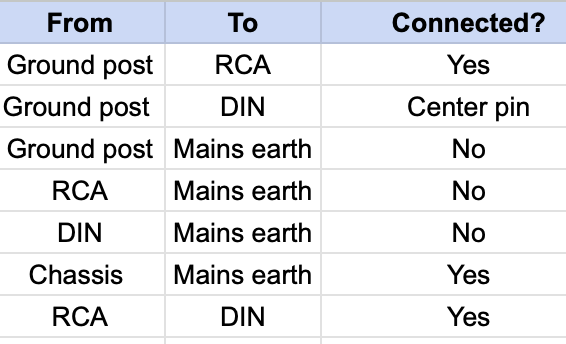
A Rega turntable directly into Nait 50 is not connected to mains earth since it’s using a DC power. With no other source connected using connection to mains earth to Nait 50 the ground level is floating and may cause hum issues.
The Creek amp is likely connected between mains earth and signal ground and then your problem will be gone.
5 Likes
Thank you 
1 Like
Correct, as said that is how Naim design their amps. The grounding should be one and only one of the sources. Historically that is the Naim CDP, now streamer and DAC sources have a slide button to ground (chassis) or float the signal return.
As for optimum performance with a Naim amp one and only one source should grounded through to mains earth. Its part of the star earthing principles that are often required with unbalanced signals.
With non Naim sources you will need to determine whether it is grounded or floating on the signal return and take appropriate action.
2 Likes
The difference is that in the past with Naim,there was not a loud hum when connecting only a Linn LP12 with Lingo PSU,but it sound better when earthed properly.
So something is different in the N50,but not a big problem to fix.
With quite a number of manufacturers (though it seems somewhat rare for UK brands) the user manual contains a full circuit diagram. I used to think this was a bit silly and to satisfy armchair knowitall engineers.
It has since proved pretty useful in troubleshooting a number of problems.
3 Likes
Thank you for the time and effort to clarify this.
2 Likes
I just wanted to close this out. The N50 went back to Naim and there was actually something wrong with it, not sure what it was. Hum mostly gone, tho at high levels still comes out…I’m fairly certain this is just from all the electrical garbage that is on in the house, dimmers etc. It works great for how I use it.
3 Likes