For those in the know: is there an ideal length for non-Naim speaker cables? I’m familiar with the 3.5m rule on NACA but wondering if it applies to other cables and non-Naim gear?
I’m putting together another system with a vintage receiver / TT / Wiim mini and have some decent (not high end) 4mm cable that’s currently 10m. I can simply chop it in half and be done with it, but in reality only need 1.5/2m on either side. Just wondering what the accepted practice is here, given I know almost nothing about electricity
You need to know the inductance of the cable.
Naim recommend 3.5 metres minimum with NACA5, what they are actually recommending, with NACA5 at 1uH/m, is 3.5uH inductance.
If you can find the cables inductance (uH/m), and unfortunately not many brands publish this, a quick math calc will give the answer.
e.g. 3.5 / inductance = required length
This inductance loading only applies to Naim amps, most all others have the inductance load built into the amp internals.
Doesn’t matter that much then if not the non Naim receiver is sensitive. I would target minimum 2m which is what Naim recommended with their new classic design which is not sensitive as their old boxes.
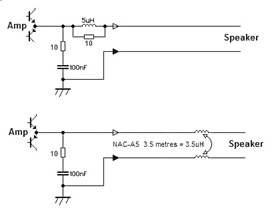
This is a generalisation of the circuit differences between most other power amps & Naim
(Naim circuit is the lower one)
The 10ohm resister & 100uF cap is the zobel, the 5uH & 10ohm is the series inductance load.
If not a Naim amp, as the term receiver suggests, then I am unaware of any other manufacturer with a minimum requirement, so the answer is whatever length is needed to couple the amp to the furthest speaker (best to have equal lengths). Beyond that, if the cable has a very high capacitance, e.g Kimber cable, just a few metres might be expected to cause a noticeable roll-off of the highest frequencies, the frequency where roll-off starts halving as length doubles. Otherwise with very long cables (say 10s of metres) the resistance might start to be significant, the thinner the wire gauge the greater the resistance.
There is no requirement from the DR classics onwards. It’s just a recommendation based on how Naim feel the amps sound and perform these days. They are all tested with very short runs and very long runs including non Naim high capacitance cables. I believe the docs and FAQ are somewhat out of date here. Steve Sells shared background on cable compatibility a few years back in this forum.
The early Chrome Bumper amps had no Zobel network but mid Chrome bumper onward they have all had this on the output stage. The strict requirement pretty much ended there.
Olive was more tolerant. Classic more tolerant still. DR as tolerant as any other amp on the market. But their performance is still tested and baselined on A5 at a minimum of 3.5m. You can consider that an assured level of performance. If you prefer something else, perhaps more exotic or shorter, that’s really up to you.
I conferred with some of my colleagues at Naim a while back and my understanding is that all the power amps have zobel networks, but there’s no extra additional inductance in the output ( normally used for stability), instead Naim rely on the inductance from the speaker cable for the same purpose. This rather elegant solution gives better overall sound, but does rule out the use of more extreme speaker cables that differ markedly from the ideal of low capacitance and moderately high inductance.
What is ideal cable-wise from a performance point of view hasn’t really changed, but what has changed over the years, and as has been stated here by @110dB, is how tolerant the power amps have become to using less than ideal speaker cables. Where the early power amps could well be damaged by this, the more recent amps have grown much more robust, so fears of damaging the latest power amps through using the wrong speaker cabling are now far less of an issue. Again, note that this is not the same as the question of which cable parameters will allow the amplifier to perform optimally and sound best.
I suspect test signals are used. But Steve had described a scenario where they ran silly lengths of high capacitance cables up and down the corridors at HQ and the DR era amps were perfectly stable.
That said, they haven’t tested every cable in existence so a guarantee in writing isn’t possible. But that is true for every manufacturer.


 It likely has a zobel network design.