Can you share some hints on how you solved the issue?
I can’t use Tidal and Quobuz for the same reasons my Core has problems.
According to Naim scans, the quality/performance of my ISP internet is poor.
Can you share some hints on how you solved the issue?
I can’t use Tidal and Quobuz for the same reasons my Core has problems.
According to Naim scans, the quality/performance of my ISP internet is poor.
It depends what you use to affirm quality/performance as poor. A lot of people think that high latency is a sign of poor performance. That would be true if you were an avid gamer, but not for anything else really. Some would say that Bufferbloat is a sign of poor performance, that would only be true if you are constantly uploading and downloading at the same time. So your question to Naim should be “In what context is my ISP poor”.
It’s unlikely to be that. If you take the power off the Core for a few seconds, then let it start up again, then you will likely find the eject works again.
There is also an emergency eject button inside a hole in the front panel if the Core. But this isn’t an electrical eject, it’s a mechanical one and you have to push hard several times for the CD to actually come out enough for you to grip it. I was once told that you should do this with the power off “for safety” but I have done it with the Core powered up with no adverse effect.
Learning new tech can be hard. My remote has never not worked properly and I didn’t even know it needs to be paired. I’ve never heard of a noisy volume control on a 222. I wonder how often this occurs. Is it possible something is amiss in your local environment? I lost a channel in my NC250 and Focal Naim gave me a new amp, it was a smooth process using the Focal NA website and didn’t require the dealer. It’s the first 250 I’ve ever had a problem with but it’s also the best sounding 250 of all the olives and OCs I’ve owned. Go figure.
And it’s good to read the manual before yelling on social platforms. Now I’m not sure what sort of ‘noise’ it makes that Naim said it’s normal.
You obviously haven’t read any Naim manuals lately!
My 222 and another one have the same noise; at my home and at the distributor.
Nothing to do with my environment,
Naim tested my 222 and said “TRUE the noise exists but we consider this to be within the margins of tolerance so that it doesn’t affect performance etc etc bla bla bla”
My distributor told me this but didn’t have the courage to send me the mail received from Naim.
Of course i read the manual.
I have the 222-250 since 6 months ago.
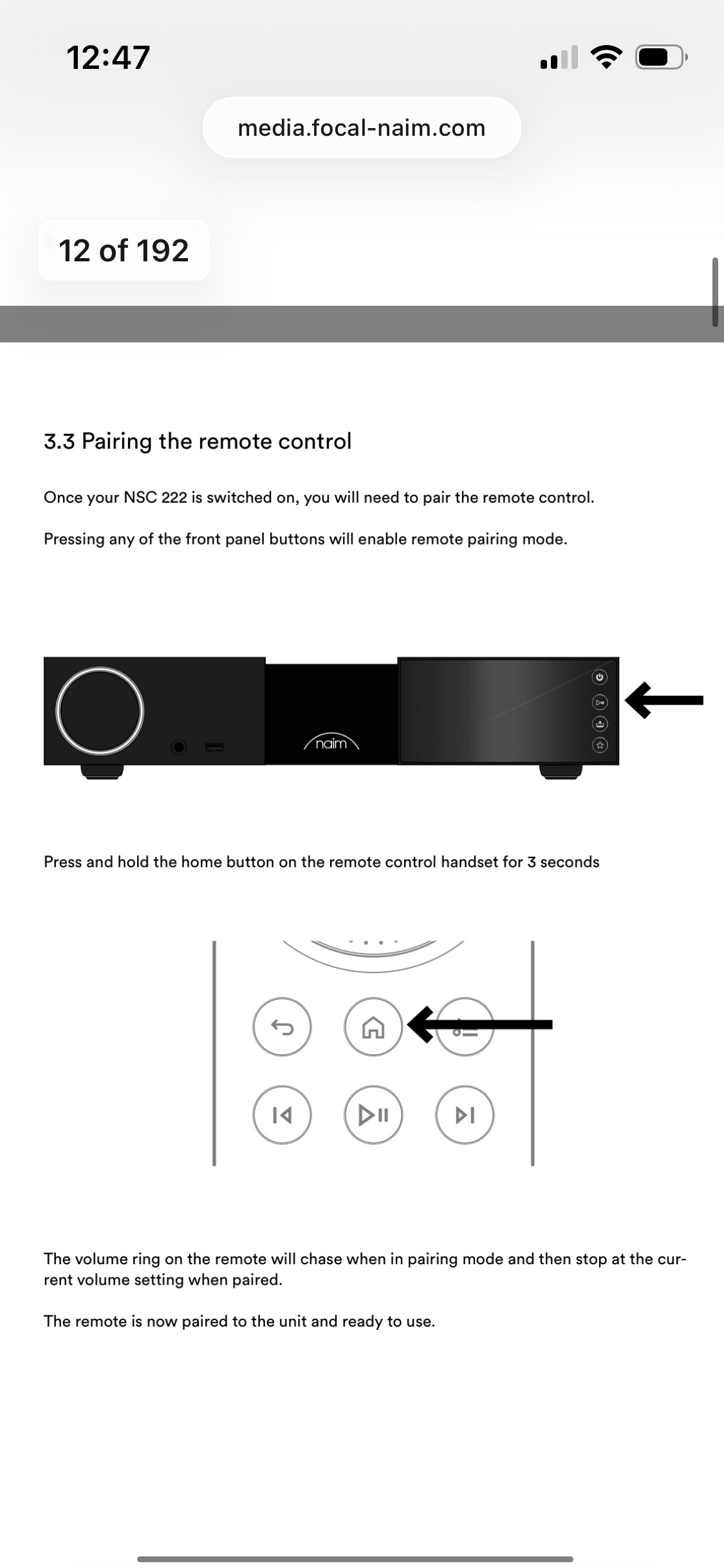
I was able to pair according to the manual. Recently, for some reason i don’t know, the remote was no longer paired, and i couldn’t pair like before. I did it as i explained, in a slight different way.
It is how i am saying.
Whenever the Core can’t reach and external “database” for metadata, while ripping a CD, i can’t eject the CD. Of course i can power off (press and hold for seconds the start button), wait for 10-15 seconds than wait for more 10-15 secconds until i can start up the Core again and then it automatically ejects during startup.
It is a bug, if if you have an ejject button it should bypass whatever the machine is doing.
Ah if i wait ….after ± 20minutes it starts ripping the CD.
Please don’t tell me to do factory reset, reset the router and reset the whole house, myself included….i already did that a million times.
Always the same pattern, after restart it ALWAYS manages to rip the first CD; after that it normally can’t on the 2nd or 3rd.
I am a big Naim fan and have several components including 2 Muso 2’s, an Atom HE which I love, and a Solstice TT. A few months ago I ordered a core when I found out it had been discontinued. When it arrived, I couldn’t get it to work. It wouldn’t connect properly to the network, I couldn’t do a firmware update, and I could get occasionally one CD to rip after which the app would no longer connect to the device. I am simplifying - it was an absolute nightmare. I even setup a new network in case there was something unusual about my network. The dealer reached out to Naim support and they didn’t have much advice - factory reset, etc. I was able to return the unit for a full refund. The twist in the tale is that the dealer was immediately able to connect it to their network and perform a factory reset, rip a cd, etc. So, I’m completely confused about whether the unit was faulty or if there is some incompatibility with my home network (all other Naim units work, both wired and wireless). My conclusion was that network audio devices are getting pretty complicated and honestly, it’s pretty easy to pop a CD into my CD player, which is connected by SPDIF to the Atom HE. The sound is amazing - much better than Qobuz. You have my sympathies!
My Core works perfectly fine in two diferent locations.
Even if it is my network/isp related, as Naim says, it is still a bug.
The issue with my Core must be relate to software. The same with the 222 as it can’t reach Tidal / Qobuz…the same behaviour, no issue playing the first music, after that it is a nightmare, i canceled Tidal /Quobuz.
Naim software is crap.
That’s a bit of a logical long jump.
According to Naim Scans, everything was ‘ wrong ‘ with both my Internet connection and my home network ( too many devices, shared SSID etc - all utter rubbish, as everything else works just fine) I simply went into the web interface of my 555, Atom and QB and enabled ipv4 only.
Hi @rcsm
I just wanted to say a few words about the NSC 222 volume control to try and explain why that small pop exists.
The 222 and 332 use a resistor ladder volume control because that’s what sounded best for these preamps. There is a large bank of resistors and relays that can use a combination of them to achieve the selected volume.
However, if you switched between them while listening, you’d not only hear loud pops and dropouts, the speed of the relays wouldn’t allow a quick enough change.
Therefore, when you change the volume, a relay moves to a conventional volume chip that changes volume while you’re moving the knob. When you stop moving the volume, within approximately 1 second, the system calculates which resistors to use, and the relays set that up.
The system then switches you back from the volume chip to the resistor ladder.
It does mean that depending on what you’re listening to, there can be an audible pop as the signal is switched between the resistor network and the volume chip.
This design is based on the volume section of the Statement preamp, and it’s a great sounding part of the 222.
Hopefully this is a bit of better explanation than just saying it’s “within tolerance”.
Paul, how interesting. Things are clearly not as simple as one might expect. Just out of curiosity, does my beloved Atom HE have the same arrangement? I don’t recall hearing any clicks or pops when changing volume.
I find it fascinating how many different approaches there are to something as apparently simple as changing volume.
The Auralic Vega I’ve had for a few years also boasts a resistor ladder volume control and I do hear soft clicks from the box itself but just when when changing volume, but it doesn’t interfere with the music at all and I actually find the effect rather reassuring. My Selekt has a digital volume control which some regard as inferioir, but Linn strongly disagree and even have a white paper explaining why. The Atom has a digitally adjusted analogue volume control whilst my little baby Nait 50 has a traditional knob which is a pleasure to use.
Thing is, all these methods work well and I enjoy using all of them, but I do find it interesting how much variation there is under the bonnet.
Roger
@HungryHalibut Your Atom HE has a different arrangement. You have an electronically controlled volume chip, which is extremely smooth, so won’t give you those pops.
It’s a really excellent chip, and the implementation of it from the hardware boys here is fantastic.
However, for New Classic, it was decided to bring some “trickle down” technology from statement to exceed this design even further.
Thanks Paul. Does that mean that the HE has a different arrangement to the other Unitis, which I believe have a digitally controlled analogue pot? Not that I really know what any of this means of course!!
All of the Unitis share that electronically controlled volume chip. Think of it as an analogue volume controller that is operated by control messages from the digital side.
(The HE’s special part is its output stage)