I am gagging to try my NN50 with my TX9s, but a sporting injury has me in a sling at the moment so o messing about with speakers…. I’d also LOVE to B2B TX1s with my SCM11s……on the end of my NN50… I do think the TX1 could be quite a spectacular speaker with the NN50……
An update… Enjoying my new Falcon Gold LS3/5a s with my N50. Really entertaining and the added non etched detail is joy to enjoy. Genuinely listening to some of my older recordings and enjoying timbres in the instrumentation I never noticed before..
However stand speaker decoupling on these little marvels has been a struggle to get right. So easily they can blur, or add unnatural weight which can get bloated and lumpy, or overly forward upper mids that detract..
In the end I have found medium weight sorbothane pads between my medium weight SS60 stand top plate and LS3/5a works best. So dar provides a neutral eq, with no exaggeration. Upper mids and low bass are clear and defined with no veiling or exaggeration.
They also the speaker to move slightly when you push it.. and I suspect with these thin wall speakers that is important.
I will see if the sorbothane performance changes over time.. but so far all good.
infinity by Juru Gosh is a good test track for eq balance and timing. Horns, arpeggios, piano, and electronic percussion… all the instruments should be in balance, the horns not too shrill and forward and bass tight and clear with good pace and timing. Poor setups can have this track sounding a headache inducing mess.
6 Likes
Would you be able to post a pic of your Falcons on their stands please? I’m interested in how they sit AND how they look.
sure I will take a shot later - but I reverted to a rice grain of blu-tak one each corner - just to raise the base a mm or so from the stand plate - but with out undue damping.
2 Likes
Really helpful @MNIM
Thanks for taking the time to post. 
1 Like

They are the bare metal version and they look absolutely awesome. Thanks for posting they look great together.
1 Like
I think my Falcons must be wearing in nicely now..
Listening to At Folsom PrIson live album by Johnny Cash… and shut your eyes and you are listening to the masters back in the 60s… you can hear Cash moving around with respect to the Shure SM56s mic, with the tape overload softly clipping/saturating in and out.. really make it feel real. You can hear the dire acoustics of the dining room hall they were playing in with a low level concrete room reverb often audible around Cash’s voice and other voices, and a soft boom from the bass .. and the vibe and atmosphere from the prisoners interacting with Cash.. which I always enjoy
2 Likes
Does he shoot a man again in reno ?
1 Like
If you like that, check out https://www.theghostofjohnnycash.com/
It’s not a commercial link so hopefully, it won’t get busted off the forum!
2 Likes
cracking production and worth looking oot on TIDALi . I like that ane messel
Thanks, yes I am aware of this cover / tribute artist. He is very entertaining like many tribute bands are.. But I prefer the feel and vibe of the real thing, and the feel and atmosphere of his prison concerts is really engaging , especially his first two.
Just a little update… my Falcons have been running in over the last three weeks or so, and it is fair to say during that time, their balance was moving and was sounding quite forward or slightly indistinct at times.. which led me to fuss about stand decoupling etc…
Well they appear to have settled down in recent days.. and the sound has settled on being beautifully balanced,… bizarrely the similar balance as to when brand new, but now with added run in resolution from the bass/mid driver.
I have reverted to placing the LS3/5a directly on the SS60 stand wooden plate platforms… this seems to work really well.
I have been enjoying all morning… now time to do something else!
3 Likes
I can understand that,I ’ve always found soft material to be bad for PRaT.
1 Like
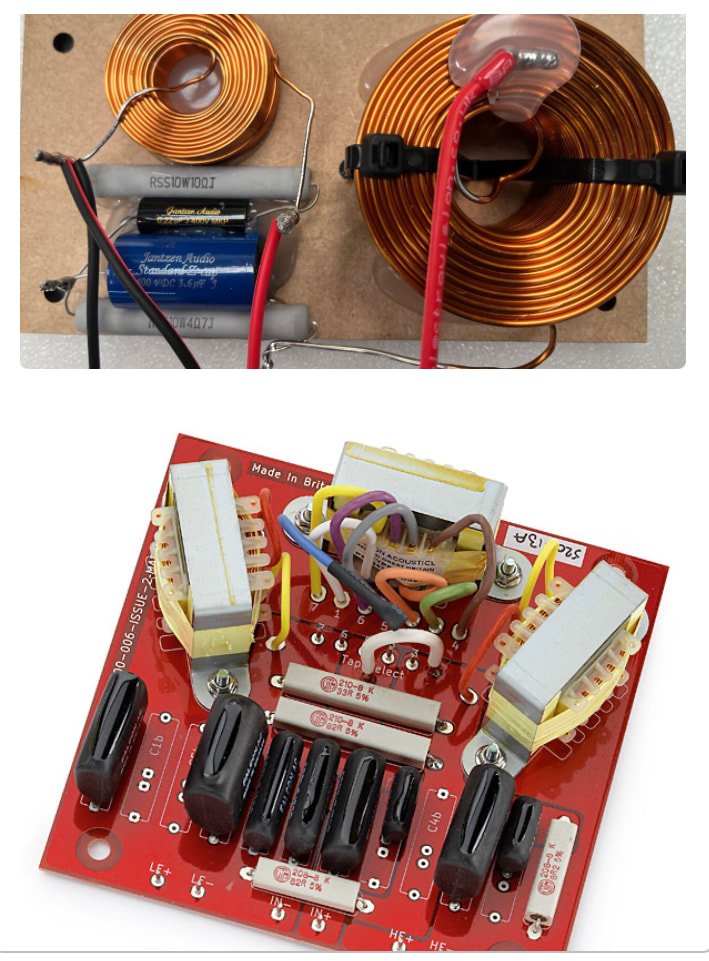
2 favourite speakers are Falcon Q7 and Neat Petite classic. The N50 advocates the strengths of a simple design if done right. Anyone tech minded have thoughts about the Neat Petite Classic crossover (top) vs Falcon Gold Badge (lower)? Visually at least (component count) very different approaches.
1 Like
One understands why active crossovers are so superior,avoiding all those components between the amp and the speakers.
1 Like
Well the Falcon crossover is based on the original BBC design - which is a requirement for LS3/5a speakers. The Falcon Gold chose uprated versions of the inductors and capacitors over the more mass produced consumer versions of the LS3/5a released in the mid 1970s.
1 Like
They can be, but not always. Active cross overs come into their own when driving a lot of power - as they minimise the heating effects of the passive crossovers between amp and drivers which modify the performance. For low power its less important - and the cross over can closely link to the performance of the drivers so as to minimise driver interaction/distortion.
The cross over, its drivers and cabinet are a single matched system. Whether you put the active amplification between drivers and cross over or before the cross over is a choice - and as I say the former tends to work work more effectively under higher currents when there is more heat dissipation. Heating of speaker voice coils and the crossovers will drift values and performance.
All things being equal, where you can minimise drifting passive component values through heating - a passive cross over will introduce less artefacts than an active crossover. However the latter will be more consistent under high power and changes in temperature (if designed properly). Horses for courses.
I wonder if it’s a result of extreme fine tuning or technological limitations of the time. Regardless it works very well, as does the simpler Petite design.
I think more fine tuning to drive the drivers in a sealed thin walled enclosure which also act as passive drivers.. you see that it was a combined equalizer and crossover.. which in some implementations had adjustable HF gain. Interesting research references at the back of the doc that the principles were derived from.
You can download the original BBC LS3/5a design paper.
1 Like