Meaning you can clearly hear their distorting effect on the sound on even the best digital you’ve heard, irrespective of the firmware update angle? What about the distortions of sound through the vinyl production and reply processes? Ican’t hear anything negative with digital as I hear it now through Dave DAC, though i haven’t done a direct comparison with pure sound, only against different digital and against vinyl, and memory of live sound. That is not to say it is perfect, but it sounds perfectly good to my ears, if that makes sense, and I have never heard recorded sound sound better.
The brain processes sound from the ears by filtering, resolving phase distortions, and masking artifacts to create a coherent auditory experience. While these processes often go unnoticed, they require significant cognitive effort, which leads to listening fatigue. For example, the brain works hard to integrate spatial cues and suppress distortions, even when they are not consciously perceived.
And I do hear your point, not all vinyls are born equal. Some are made from digital sources, not to say from MP3 files. Unfortunately there is no ideal solution yet.


2 Likes
Interesting, as I don’t find listening fatiguing at all, even after, say, six or more hours continuously. Perhaps my brain has got to use to the processing. As for vinyl, through it’s very process even from purely analogue recording it has distortions from the pure sound - but presumably your brain has got used to those, where it hasn’t yet been given a chance to get used to digital!
Indeed, and to be fair that is where Watt’s approach with oversampling with a very large kernel response filter really helps minimise artefacts leading to a very natural, fatigue free presentation, that sometimes can sound startling real.
To be honest I first noticed this with the Hugo mk1 as I said before that approach is transformational in providing non highlighted detail, insight… and naturalness. It’s the sort of thing where you double take sometimes with an intrigued grin. You have to hear it to experience it.
Now the downside of FIR is latency, and some of Watts products there is an asymmetric lower latency mode for AV… there is a slight hit to naturalness, but it’s subtle.
The relative lack of time domain phase errors with FIR with large kernel response filters I I think is one of the reasons it has become increasingly popular in reconstruction.
1 Like
Since oversampling and consecutive signal interpolation are performed entirely in the digital domain, this process can be implemented using software and then output as raw PCM to a DAC that supports it or offers a bypass feature (such as Holo Audio DACs or Audio-GD DACs). Software like HQPlayer and Roon provide this functionality.
If Naim were to release a DAC with similar capabilities in the future, users could customize its sound signature to any preferred style of reconstruction. We live in interesting times.
Great points, Simon. The RFI that is radiated by the FPGA is <not> a solved problem for Chord.
For my Qutest, I used 3M’s AB7050HF RFI/EMI absorber fabric direct-mounted to the FPGA, mounted on a few other chips (including the clock), lining the inside of the case, and addressing a few longer board traces.
HUGE improvement. Bigger than going from standard SMPS to Plixir Elite BDC. Bigger than going from Lavender DIN to Morgana.
FPGA’s (and nearly every CPU) radiate RFI as a function of the individual transistors switching on and off during normal use. It’s unavoidable. However, a) not all processors are created equal and b) reducing compute overhead on any processor will reduce radiated RFI.
2 Likes
Exactly - like Naim does via i2s- though they user zero stuffing in the oversampling to eliminate interpolation arithmetic errors. The Naim designers use the Analog Devices SHARC to oversample and undertake the reconstruction filter in software and then they send to the converter chips(s) where the internal reconstruction chip filter is disabled.
1 Like
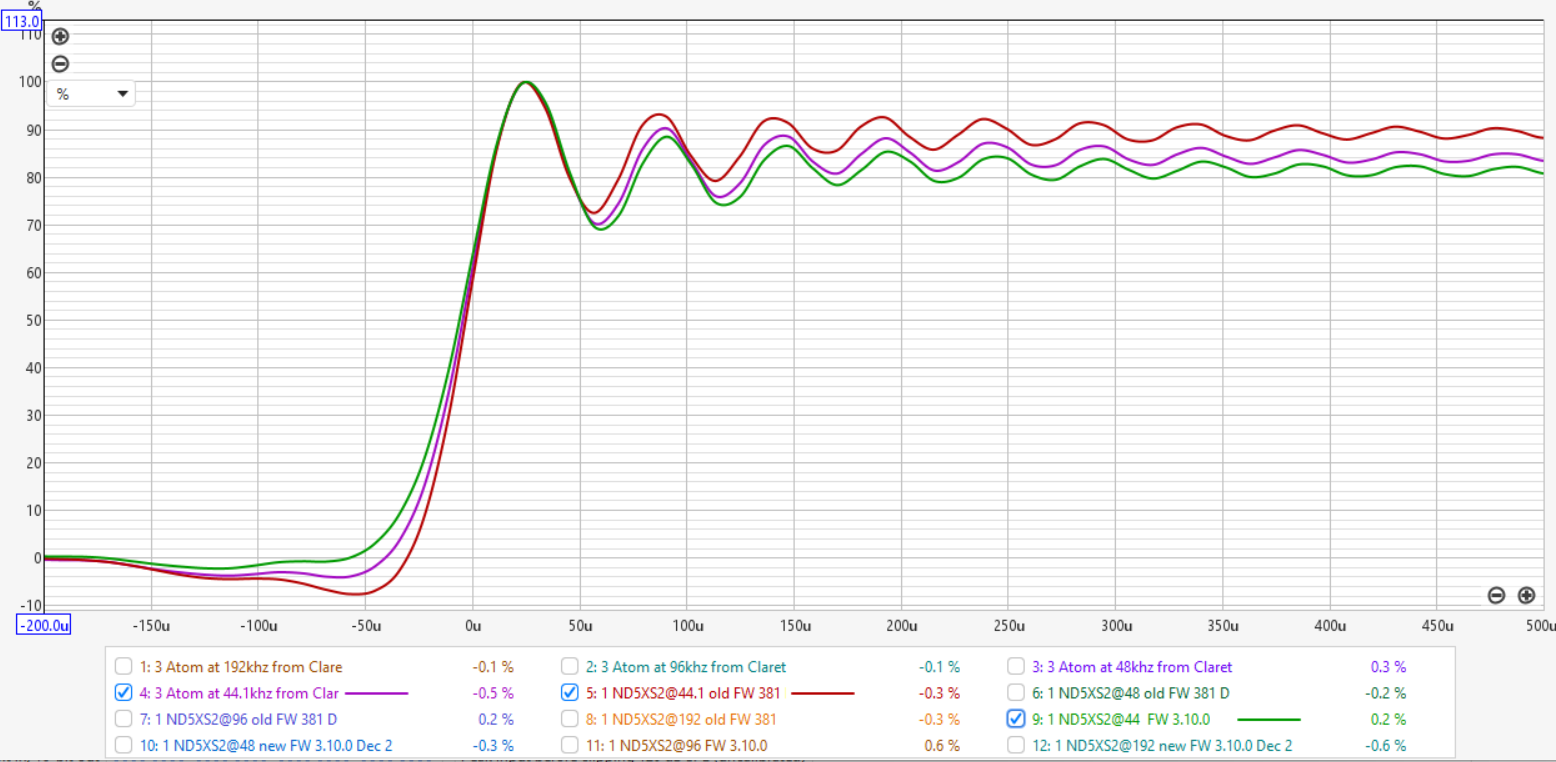

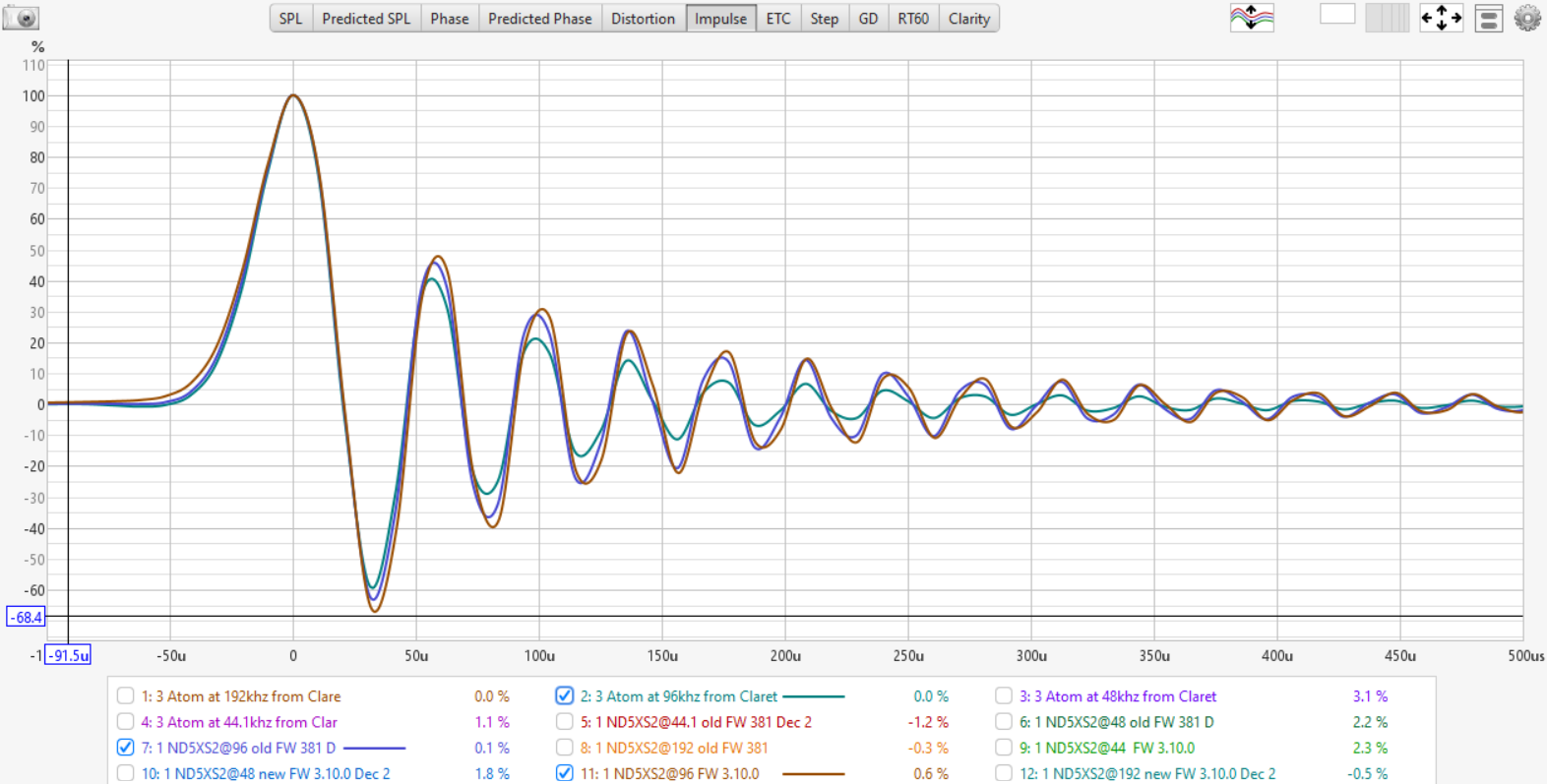
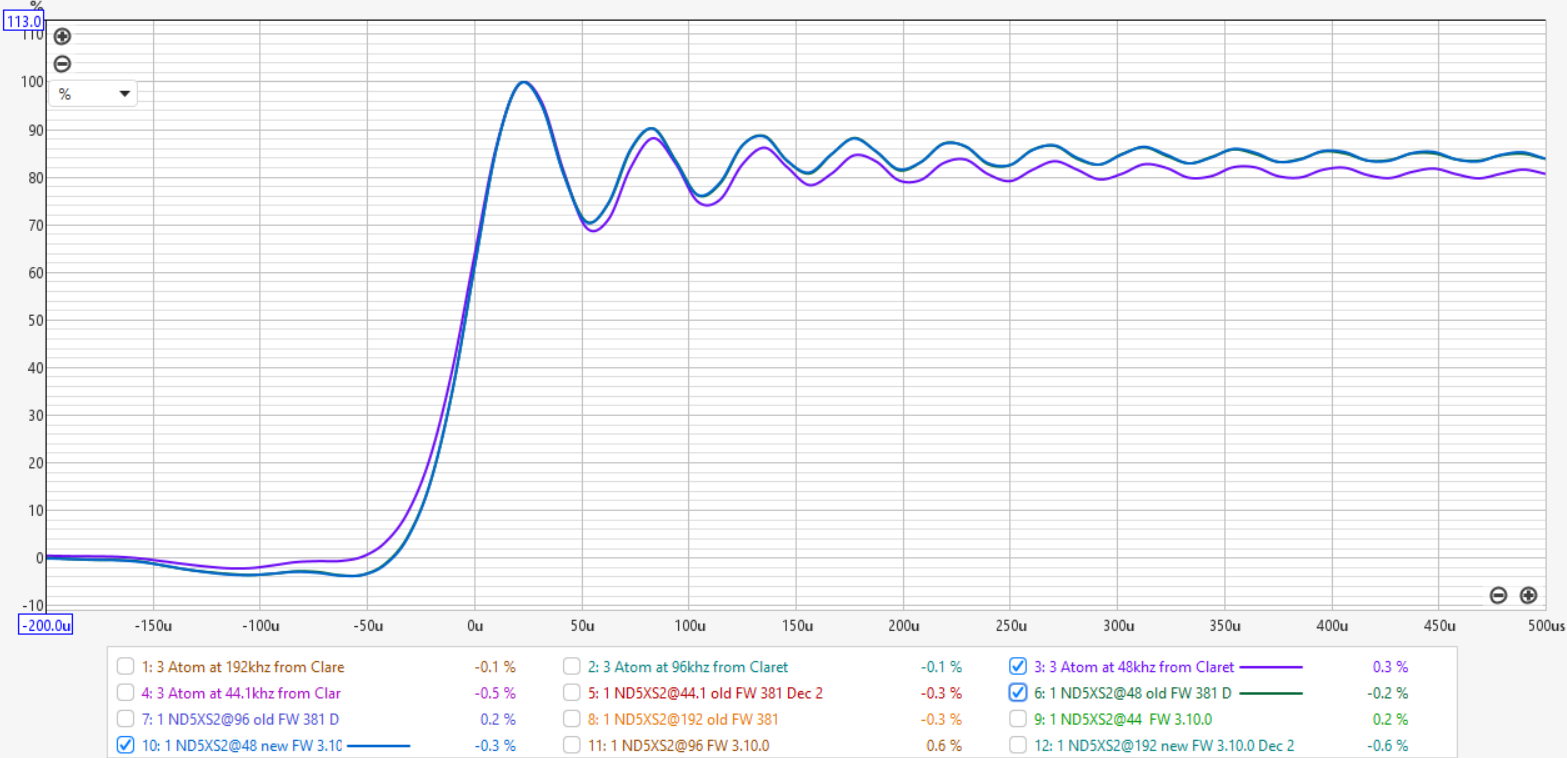
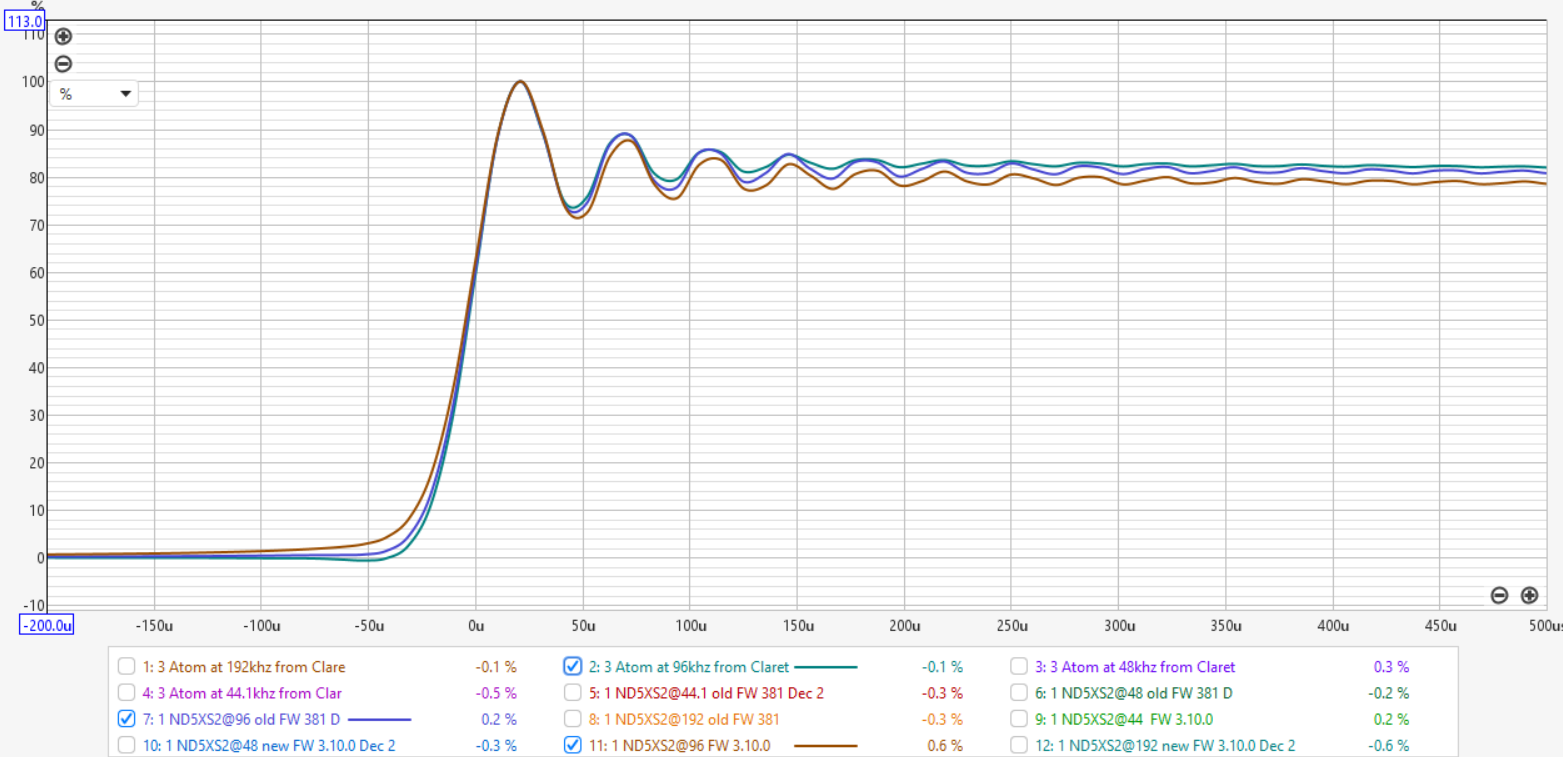
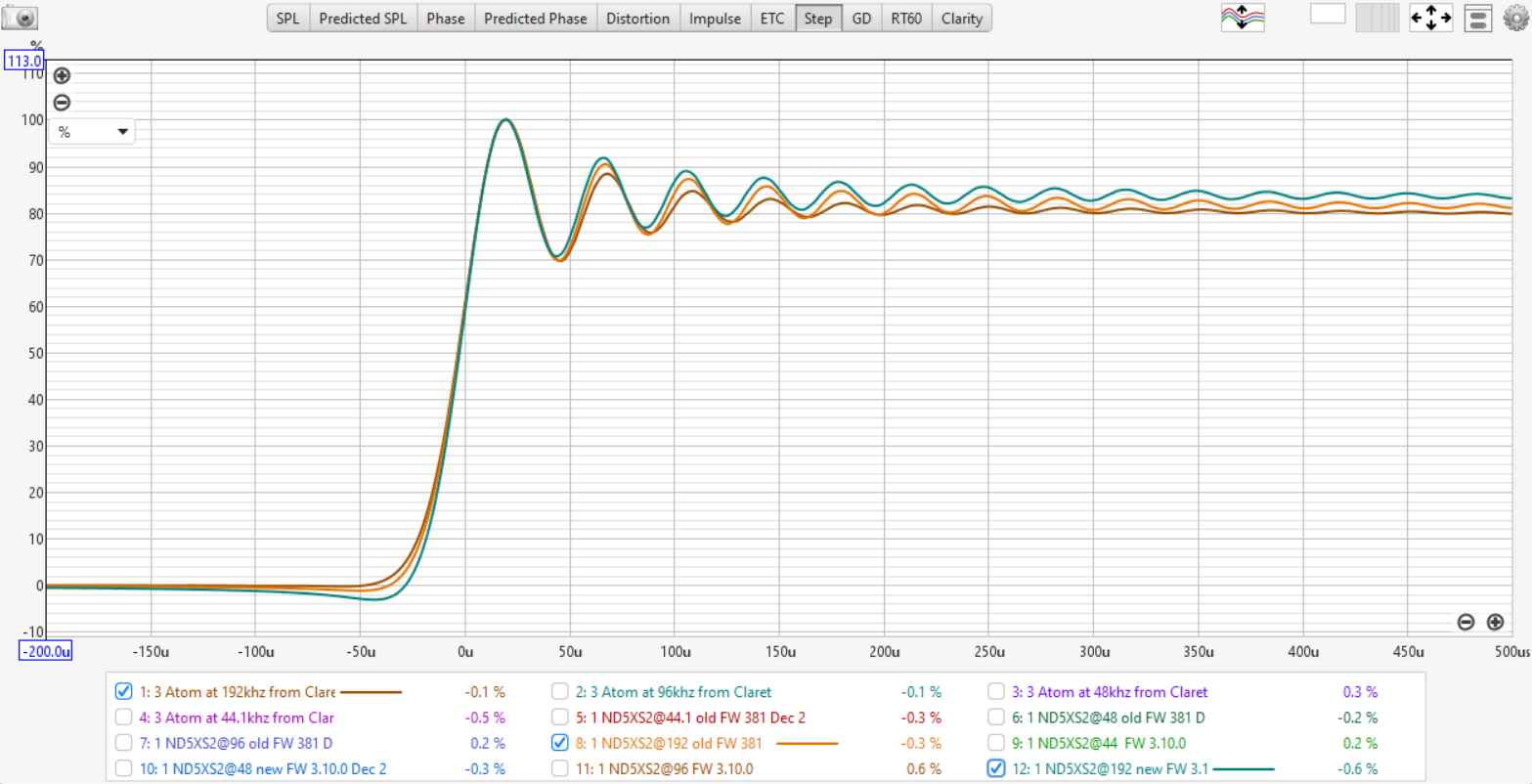
After spending more time comparing the impulse response (IR) of the ND5XS2 before and after the update, I noticed some differences, particularly at 44.1 kHz (2nd, 3rd and 4th ripple are somewhat bigger). These differences are subtle and required significant zooming to identify, but they are clearly visible. On a related note, the Atom exhibits a noticeably different IR behavior, likely due to its distinct IIR coefficients.
44.1kHz
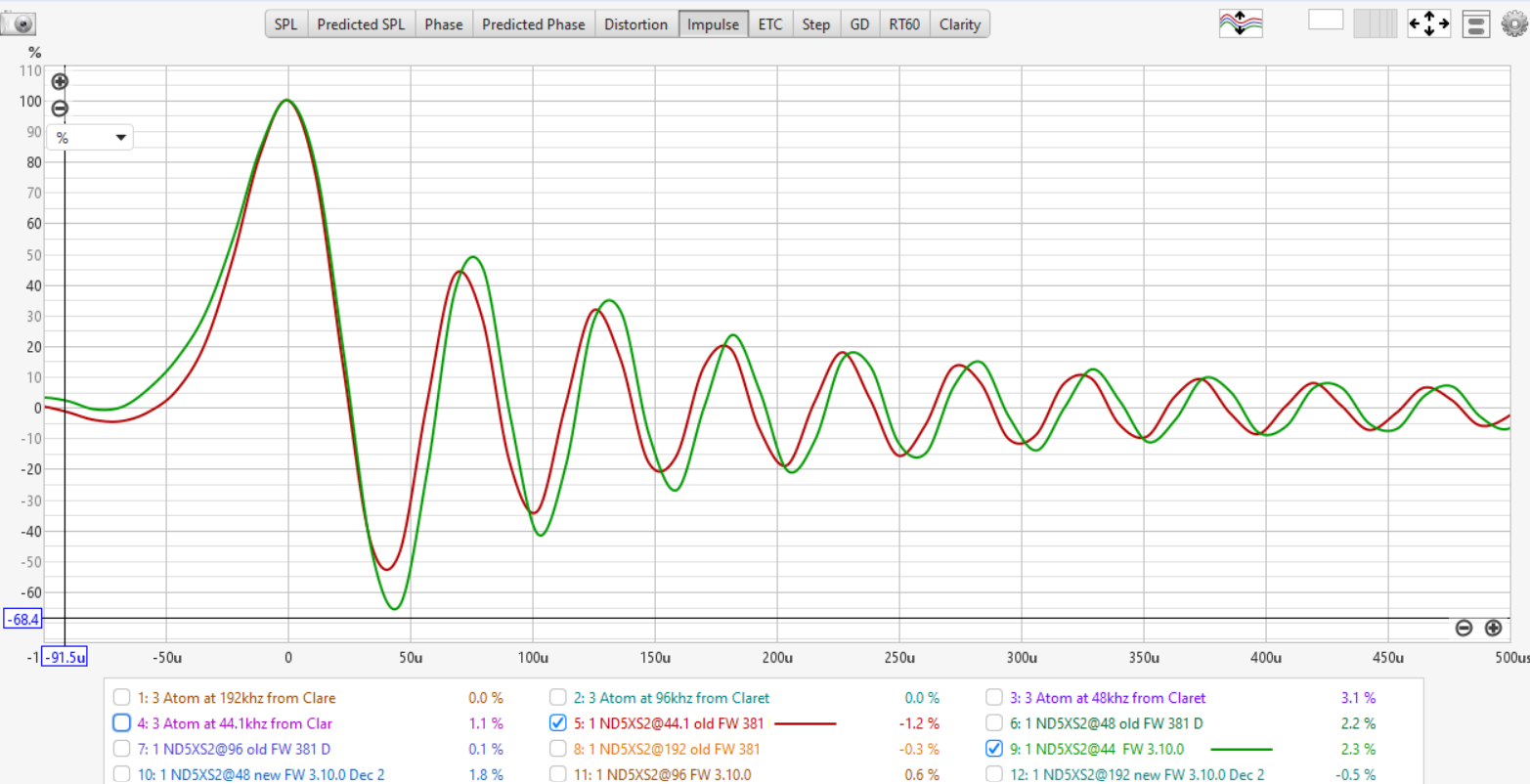
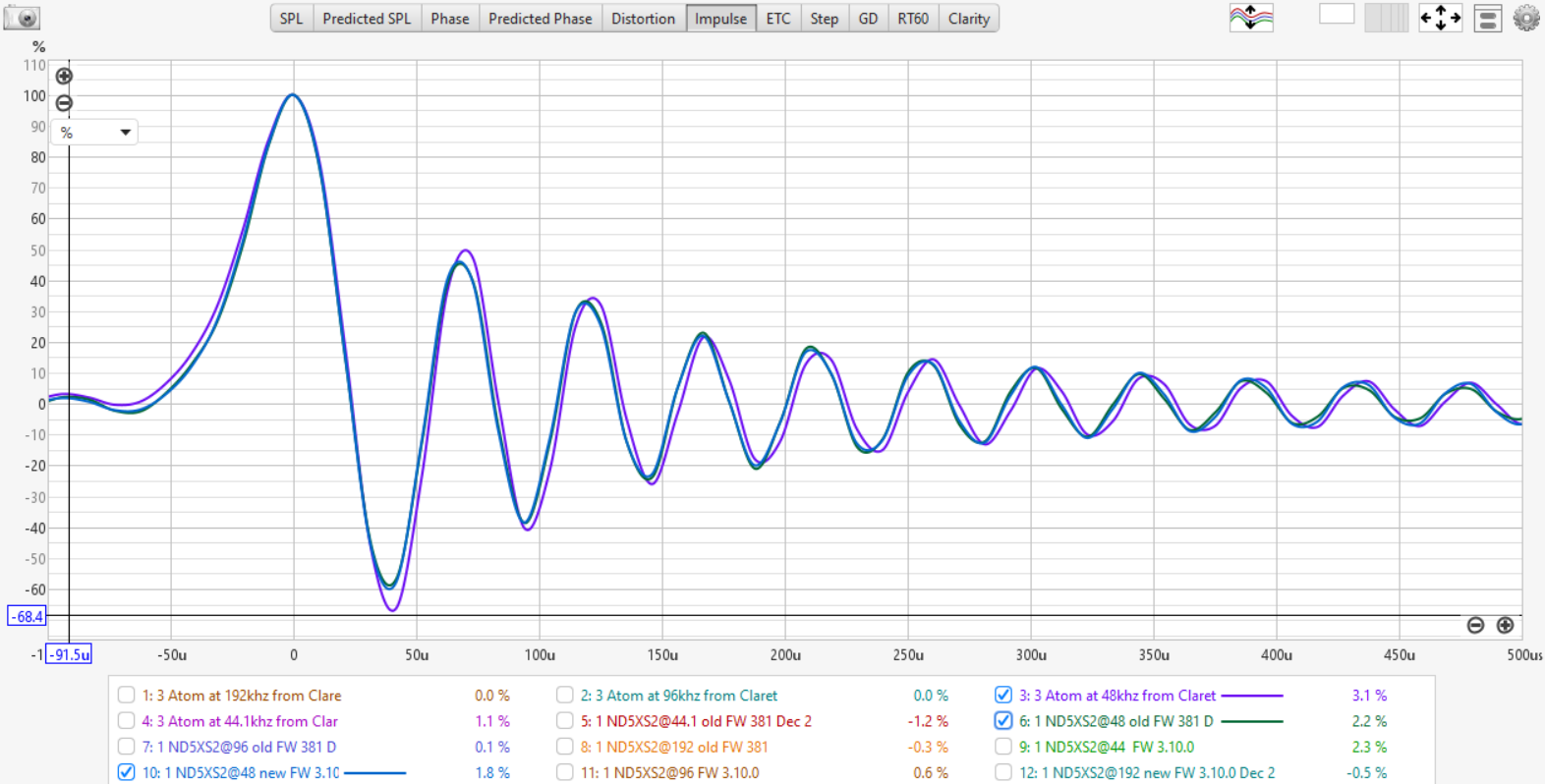
48, 96 and 192 to follow up
Out of interest how have you isolated tolerence and the the effect of the low pass analogue domain filter, line out and i2v… have you tapped the current out of one of the channels on the converter chip?
2 Likes
Thank you for your thoughtful input! I understand that concerns about potential type I (false positive) and type II (false negative) errors may be motivating your question.
Step Response and Statistical Variability:
I compared the step responses, which are the integrated impulse responses. The step response inherently smooths out statistical noise and variability, making it a robust indicator for comparisons.
The step responses for 48 kHz sampling showed no differences pre- and post-firmware update, while differences appeared at all other sampling rates. If the differences were due to statistical variability, I would expect inconsistencies across all step responses, not just specific rates. This consistency supports the conclusion that the firmware update introduced measurable changes.
Noise Mitigation via Deconvolution:
Using deconvolution method, noise variability was effectively mitigated. This ensures that the observed differences in impulse responses and step responses reflect actual changes in the system rather than random noise or artifacts.
Analog Low-Pass Filter Independence:
The analog low-pass filter is a fixed hardware element and cannot be altered by firmware updates. This means that any observed differences in impulse or step responses are not attributable to the low-pass filter but must originate from the digital domain or changes in how the DAC processes the signal under the updated firmware.
I-to-V (Current-to-Voltage) Conversion Network:
Similar to the low-pass filter, the I-to-V conversion network is an analog hardware element that cannot be affected by firmware changes. Its behavior remains consistent regardless of the firmware version, further reinforcing that the observed differences must stem from changes introduced in the digital domain.
2 Likes
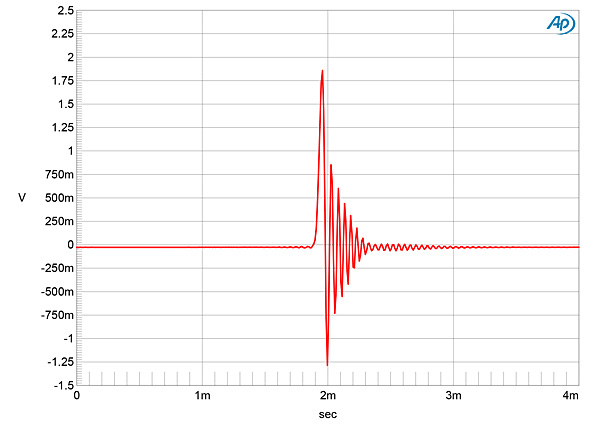
My measurements of the Naim ND5 XS 2 impulse response show results that are consistent with those published by Stereophile, despite using a different methodology. While Stereophile likely used a direct single-sample impulse with the Audio Precision SYS2722. This further corroborates the reliability and accuracy of the observed differences.
Mar 19, 2019
Thanks, though the firmware doesn’t directly affect any changes in this part of the chain. The firmware controls ie shapes the noise from ARM micro controller in the heart of the digital streamer board… at least in the OC streamers.
It’s possible the change in noise floor could affect very subtly the the response in analogue filters and digital clock, including intermodulation.