True wireless support is limited although all NUCs have a wireless card that can be fitted. RoonOS was designed and written with a specific architecture of hardware , whilst it can work on non NUCs as it does on mine you run the risk it won’t. If you stick with known intel chipsets for motherboards and ethernet etc then it’s likely to work. But it’s been optimised really for NuCs as they worked with Intel to get the most out of them with less operations.
1 Like
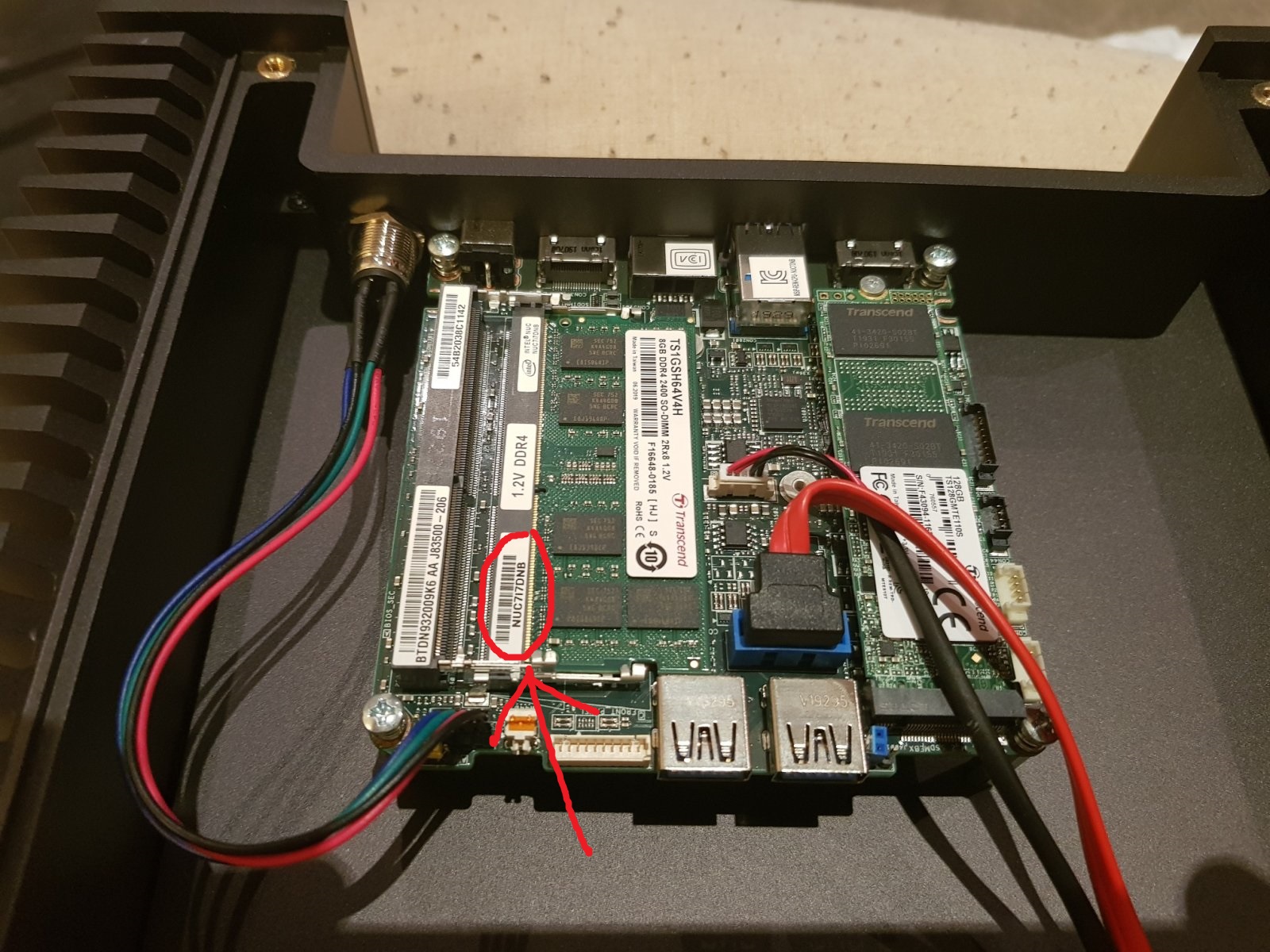
With very little plugged into it 
The exact same as any other DIY fanless build, like mine.
→ ROON users - Nucleus or Nucleus+ what are you using? - #33 by Thomas
I didn’t buy the Nucleus+ because the case wasn’t as convenient as the AKASA (which I stacked into my network cabinet)
And it gave me the opportunity to carefully choose the components.
The only thing that would be nice to have is the thermal management of the Rock OS included with the Nucleus. But, I don’t use the DSP possibilities of Roon, so I’m fine in terms of CPU load.
1 Like
Which is why I quote the 3 numbers
6.5k albums, 85k tracks and the actual size of the 8TB library (over 55% is 24-bit).
This accommodates albums which have a low track count but are large in terms of individual file size.
So my averages are 13.2 tracks per album, and around 1.1GB per Album and 86MB per track.
1 Like
Nice to wake up here Stateside and see more informative posts.
Simon.pepper thank you for the highly informative post and link. Is it possible there was yet another more lengthy thread on the Roon forum with Benchmark analysis? Regardless your post definitely put things in perspective. A basic Nucleus will easily suffice for my needs. It is also cost significantly less than the + allowing one to easily upgrade (if necessary) should Roon update their boxes.
I almost wonder if the reason Roon offers the i7 Nucleus+ is not unlike the computer manufacturers trying to upsell on increased specs of cpu’s, graphic chips etc… They try to capitalize on the bigger is better - and make larger profits in the process.
As to other comments I recall Danny stating that the Nucleus has now become an important revenue stream. Why not - more power to them. There was some complaining that certain commercial fanless NUC builders (in the UK) were advertising and selling their devices with ROCK already installed - a clear violation of the EULA.
Best
Gregg
4 Likes
If so, this is a good thing and augurs well for Roon’s future.
As for the the needed specs, as Simon.Pepper said, as long as you don’t use the DSP, the basic Nucleus or a i3 NUC should indeed suffice.
1 Like
I think the main point of the Nucleus/Nucleus+ is that Roon has something tangible to use for standing up a dealer network that can help them sell Roon subscriptions. My Naim dealer recently became a Nucleus dealer, as is AV Options in the U.S. I personally don’t believe there is much brilliance to it otherwise, and if you are reasonably handy, standing up a NUC to do the same thing is much less costly, albeit not as pretty looking.
2 Likes
I am have posted these results or links to these results in a number of topics in the Roon forum.
I don’t know what it is, but this concept of buying the biggest server, is still the norm.
My benchmarks and comments from quite a number of other ROCK users, have shown that unless you have an enormous library of 200k tracks, you don’t need i7 CPUs, anymore that 8GB etc.
Even the DSP (upsampling to DSD, upsampling to Max PCM, downconverting, EQ filters) can all be done on a 5-year old i3 device.
What people haven’t seen is that Intel actually hasn’t advanced the core CPU processing capability in the last 5-years. They have added more on-board function (WiFi/Bluetooth, GPU), increased Cache and increased the Clock speed, but the chip die size and architecture (CPU pipes etc.) is still the same.
Now a NUC uses the Mobile CPUs as these generate less heat, don’t need huge PSUs (the sort that go into a rack mounted server or a gaming machine), and hence these are not availing of the higher possible clock speeds.
ROCK doesn’t need GPU performance (no displays attached), nor WiFi or Bluetooth.
So for the extra $ you are getting nothing of additional value for a ROCK based usage.
It is just marketing, and exploiting that previous generations did conform to Moore’s Law and buying the latest gave you more available power etc.
But ROCK as with any embedded, optimized appliance usage is different.
However if people want to throw their money away, who I am to stop them.
I have done the benchmarks, published the results - made the case, supported the argument - but if people are hell bent on spending $1,000 when $500 will give the same actual performance (or worst a $2,500 Nucleus+ when a $1,500 Nucleus will do the same for them) or $1,500 on a Nucleus when they can build a $500 NUC - what can I do?
3 Likes
Did you go through my Benchmarks - I applied lots of DSP - upsampling to DSD128/DSD256, EQ filters, downconverting DXD/MQA352 etc. and the NUC5i3 played all 4 zones simultaneously.
Same level of performance as a NUC7i7
Again if people want to spend more and spend unnecessarily on NUCs with features/capabilities that ROCK doesn’t use (GPU, WiFi, Bluetooth) or processors that just kick out more heat (i5, i7) then go ahead.
1 Like
Did you also compare for replay sound quality or just execution speed?
In fact, the recommendation should be, save the additional spend on the more expensive NUC/Nucleus, and spend it on a Streaming Cable - an AQ Vodka, Chord Epic, True Signal Audio (they made the Sarum cables for Chord) - there that should put the cat back amongst the pigeons.
2 Likes
I just went for ‘does a NUC5i3 from 2015 work with all the DSP I can possibility throw at it, on all 4 zones I have, all playing together will it work’ test.
But all 4 zones were playing back correctly without dropouts.
In normal operation, I don’t listen to more than 1 zone at a time, transferring the stream from zone to zone (very cool feature, across different hardware (hah, all those who bought Sonus systems or single manufacture multi-room systems!)
Certainly 2 zones are more background music, Radio News, so highest SQ is a not a primary objective for those.
And when I listen and want (no expect, no demand) highest SQ, it is a single zone, I don’t use DSP, the network for the playback stream is optmized and there tends to be less other network traffic, as there is music being listened to.
ROON is on record as stating that different appliance solutions do not affect sound quality. They make a point of stating that a Nucleus does not “sound better”.
1 Like
Simon
Once again thank you so much for these helpful comments
Best
Gregg
Oh yes! I want to know more about this 
I run MUSIC interconnects between my Linn KDS, dCS Rossini, and LP12. That is it though - no fancy digital or ethernet cables for me. BlueJeans Cat6 between the 2960 and Linn/dCS.
Do Chord farm out only the digital cables (USB, ethernet) or others as well?
I only know about the early Sarum tuned array ones etc.
I picked a Sarum Tuned Array 2nd hand. I also have a Chord Anthem Streaming cable, and a couple of AQ Vodkas.
Most of my cables are from Harmonic Technologies, their Magic range of Interconnects and Digital cables, their AC-11 power leads and Pro-9 speaker cable (all Stereophile Recommended components at the time)
But give True Audio Signal a call (ask for Tony) and see if he can furnish you with a home demo cable.
I have their DIN-RCA (Ultimate Silver) and it blew the existing HiLine out of the water, (same sort of money), and I wasn’t going to entertain a Naim SL.
Yes, I did.
I’m quite aware that my little “monster” is far too much for my rather smallish Roon library (~5000 albums) and even more aware how useless is my expensive power supply 
I know that, and it saves them a lot of grief. But it is clear that their component selection technology does bear SQ in mind and there is no doubt in my mind following auditions that the Nucleus sounds superior to a well equipped QNAP NSAS with all non-essential processes shut down/disabled (and with no DSD, upsampling, multiroom etc. to influence the outcome).
Clearly, it’s reassuring to know that it can cope on a technical level. And from what Danny says the slower processor is actually quieter if not taxed, so that could be positive for SQ.