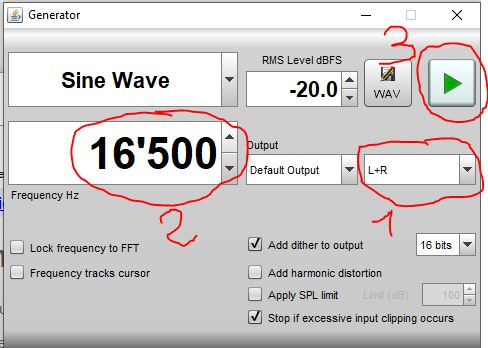
This is so cool. I could quite clearly hear from 20Hz to 15kHz, then nothing at 16kHz or 17kHz…but here’s the weird thing, I can distinctly hear the 18kHz tone. How on earth is that possible?
Then, unless you’re 20 years old, be prepared to cry when realizing you can’t hear 18kHz anymore
EDIT : you need, of course, to check that your headphones are able to produce frequencies as low as 20Hz in order for the test to be relevant (20kHz won’t be a problem).
I was thinking of trying some tests, but as mentioned, it might be too depressing. As long as I continue to hear Kate Bush, I’m happy, and dont want to know what I’m missing
Did you conduct your test with your speakers?
Do they actually go down to 20hz?
Congratulations on still hearing 16khz tone of course that’s age related
If you want to test your ears, use headphones, and ideally ones that have been tested and shown to have a reasonably flat response across the spectrum, or otherwise reveal any significant dips or peaks so you can interpret what your ears hear.
If testing your speakers, do in the garden well away from walls, and evaluate with a measuring microphone.
If testing your speakers in situ in the room, again best use a measuring microphone, and if using ears do assess your ears first, at least above say 10KHz. Positioning of speakers and listening position, will be key to bass performance, together with any bass traps or really thick/dense absorbing material.
Yeah, I was just responding to this particular Qobuz test and thought it was pretty interesting. I already have REW and used the Stereophile Test Disc to measure my in-room response, which is impressively quite flat from 20Hz-20kHz, save for a pretty nasty dip around 45Hz which can be mitigated with seat positioning I haven’t bothered with to this point. Off subject, I also have a Dual Core 2.0 which did wonders for my two SVS subs; they do go down to 20Hz if even a few dB down and sound terrific in my listening/music room.
I just always assumed in the upper frequencies I am like many here. If there’s any legitimacy with the test tracks (the ‘narrator’ speaks which freq. is being played just prior to the tone) I just thought it interesting that 18kHz was pretty obvious to me, while the 16- and 17kHz tones were silent.
Is it universally accepted by scientists that hearing becomes to decrease dramatically after 50 years old?
There are exceptions, as for all.
I did a test with 10 young persons at work, none of them could hear some very low voices as accurately as me. It was 5 years ago, I had 49 .
However I am aware that my hearing will decrease, and has begun to. The reason I will never invest in Nd555 / twin ps/ S1/ 500dr when I will retire. It’s better to be confronted to reality.
True. I try not to think too much about what I can vs. cannot hear. It’s funny, though, how there is a myriad of things that affect our listening experiences: room interaction, age/hearing (or lack thereof), equipment’s capabilities (in terms of covering the spectrum at least equally across the board…or not) and, of course, quality of a given recording—just to name the four off the top of my head. We then post fora-wide about how this sounds so incredible or that sounds rubbish with each addition or retraction of pieces of gear, etc. without regarding all of what I mention from a more synoptic perspective. Makes me wonder why we always have tried so hard to get it ‘right’ when such a thing simply does not exist due to the factors outlined in this and many other threads.
Thinking about these high frequencies, what tracks actually have instruments or voices that reach that high. I can see why a speaker would need to have a big range in order to have a great middle range, but does it matter if we can’t hear a range that doesn’t come out in our music
It is a cruel irony that for many people the cost of top hifi is such that they can only reach the point of affording it or finally upgrading to it in the later years of tgeir working lives, when age is starting to play its tricks.
However, age related hearing loss does not necessarily rob you of the ability to appreciate better sound, even if one day you may not notice if your tweeters are working…
Yes I agree it’s a bit of cruel irony indeed, but maybe never say never.
For example Michael Fremer is past 70 years old and still buy very expensive gear and enjoy it.
He bought 10 years ago a > 100 k turntable and a few years ago a 60k phono stage.
As for me I noticed one thing : I am less and less immune to brightness, edginess. So I am more thinking of buying a tubes amp for my retirement.
I heard recently Aries Cerat ( integrated tubes amp) and it’s perhaps my best listening experience since many years .
It’s human nature I suppose. We enjoy doing more, better, harder.
I’m a climber/alpinist. I’m still a relatively strong climber. But a lot of youngsters climb a lot harder, and are able to cope with a lot more training.
The key is to enjoy what we have, embrace aging wisely and treat our body like a temple

 .
.