Couldn’t actually see the CI102 left antenna on picture one. Is it horizontal and all you have done is reposition it so it is more vertical?
1 Like
A few moments looing revealed 7 to me:
Naim CDP(?) appeared
Box with Dora Dora Dora gone
Naim CI box moved racks
Teddybear
cables changed positions beside teddybear
ATI amp on in second pic (off in first)
Camera angle different
1 Like
Hi Orac, thaks for the contined interest, I am actually trying to change a setting on the CI-102 as we are both typing!
The left hand antenna is actually connected to the Naim CI-102 in both images and is vertical in both of them and the orientation of veritcal is still upwards! (i.e. I have not rotated the antenna downwards).
Oh, it now looks like top ‘Spot the difference’ performer I_B has joined in now…
Seen - left antenna camouflaged by leg of hifi stand.
Was going to mention what looks like speaker cable changes but @Innocent_Bystander mentioned it first.
1 Like
Hi I_B,
Apologies for my delayed response - I have been busy posting on other threads.
I think you already know you got everything right (mostly)!
One small deviation from your observations is:-
CD player is a Naim CD5
I am not skilled at constructing these ‘spot the difference’ challenges, and to my mind the amp on/off and cable position differences might be considered as one functional difference (as they are connected) but two practical observable differences?
I think I am the one making errors here as @Cat7 also had a higher number of differences counted using the observations made above.
Camera angle difference was almost inevitable as I did not use a tripod and took both photos quickly using iPad mini. So the two photos are certainly not taken from ‘identical’ observation points and the light conditions are sure to differ! But hopefully it was close enough to generate a bit of light hearted entertainment?
PS: I was not sure if you were being ironic in your reply when you identified “box with Dora Dora Dora gone”. This item is the Linn Klimax DSM, which is listed in my profile. BTW, I actually began to wonder if you were testing me on my own photo! If so, you certainly succeeded, because I had to go back and check and look at the photo to see what on earth you were identifying! Touché.
Thanks for joining in!
1 Like
@Innocent_Bystander is never ironic, be assured. He just couldn’t name the box I am quite sure.
2 Likes
Hi Edmund, what are your thoughts on the CU 102 ?
1 Like
Well it is true I couldn’t naim tge box by sight, but I rather liked referencing it by the title on the screen - which rather made me think of Dory in the film Finding Nemo!
3 Likes

Hi Ian,
My apologies for taking nearly a week to reply to your question - I have had quite a lot of things I wanted to try in my system setup with the Naim CI-102 and it was only last night that I finished. This post (which may turn into more than one) will later drift into highly technical graphs and possibly a question for Naim staff? But I guess you want the quick answer?
My thoughts are that this product offers incredible value for the capabilities it has within. The ‘sound’ it produces can be ‘controlled’ to a certain degree by the user and you will note from my friends response (see previous postings) that he preferred the Naim CI-102 sound to the Linn Klimax DSM (Organik DAC) sound (when listening to Pink Floyd). Indeed, for many kinds of music, particularly electronic amplified instruments, the Naim CI-102 is very very good. For more live recorded, non-amplified instruments and complex orchestral works - to my ears - the Naim CI-102 provides a less appealing sound.
I don’t know what your music listening preferences are in particular - but I hope the above short summary answers your question?
I think I will post all the technical assessment information separately so forum members can choose which posts to read and potentially engage.
2 Likes
Thank you, I am thinking the CI 102 offers a certain appeal for using with my TV .
My plan was to downsize at a point in time. My medical issues have put a delay on that, but my idea is for a simple system for everyday usage and my better quality system being used for headphone listening
Many thanks
Ian
2 Likes
About a year ago I heard a CI 102 in the HQ dem room, on a dealer arranged trip, Ian, into a large pair of Focals. We were all pretty gobsmacked at how good it was for the price.
Best, C.
2 Likes
Hi All,
This post contains a lot of technical information which may only interest a few readers, so You Have Been Warned…
In my list of things to try with the Naim CI-102 I wanted to see if I could set the CI-102 to give the same room resonance correction as the Linn DSM (that uses Space Optimisation). The Spot The Difference Challenges were in fact the two graphs from the Naim EQ software (left hand pictures) and Linn Space Optimisation (right hand pictures).
The table posted previously and repeated below summarises how similar I could make the settings:-
Product A is the Linn Klimax DSM.
Product B is the Naim CI-102.

In summary:- for the Gain and Q factors of the EQ filters I could make the settings identical. Only the centre frequency and hence the corresponding bandwidth differed very slightly. Is this significant? Probably not for most users. These EQ corrections are trying to linearise the phase perceived at the listening position - but only for sound below 100Hz (see ‘Special Notes’ comments at end). When I undertake REW measurements, I can spot if a correction filter is not properly sitting precisely on the centre frequency or if the bandwidth (and/or ‘Q’ factor) is not quite precise. But at this level we are needing to also consider compensation for air temperature and humidity.
Here are two images from the relevant control windows in the Focal-Naim Manager EQ Software where I am able to set the relevant filter parameters.
Left Channel:-

Right Channel:-
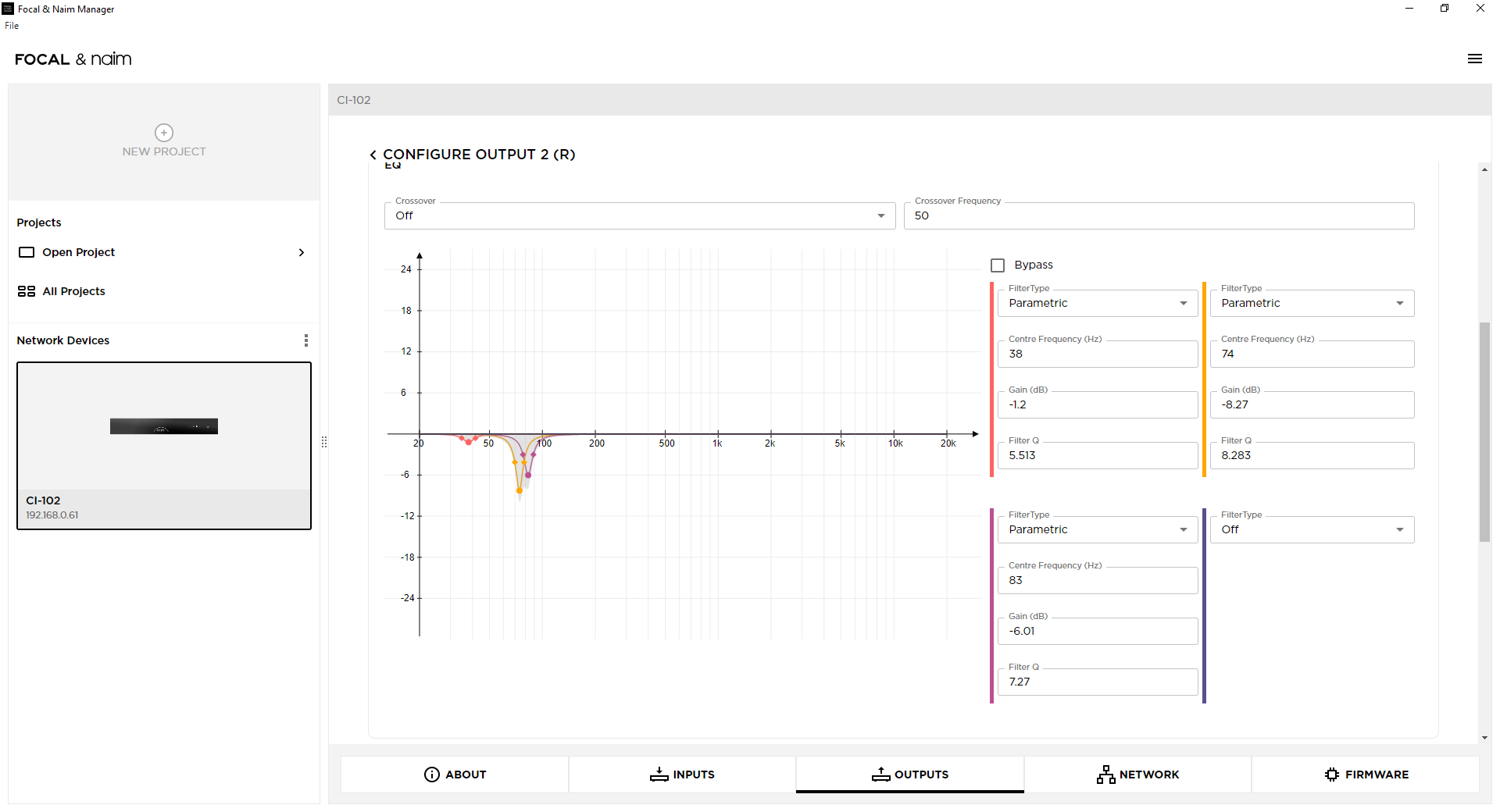
For Linn SO, the method is different - it choses the default settings for centre frequency, but control over bandwidth (‘Q’ factor) and gain for each filter is achieved collectively and indirectly by sliding the ‘Optmisation’ between ‘Flat Frequency’ and ‘Short Decay Time’.
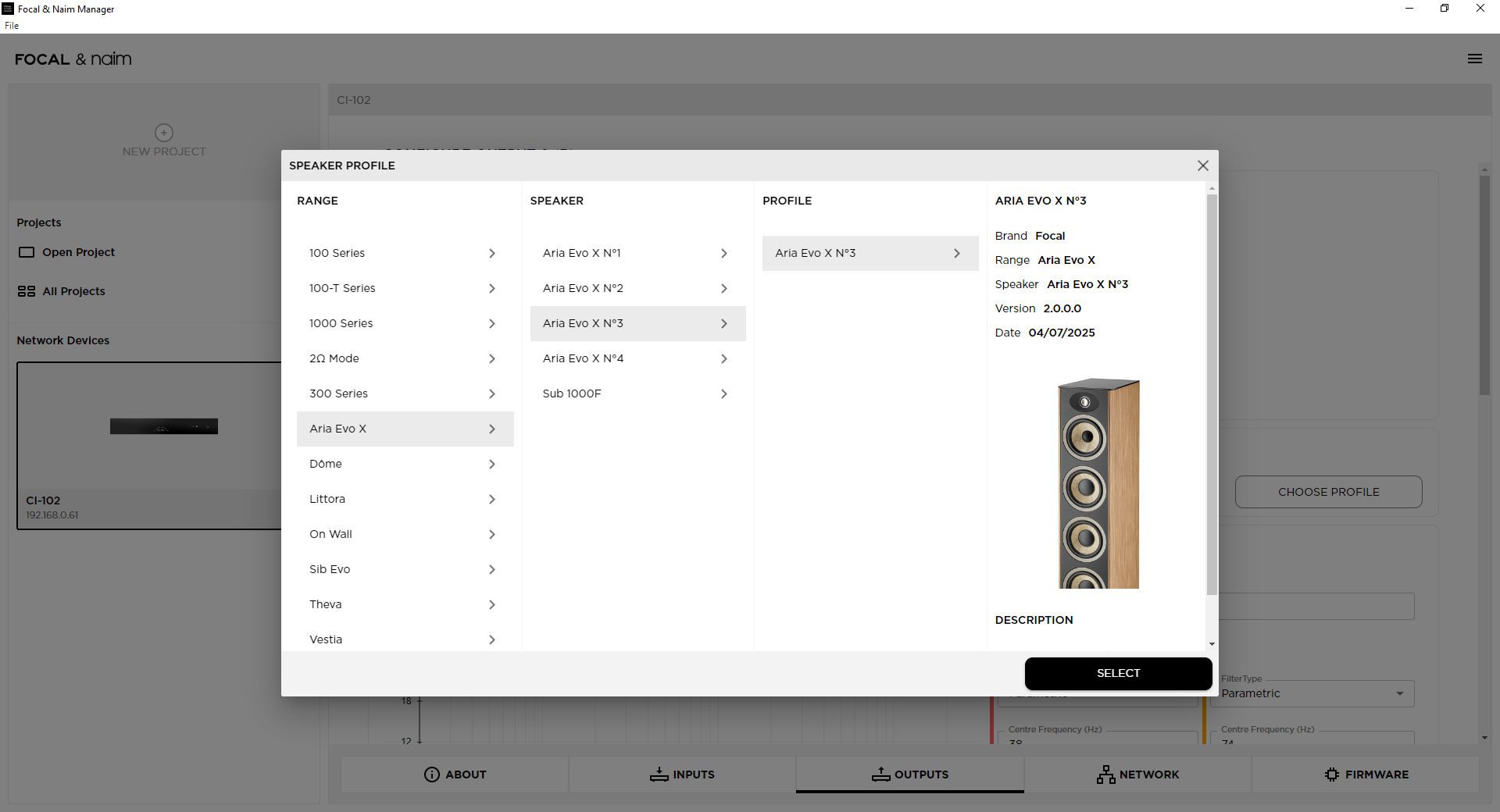
Special Notes: Linn SO only facilitates corrections below 100Hz. There are good technical reasons for this to do with human hearing. Naim EQ facilitates corrections over the whole audio bandwidth - which is similar to many other DSP based EQ audio products. The limitations in the Naim CI-102 EQ are that a maximum of four separate filters are allowed, with an additional crossover setting if one wished to use that. The other ‘feature’ of the Focal-Naim software is that it has pre-coded corrections for all the Focal loudspeakers (see example selection window below)! Not particularly useful if one has Magico or Kudos or Neat loudspeakers etc etc…
Needless to say, I just bypassed that setting!
I could at this point demonstrate how I was able to get practically identical sets of REW measurements using the Linn Klimax DSM as the source and also using the Naim CI-102 as the source. The sound was very close too - but not quite the same. More on that later.
However I also wanted to see what the Naim CI-102 offered for Sub Bass control?..
See next posting…
2 Likes
Here is the detail of what I did using the Naim CI-102 and the setting of the Sub Bass control.
The ‘Outputs’ selection tab window (note that I did not show this window in my previous postings) appears like this:-
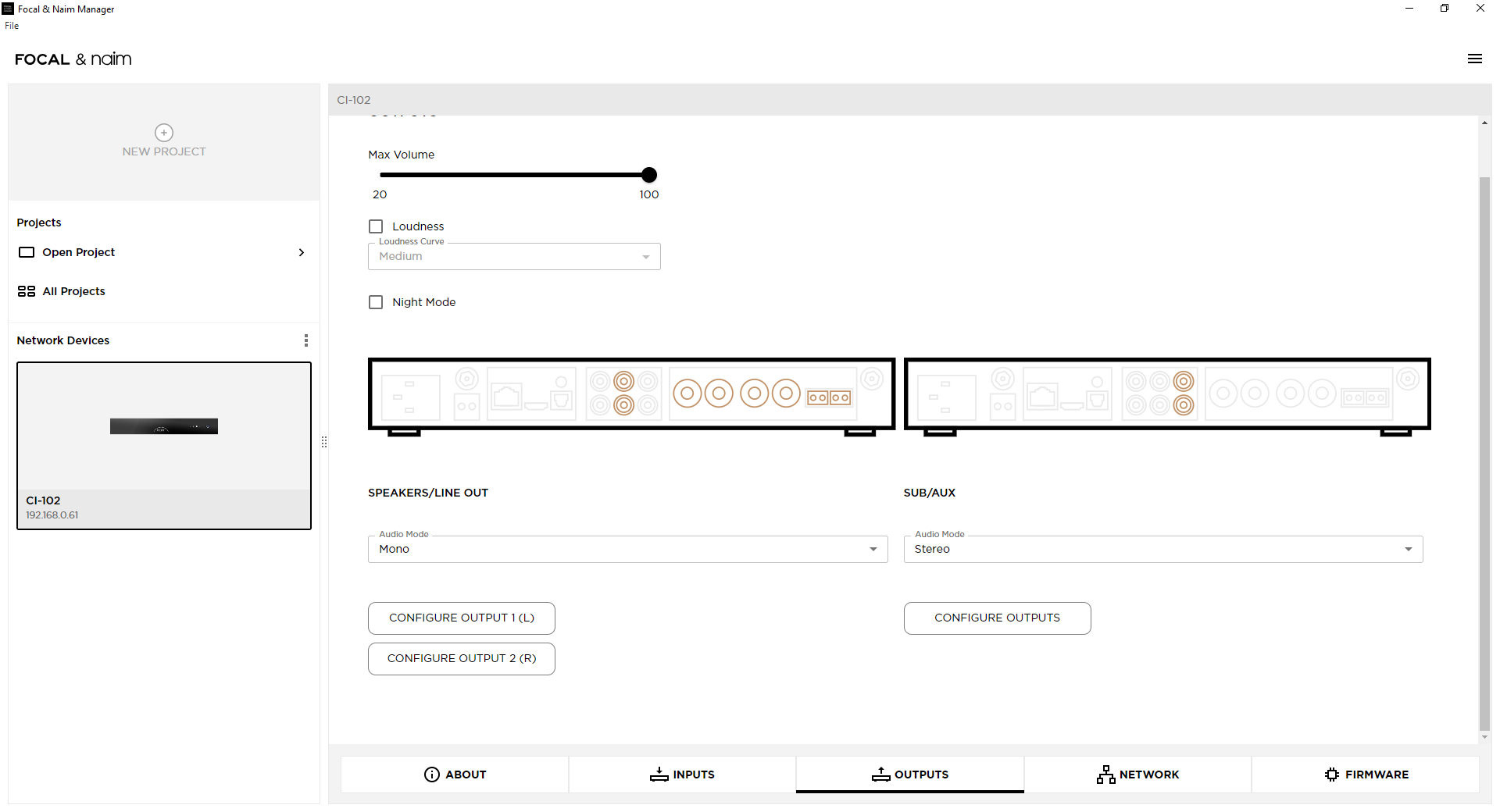
The next step is to select the ‘Configure Outputs’ button for the Sub/Aux RCA outputs highlighted in ‘brown’ colour on the diagram (maybe that colour is meant to suggest ‘Gold’?)
Again, as for regular loudspeakers in the Focal-Naim manager software, one can select from the availble range of Focal Sub Bass products. Here is an example…
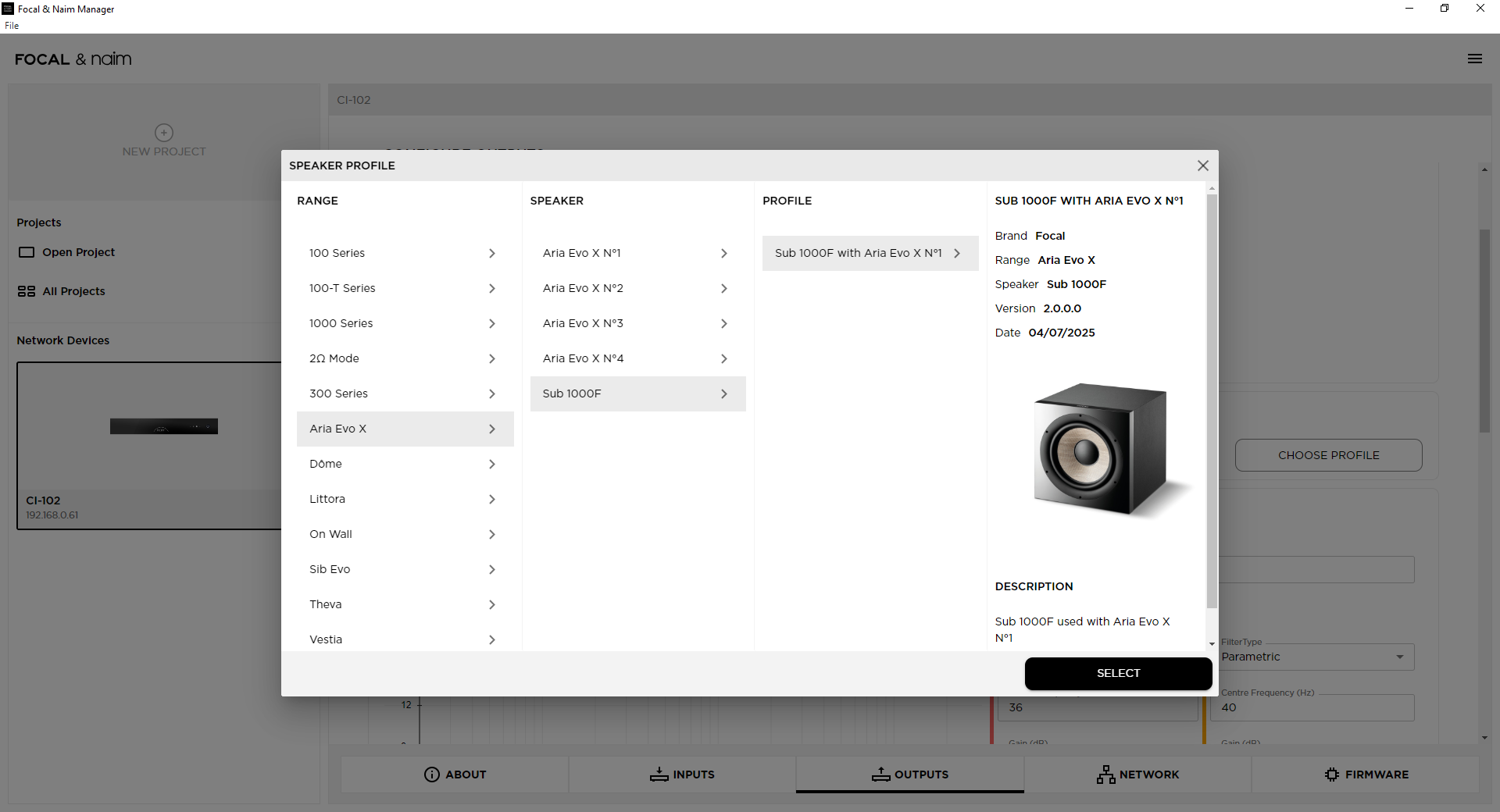
Needless to say, as before, I just bypassed that setting!
Here I could add some amusing quip along the lines of Paul Hogan in the film ‘Crocodile Dundee’, substituting the word ‘Sub’ for ‘Knife’…as in… "That’s not a Sub…
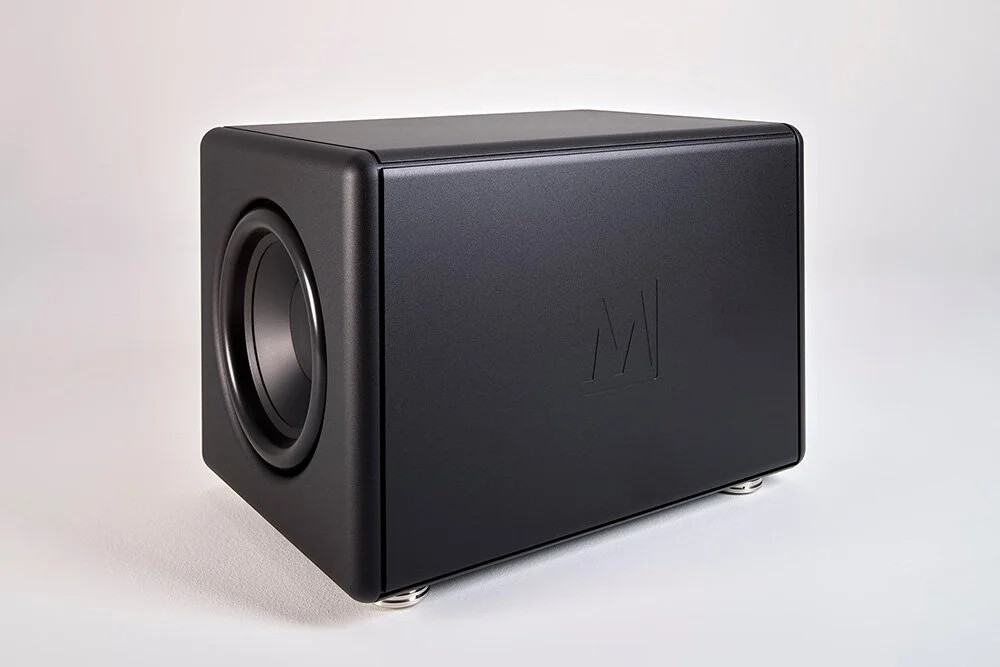
…That’s a Sub!"
The Magico Titan 15 Sub comes with its own built in DSP Equaliser with dedicated control software. I am still optimising my settings for this, but nevertheless had established a reliable set of workable EQ values, the control panel ‘Output’ tab of which is shown here…
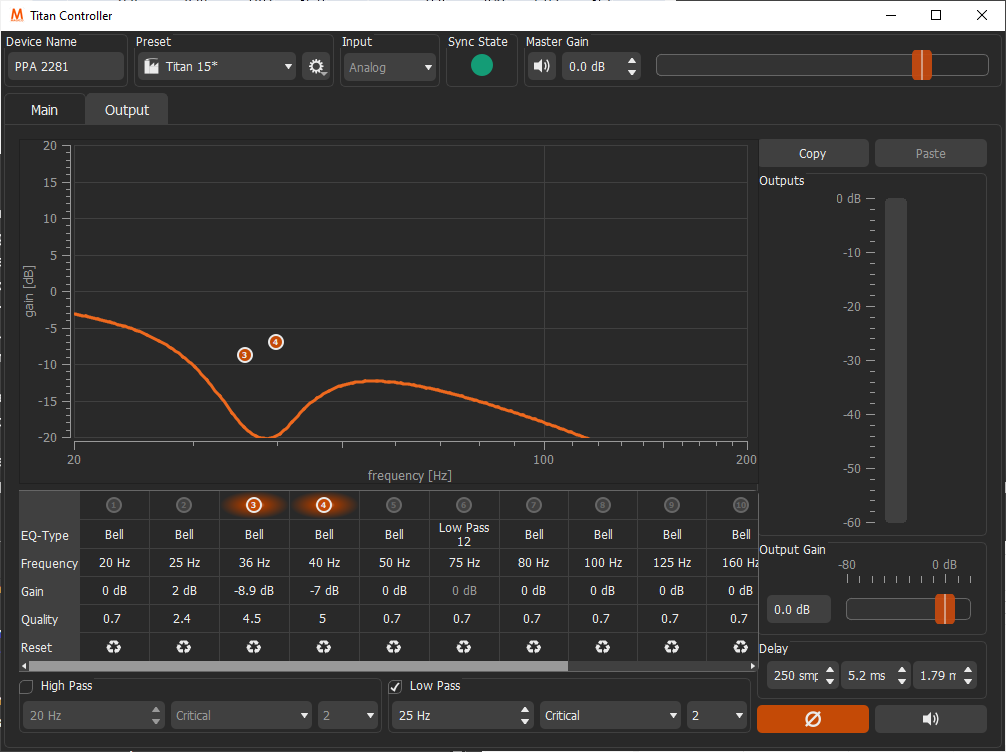
For the experiments with the Naim CI-102, I turned off all the Magico EQ (apart from the time delay correction) and set the Titan15 for full bandwidth with 0dB gain.
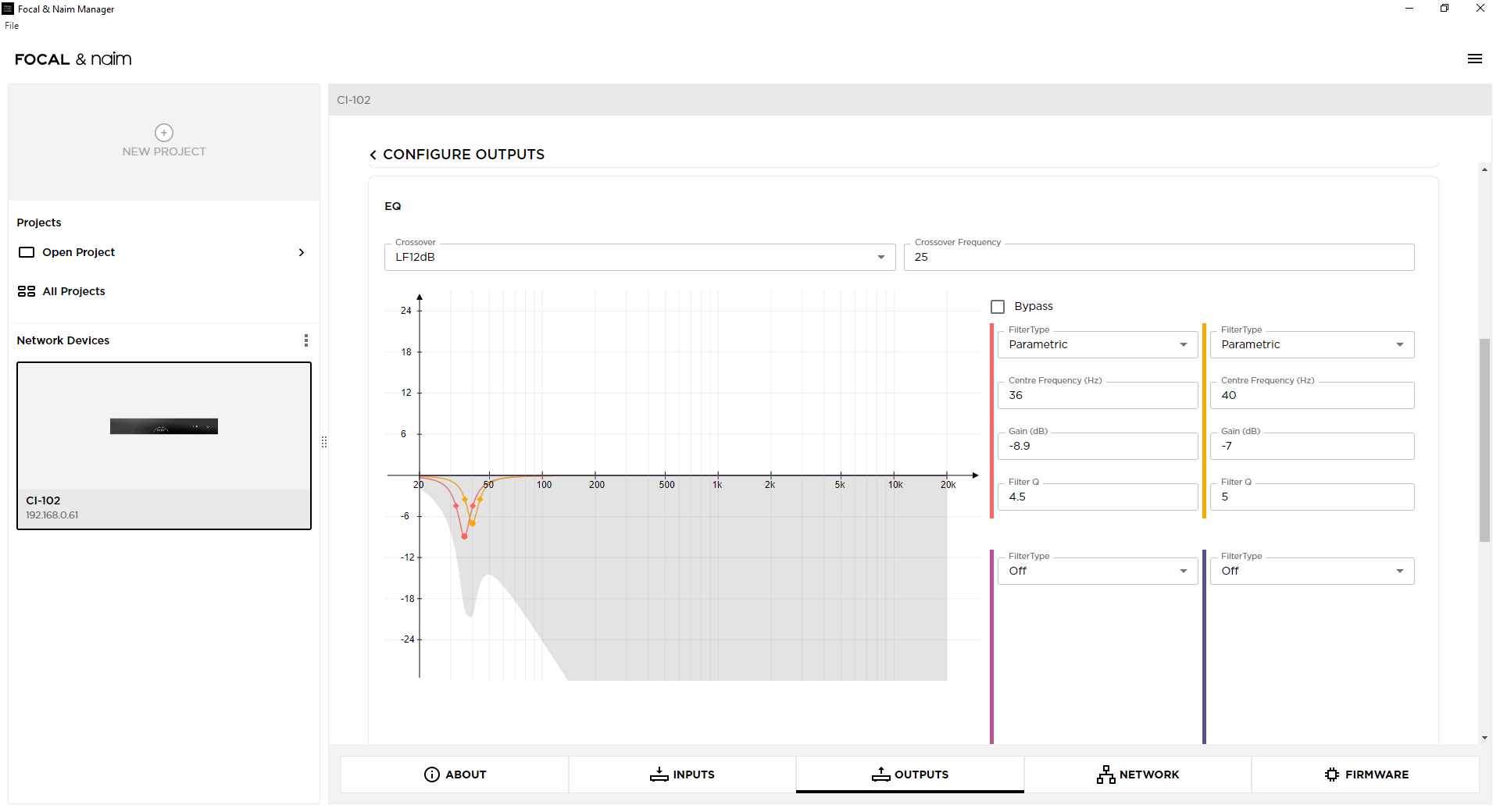
Then I set the Naim CI-102 software for the Sub/Aux outputs to give the same EQ settings that I had established previously with the Linn SO and Titan 15 together. Here is the image from the control window in the Focal-Naim Manager EQ Software where I set the relevant filter parameters for the Sub/Aux Output.
If people are really interested I could post the practically identical sets of REW measurements using the Linn Klimax DSM as the source with the Titan 15 and also using the Naim CI-102 as the source with the Titan 15.
The sound was very very very close! Amazing given the price difference of the sources?
However the ‘edginess’ of the Naim CI-102 source compared to the more ‘smooth’ and ‘realistic’ Linn Organik DAC (and hence my personal preference for the later) is the only observation I have for the differences in the ‘sound’ of the two products.
My hypothesis for this difference in sound relates to the nature of the digital oversampling processing, DAC output modulation type and also output filtering. Which brings me to the question I have for Naim staff (@Stevesky ) if they are willing to answer, please?
Which of the 8 available pre-programmed digital filters in the ESS 9033Q DACs have Naim selected for the Main and Sub Outputs on the Naim CI-102 (if indeed that is/was the design decision taken)?
I perhaps assume that Naim have selected one of the later listed 3 (three) Mimimum Phase types (type 6, 7 or 8) - but I am definately sufficiently interested to ask and find out and even be proven wrong if the answer comes back as Linear Phase Apodizing type 2!
Thank you for your consideration.
2 Likes
Thank you for those superb posts , very, very impressed
Ian
2 Likes
Hi Ian,
Very many thanks for the compliment - I do appreciate your posting  .
.
I do hope that the OP (DiggyGun) is not in any way offended by me taking the thread on a bit of a thread drift. Afterall, my various postings here have been done with the spirit and intent of keeping forum interest in Naim products (particularly the new ones) and hopefully it has been interesting?
Furthermore, in the words of that famous comic TV character from the 1980s, “It’s all done in the best possible taste”  .
.
1 Like
My view is that Naim are very tolerant and that engenders long trust , and if you depart from Naim it encourages you back.
The Nail 50 encouraged one person back , and whilst Naim are very much my preferred provider (as my long suffering dealer will testify) it is a fact that the concept of Good, Better, Best seems to have worn a little thin - on certain products
In turns that leaves consumers little choice but for the odd interloper appearing in racks what were once solidly black and green
Threads are like conversations , they meander
3 Likes
Hi Ian,
Thanks for replying. Actually I am going to go with a bit of a WILD speculation  .
.
I understand from some postings that soon the Naim beta testers have a Naim factory visit.
Maybe at the visit they will be introduced to some new software enhancement that needs testing. This software might be enhancements to the Naim-Focal ADAPT App that allows the app to work with other loudspeaker types. This software lets the user take ‘pictures’ of the room and ‘pictures’ of the loudspeakers placement in the room etc and guides the underlying DSP engine (the thing I have been playing with above) to set the correct filter characteristics - without requiring the user to have degree level training in Electronics, Signal Processing and Room Acoustics?
Afterall, the basics of this software is already available for the Focal DIVA range of loudspeakers in the ADAPT software. The above enhancements could then enable more sales by making Naim products more acceptable to the market by permitting Other Brands of Loudspeakers to be used  .
.
Furthermore new hardware could be introduced at low NRE.
Examples :-
Maybe NAIM Nova PE gets upgraded with new DSP innards to become NAIM Nova RE (as in Nova Room Equalisation)?
Maybe NAIM Atom HE gets upgraded with new DSP innards to become NAIM Atom RE (as in Atom Room Equalisation)?
Like I said, all of the above is just pure speculation.
There seems much speculation about new Naim product happening on other threads presently, so I thought I would wake this thread (again) with some more WILD speculation
Given the company is called Focal/Naim not Naim/Focal - I think the bias of new product introduction will be to more affordable and capable in-room ‘correcting’ wireless connected floor standing Loudspeakers.
Perhaps step-up derivatives from the current range (Sopra and Kanta) - or maybe an upper-mid-market product that the market data suggests would shift quickly?
Whatever, the product(s) is/are almost certain to have a SMPS inside and not a heavy transformer based PS. Those things simply add too much cost and difficulty through the supply chain and install to the end customer.
Thoughts anyone?
I heard from someone, who has very open ears and like to walk around Salisbury, that Naim should launch the Diva DBL and MEZZO SL2 wireless speakers, with Naim power amp modules inside and a new developed streamer .
But chut ! Don’t spread for now this information.
1 Like