@Blacknote @frenchrooster @Thomas @Daren_p and guys here, merry Xmas !!! Cheers 
7 Likes

Hahahaha .. cute !!!
2 Likes
What has been shown in that paper isn’t necessarily true in all cases, maybe it works only for those Gik panels. A real life scenario is way more important to me and the devil is in the details. Not everything can be put into numbers and equations, science has its limits and nothing is perfect.
Well if you fancy that, you could put the Focal Grand Utopia in your room, maybe they would work better than expected ahah.
1 Like
Thank you very much @naimophile , I wish you Merry Christmas to you as well! 

May Santa bring you some (gold) Odins and happiness 
…also Merry Christmas to all the other forum members of course!
2 Likes
@naimophile Merry Xmas to you & all others in here as well.
Got two more panels re-covered this morning, below are a couple progress pics (excuse the mess). What I have discovered is that the panels on my front wall aren’t as thick as I thought they were, at 6”. I built them first when the panels on my side walls were 3.5”. After hearing how well they performed I then added the thicker 5.5” panels to my side walls. So now I will be extending those panels on the front wall from 6” to probably 10” & the large center panel on the rear wall is currently 7.5”, it will be extended to 10” as well. As can just be seen in the rear pic, still need to cover the bass traps in the corners.
With inspiration from @Thomas & @Edmund-of-Essex I was looking at my room last night & thinking how much more potential bass traps I could incorporate, including some soffit style traps along the front & rea wall to ceiling space 
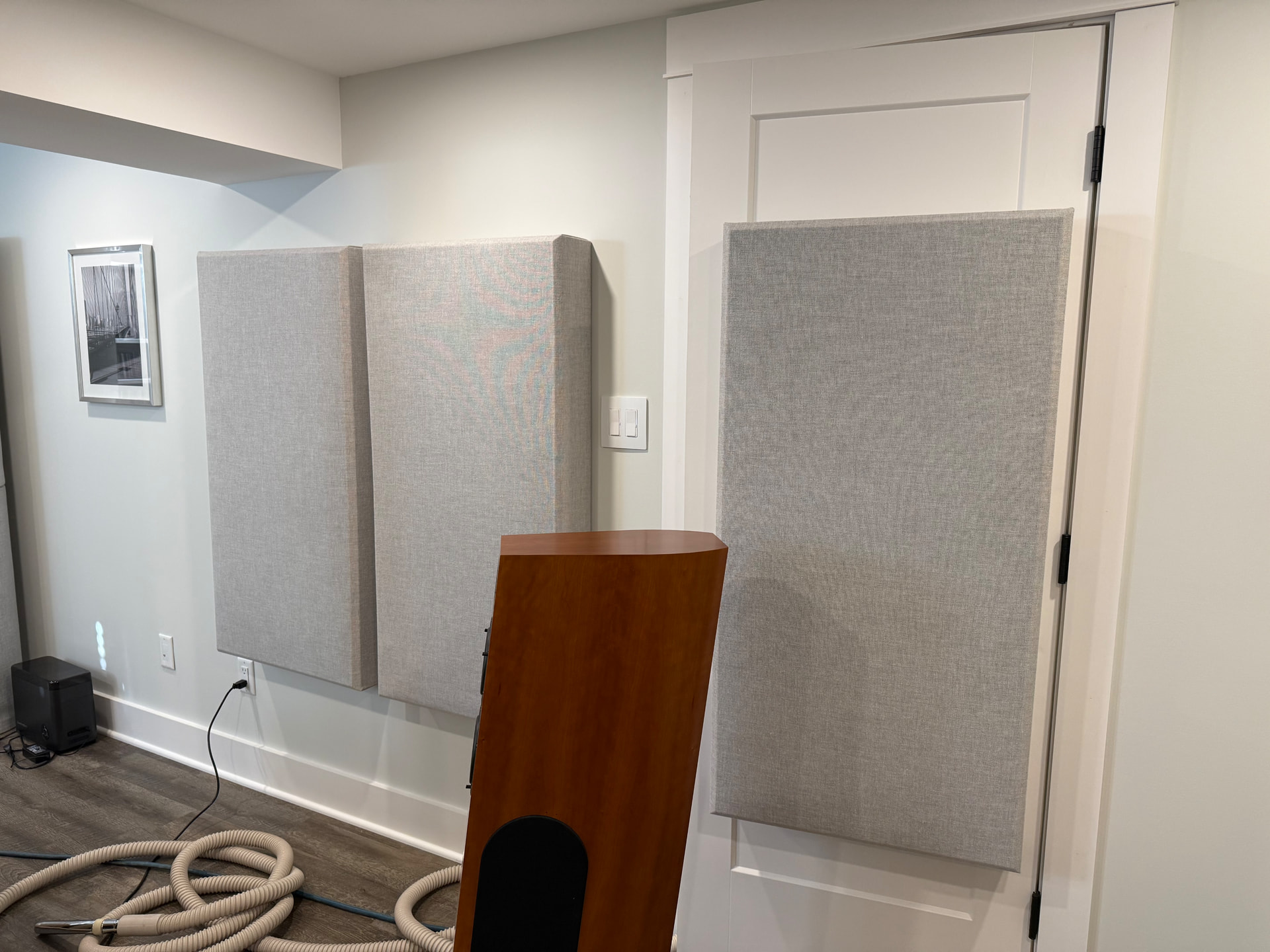
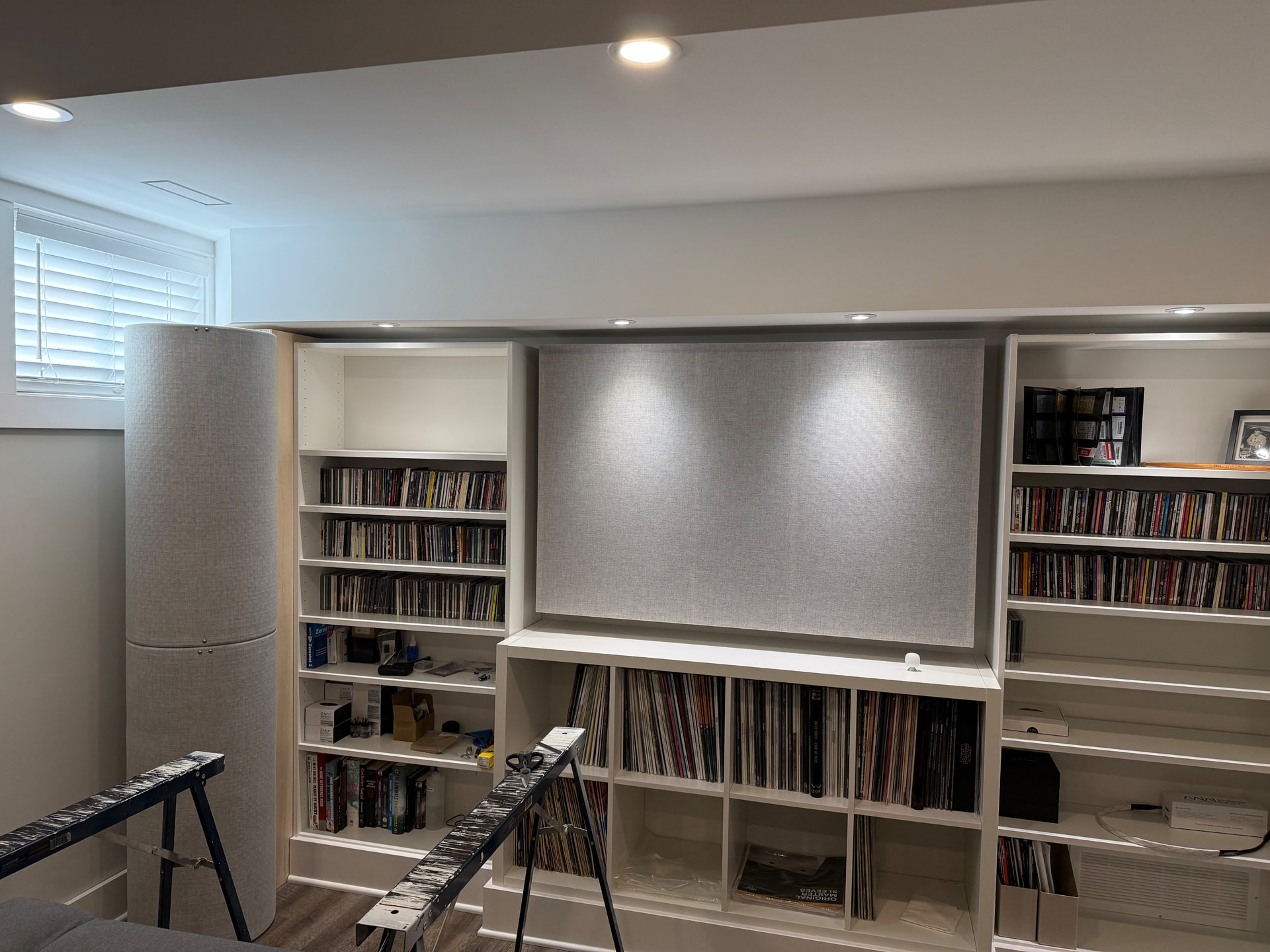
8 Likes
Thanks for the Marcus Miller pointer. New to me, and he’s great. Funk layered up with jazz, or maybe vice versa? And having electric base and harmonica as the lead instruments does give the hifi system (and listening room) a workout!
1 Like

→ https://youtu.be/JPYt10zrclQ?si=AANM7NqMPuhhDY_U
Here’s a short, educational, 3 minute video.
It’s easy to follow and kept simple.
That said, reality is a bit more complex.
-.-
One thing in the video isn’t quite clear, though.
The presenter is mixing up two different things:
- what’s good for sound reproduction.
- and what feels comfortable for animals (that is, us!).
I wouldn’t recommend using diffusers when beginning.
From an acoustic point of view, the goal is to keep the bass under control and to avoid excessive sound bouncing off the walls, which diffusers don’t actually prevent.
Diffusers should always come last, once everything else is properly under control.
Obviously, the guy is also trying to sell his product 
2 Likes
Not sure I agree, diffusers come in many forms, the most common in domestic environments is carpet, soft furnishings, curtains, pictures on walls. These scatter the reflections as well as attenuate them. These impedes clear reflections… which can be very detracting, and hard for our brains to decode… ie poor hifi results. The same is used in public places such as in restaurants and hotels where audio diffusers are used to blur and impede reflections of people speaking making it easier to talk and be heard. Without one tends to speak louder which makes the matter worse. In hifi I suggest that can equate to searching for that ‘elusive’ upgrade.
Bass absorbers are really about dampening room nodes. As was said above this defined by the geometry of the room and physics. Here dampening the boundary edges of the room and using speakers that attenuate gently to match the room proportions in the bass area. In my experience this doesn’t need to be exact in bass frequencies to be very effective. Get it wrong and monotone (resonances) and lumpy bass (where certain notes/frequencies are obviously louder than others) appears which is appalling to have in a listening environment and can destroy the results of an otherwise highly capable set of electronics.
Get it right and your speaker bandwidth compliments the room nodes to act like a sub woofer without obvious attenuation or over exciting the room.. and often the phase works wonderfully. I use GIK acoustic products to manage a few key bass boundaries in my listening room. In very much larger spaces room reinforcement effects rapidly fall away for useful frequencies.. and reflective echoes /reverb is the challenge, which can muddy bass frequencies.
As I tend to say in hifi, start with the room speaker interface and work to the source. The source first argument in hifi is a fallacy in my opinion, and I am sure is behind the so called upgradeitis condition that some hifi enthusiasts / audiophiles suffer from.
I suggest, unless you are going to design and engineer the room specifically, start with a well soft furnished room listening in the mid field and have a speaker bass response roughly matching your room size… ie the smaller the room the more softly attenuated the bass below say 60 - 70 Hz. Ideally avoid ported speakers in smaller rooms as they make room matching often harder, as their attenuation is steeper than the softer infinite baffle speakers… that can more easily result in lumpiness or monotone bass.. you can start to see why speaker auditioning for hifi in a domestic setting is so important.
4 Likes
Hi Simon,
If you don’t mind, I’d like to clarify one or two minor points in your comment.
In the context of acoustics, there’s a distinction between scattering and diffusing sound.
Diffusion is quite specific.
It’s a particular way of scattering sound in a controlled and evenly distributed way.
What you refer to as “bass absorbers”, in the context of the discussion above, are actually broadband absorbers (if made from porous materials).
They are useful both for keeping room modes somewhat under control and for absorbing mids and highs.
Which is why they need to be as thick as possible.
In small rooms, both diffusers and “bass traps” (I mean real bass traps) need to be used with care.
I tend not to recommend real bass traps (almost bought from ArtNovion).
Given their cost you’re better off going for active bass traps such PSI AVAA C20.
Your final piece of advice is spot on ! 

The best way to solve a problem is to avoid creating it in the first place!
I’d even go so far as to say that if you don’t want to treat a room too much, the speakers should start rolling off at around 80 Hz.
I nearly went down that route a few years ago myself…
In the end, I chose a different path.
I demolished my living room…
Sorry, treated the room 
Cheers,
Thomas
2 Likes
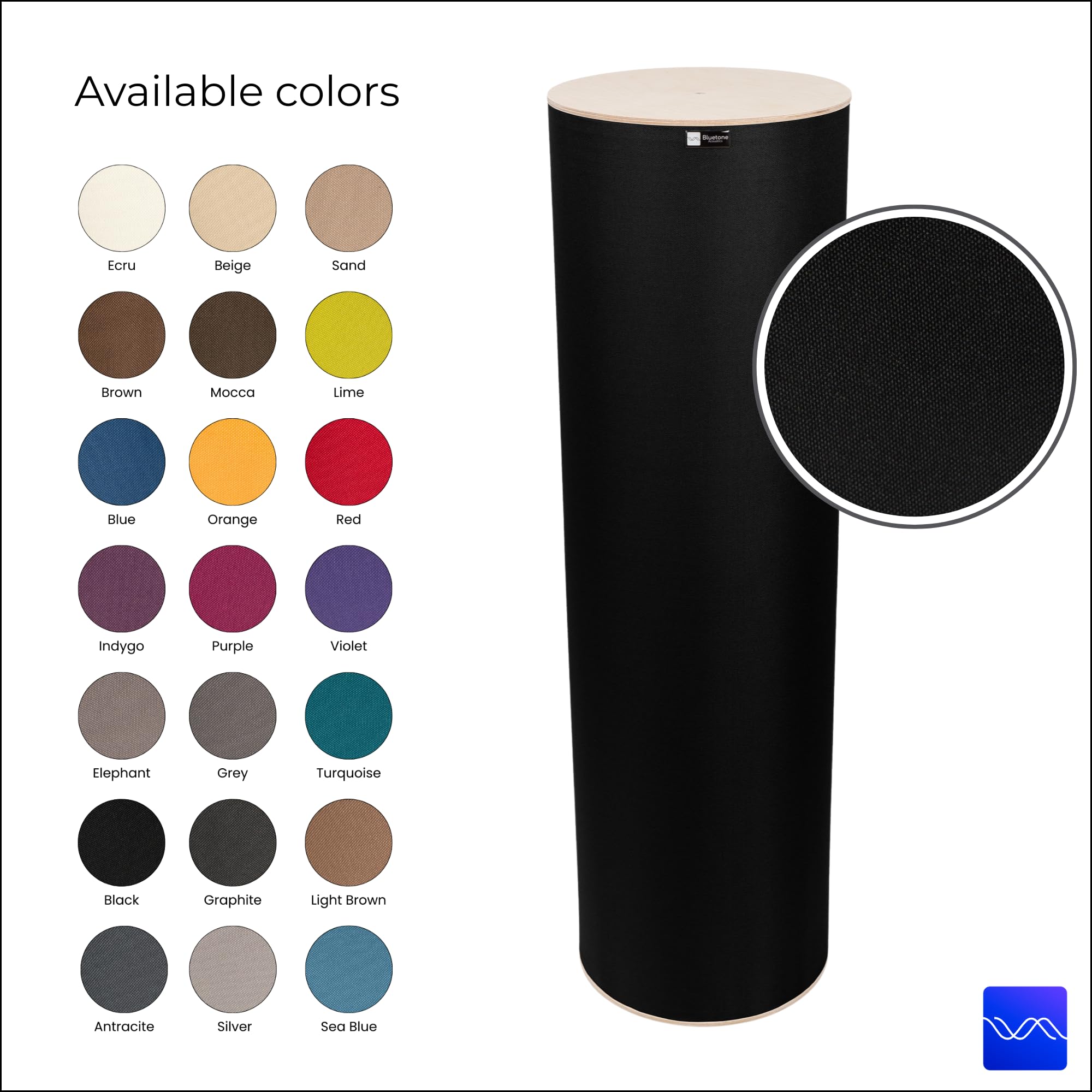
I trying to search for 2 small cylindrical bass absorber (diameter around 90-100 mm max) behind my speaker corner .
1 Like
Hi @naimophile
I’d suggest having a look at this video before committing to buying this type of product :
2 Likes
2 Likes
Yes FR this is what I saw too.. am checking them out .. 

1 Like
Thanks Thomas.. will watch it.. sometimes I do think of like just go to any art shop , but any foam cylinder , wrap them up w fabric and try them out who knows if they works .
1 Like
The reason who am searching for bass trap/absorber, ,I do agree with Thomas the wrote out that he mentioned we should hear the real bass the speakers delivers and not reflective/bass been traps .. and I am very interested to hear how it actually sound like .. very very interesting , to me ..
And if i ever move to a new place, I will definitely put in effort doing a sound room.
but I have a question - if you put a sound room base on the current speakers, and sometimes down the road , you change the pair of Speakers, how well the room will take on the new speakers . And also change of new boxes ? 
That doesn’t make any sense. The speakers aren’t what we listen to. It doesn’t matter what they are doing as long as the speaker/room combination gives us the music that we should be hearing. I really don’t care whether the bass comes from the speaker, the room, the room treatment, or the electronics. It just has to sound like the music should sound.
2 Likes
You have a point there too bruss. The same pair of speakers will sound different in different room. And also, when manufacturers said their speakers inherit their so called house sound. How relevant are this house sound ? House sound depends also very much on the room and where one place them. That also I am wondering .
And so do boxes ..
1 Like
In my uses in physics and engineering - sound, radio and light for example, scattering is random or uneven distribution where diffusion is a more tailored distribution through multiple scattering events so as to provide a statistically shaped response, such as used in audio reverb designs.. so largely interchangeable unless getting very pedantic…
which appears slightly different to your narrative but it doesn’t matter.
Yes the bass absorbers I use have a tailored response to focus on specific frequency ranges - essentially you specify the response you are after. So yes they have a very low Q so cover a few octaves but I wouldn’t call it broadband in the sense the response is equal across the bandwidth.
GIK have many specialist products for this sort of use case, and they have a consumer range as well that look less ‘industrial’ 
Yes newer techniques and material dont require to be as physically thick as previous less efficient materials
4 Likes
This thread is very interesting .
4 Likes