Nice looking room there…
For me the main benefits are natural light ans opposed to anrtificial light and in summer fresh air from open windows… which does seem to improve the tightness of lower frequencies for some reason.
Although I often listen intently with my eyes closed.. I guess I am still regularly opening them
For me music doesn’t have to be like ‘one flew over the cuckoo’s nest’… it’s not always calming or relaxing … sometimes music is composed to build suspense and tension… but I like it to come from the music rather than my surroundings.
Perhaps I am slightly claustrophobic…
BTW I use GiK products too.. I think they work well and look good for domestic settings.
3 Likes
I’ve been thinking about doing something similar with a sub.
I’ve got some problems in my room at around 40Hz and around 50Hz which don’t seem to be affected by changing the speaker or listening position. The room wont be helping as it’s almost square roughly 4m x 3.6m.
Anyone else been experimenting with subs to fix such issues?
1 Like
Whilst I like natural light and a pleasant outlook in the music room if in there during the day, I never play with the windows open: Partly because I don’t want to disturb neighbours using their adjoining gardens, knowing how much I dislike hearing neighbours’ music if I’m sitting peacefully in mine. (I know I could choose to play quietly, but better just with windows closed! However we have a central ventilation system gives us fresh air at all times, and triple glazing which is very effective at blocking any external distracting noise - whether farm machinery in field behind at certain times of year, or some very noisy birds!
Hi Thomas and @daren_p ,
Very many thanks for your compliments (much appreciated) on the artistic presentation of my media room. The art work designs are abstract designs from artists who have licenced their artwork to one of the databases that GIK Acoustics use for their art panel concept. Of course you can supply your own art or photos too.
There is a longer story to get to this point, including all the design concepts for walls and ceiling that I explored before starting. I may be able to find the specific forum posting link…
Edit: I manged to find the specific link it is here.
In the meantime, more views …
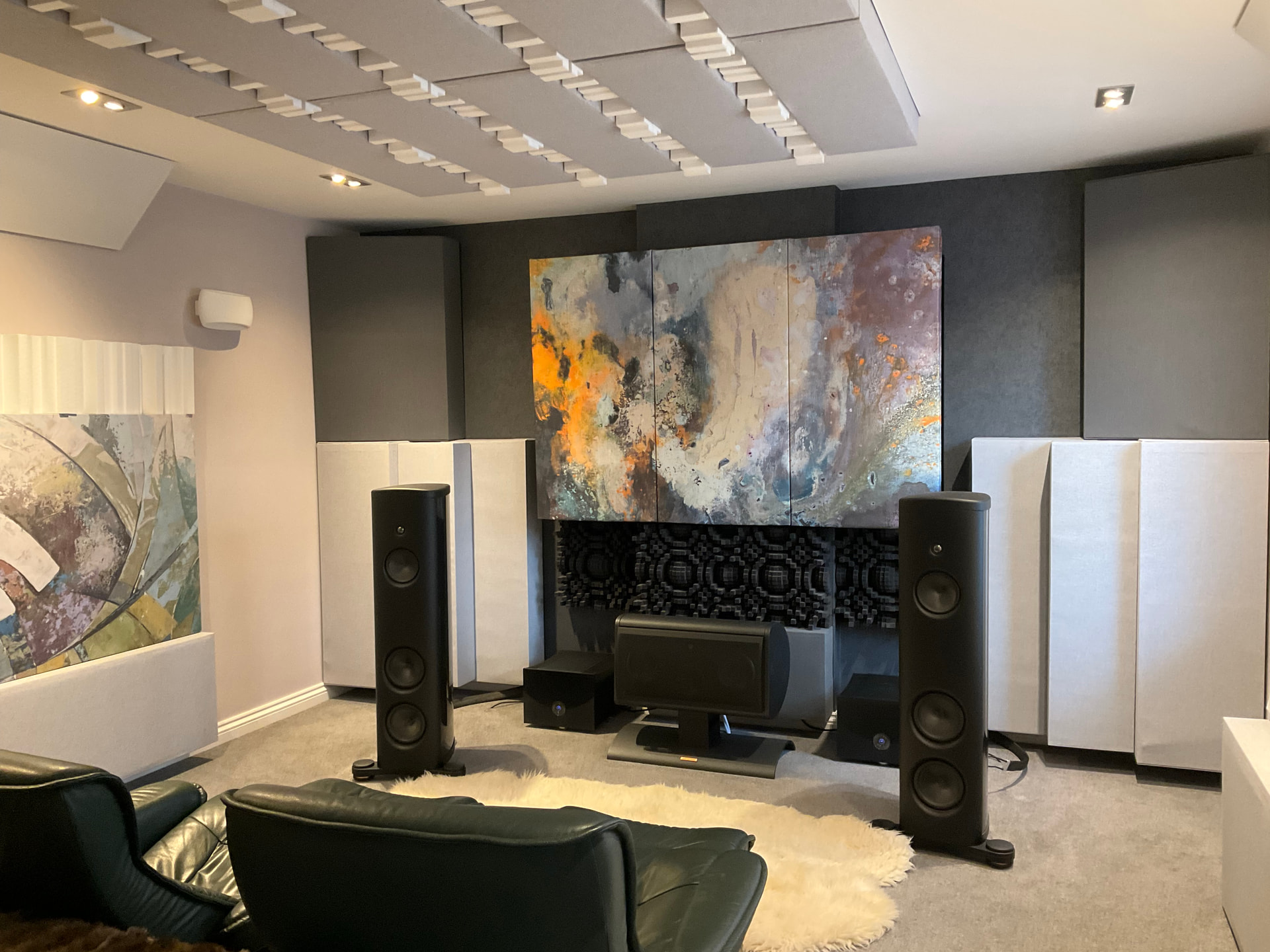
Original Image: Author provided, no reuse.
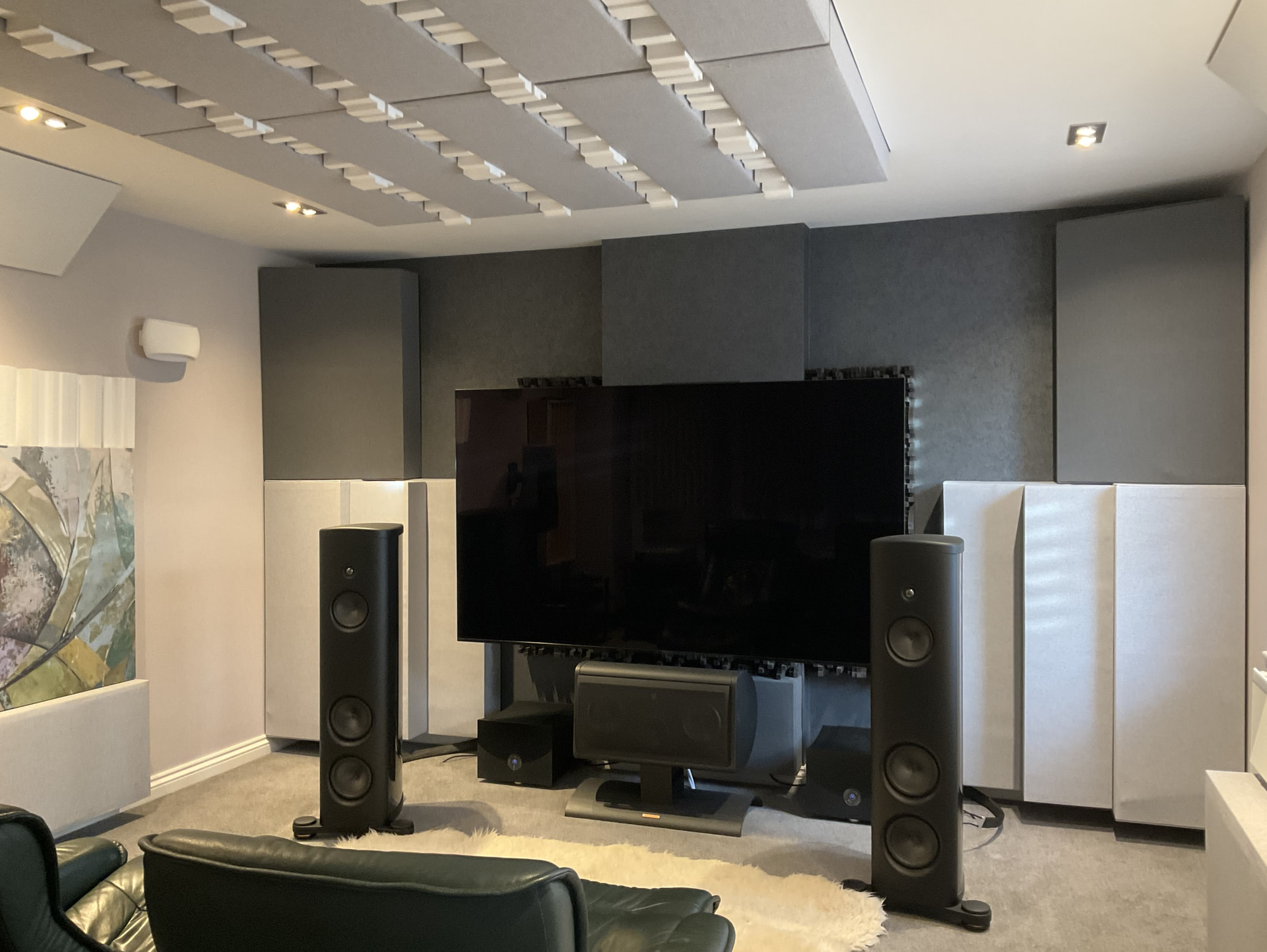
Original Image: Author provided, no reuse.
This Media Room is still work in progress. In the past, I have variously used sub bass(s) - occasionally to good effect. Thomas and Daren, there is a specific discussion starting (here on my thead) which may be of interest and which also includes the suggestion by forum member Teskey to employ PSI AVAAs.
In the end (partly because this is also a Cinema Room) I bought the biggest, most controllable, sub bass I could afford…
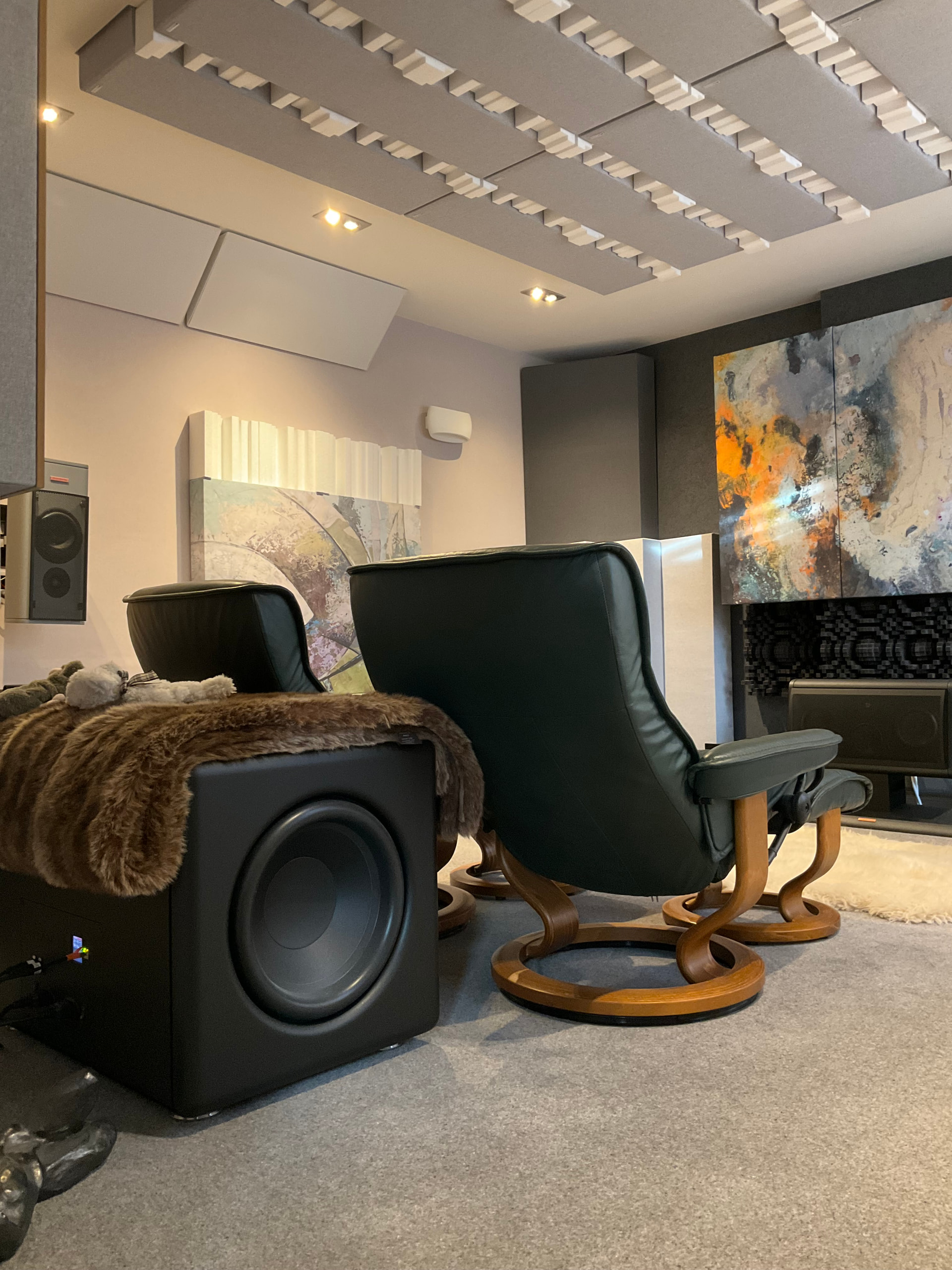
Original Image: Author provided, no reuse.
I keep promising those REW plots, they are available, I will get there…
6 Likes
Hi Simon,
My view on this benefit is that opening the windows allows the LF pressure to escape (and keeps the below 100Hz phase response more linear) - that helps with mainting the accuracy of the dSPL/dt wavefronts in the music at the listening position.
YMMV
Hi @Thomas and @daren_p and anybody who is interested…
All the following graphs were obtained in my Media Room with a microphone setup as follows.

Original Image: Author provided, no reuse.
Logarithmic Sine Sweep, 10Hz to 20kHz (44 seconds).
Sound Pressure Level at Listening Position (no view mode filtering)
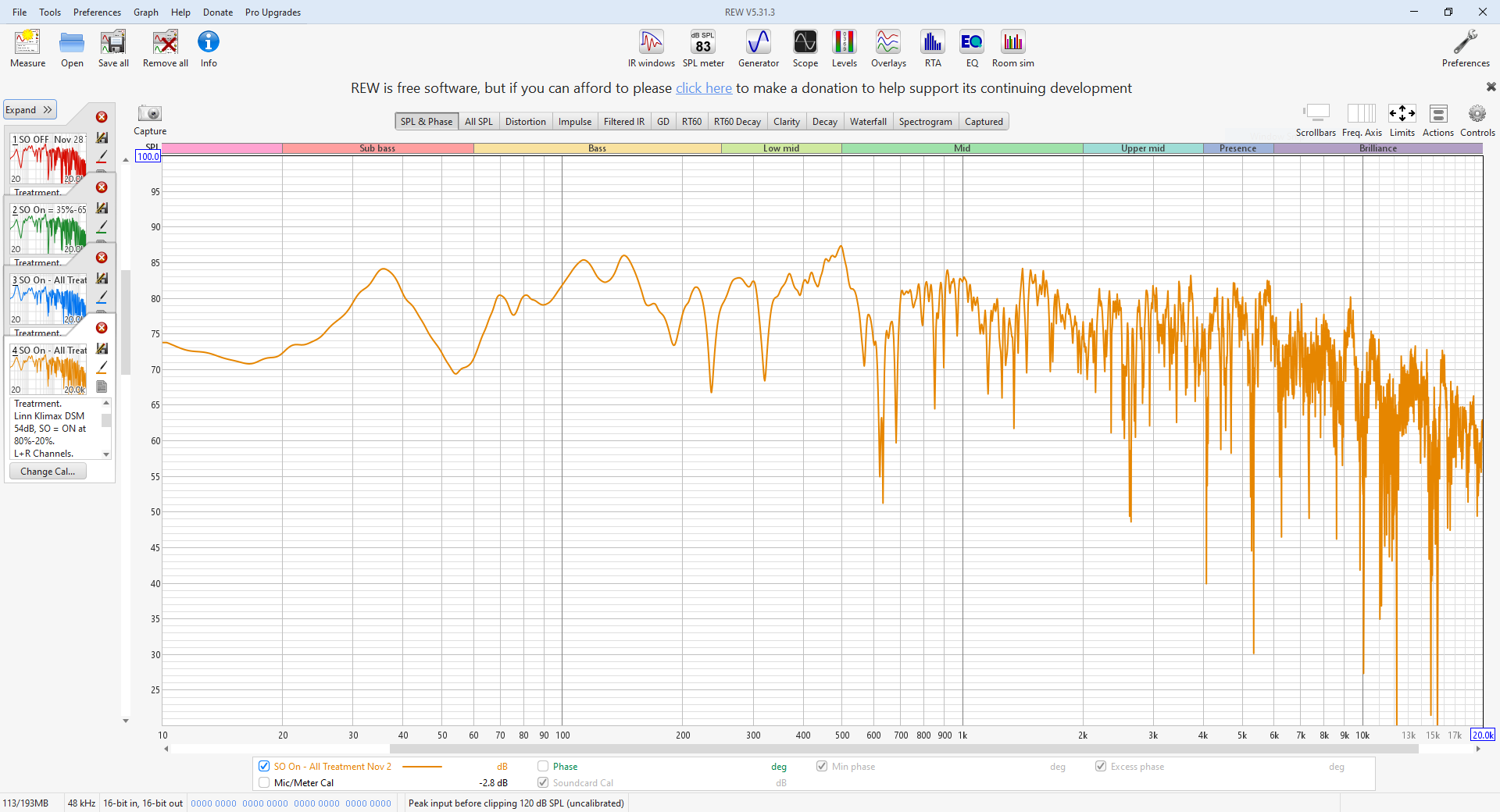
Image Credit: REW and Author
Sound Pressure Level at Listening Position (1/3 octave view mode filtering)
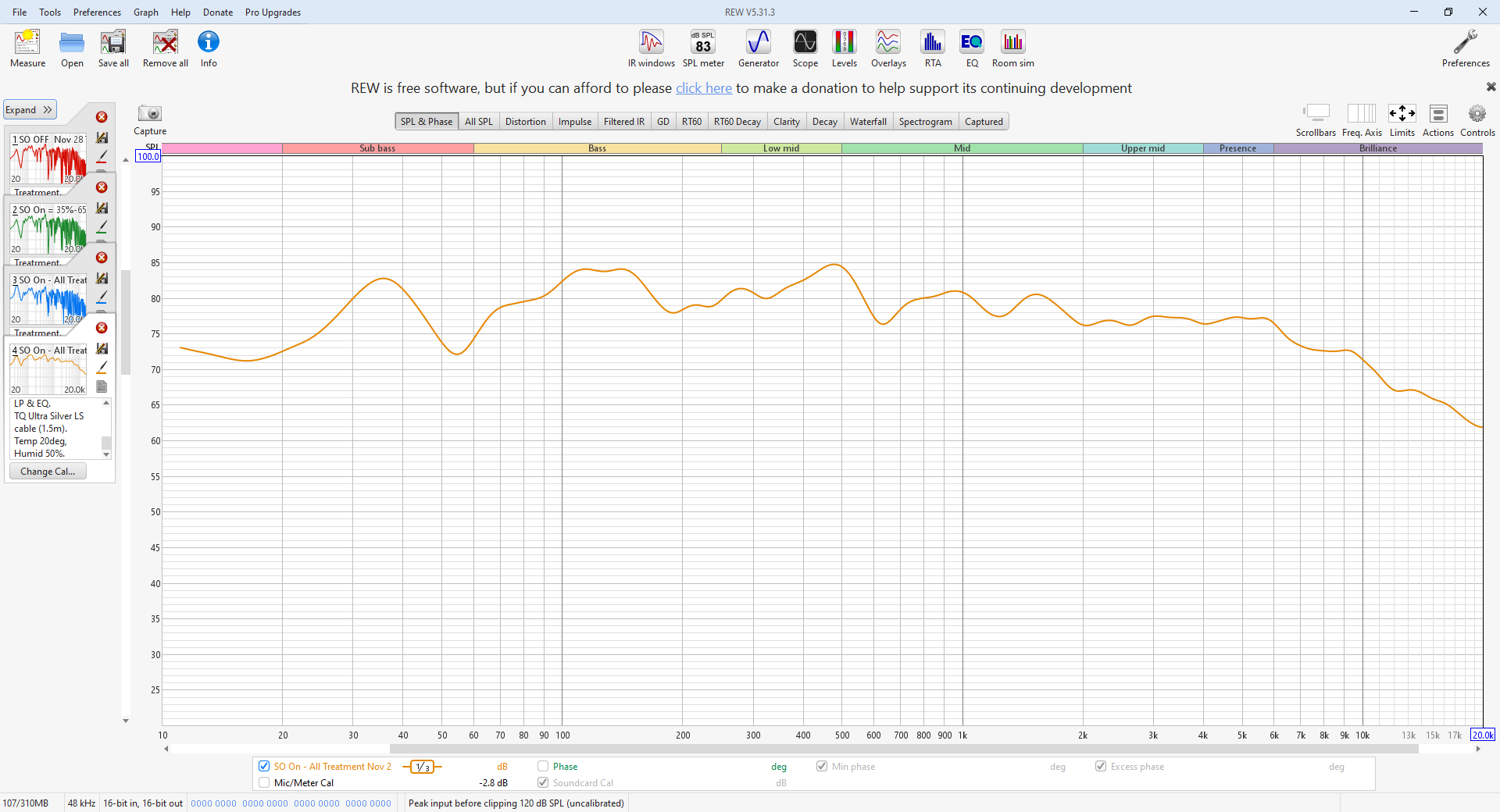
Image Credit: REW and Author
Waterfall Graph at Listening Position (1/48 octave smoothing)
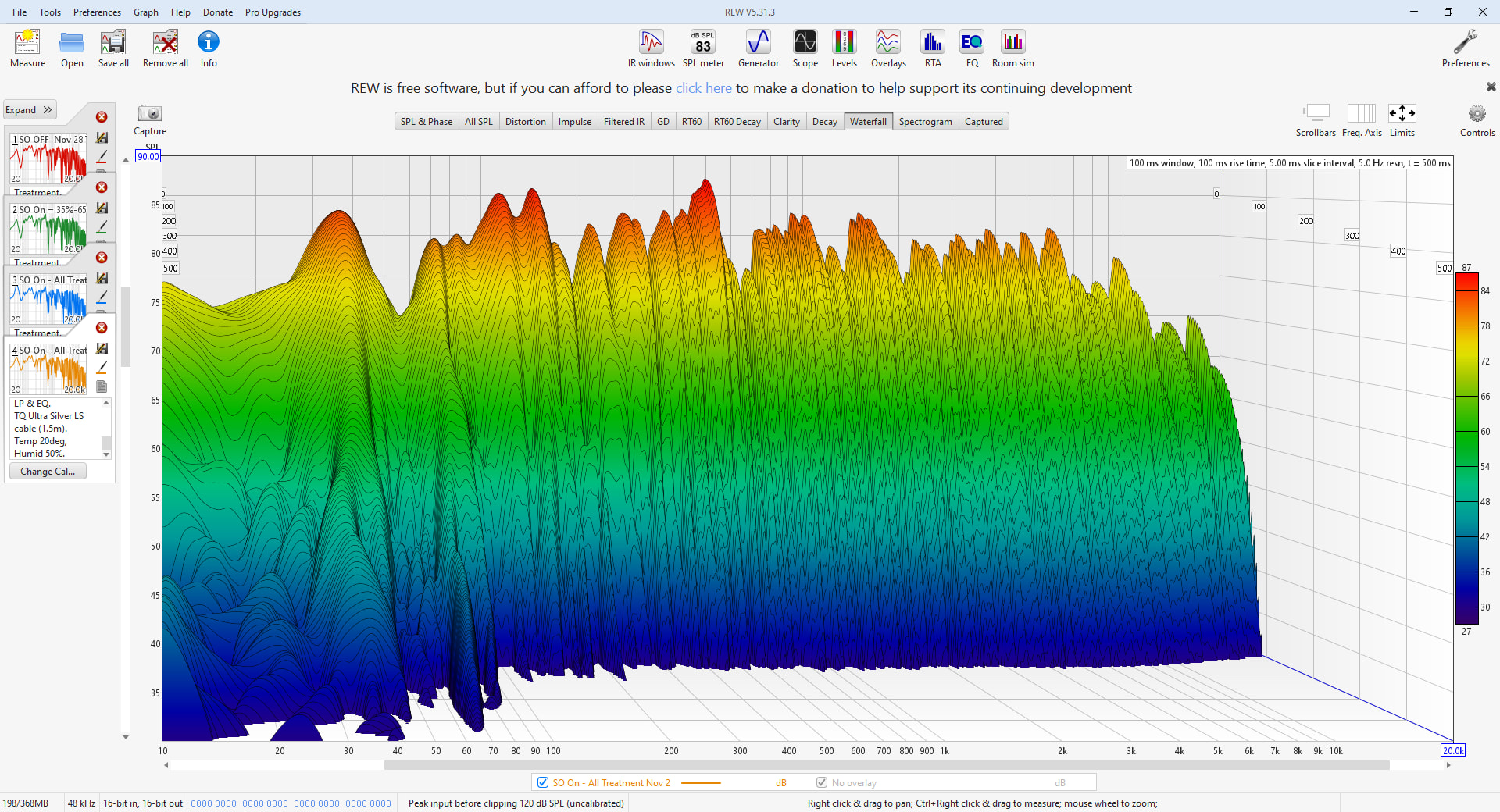
Image Credit: REW and Author
Waterfall Graph at Listening Position (1/3 octave smoothing)
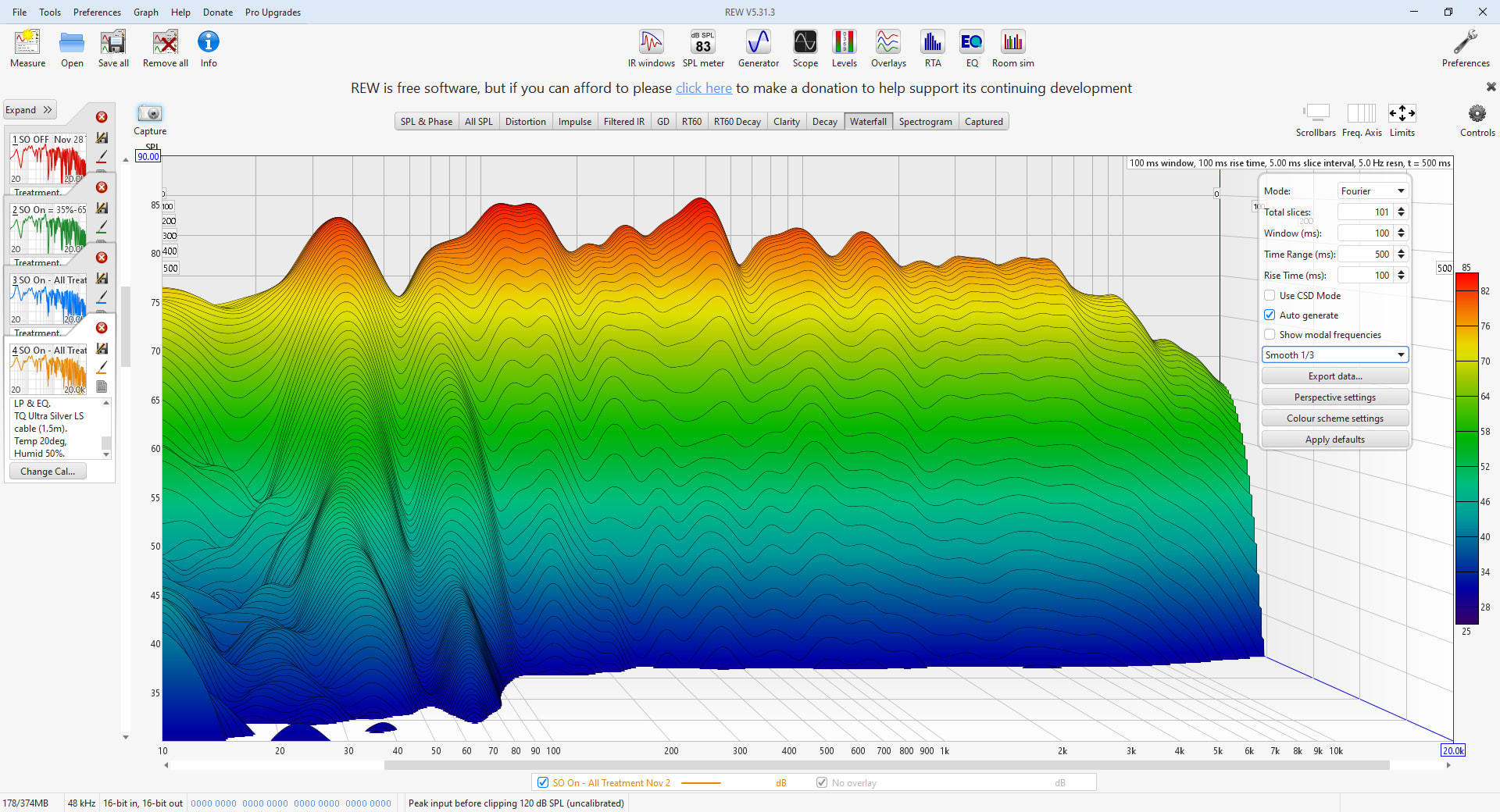
Image Credit: REW and Author
RT60 Chart…
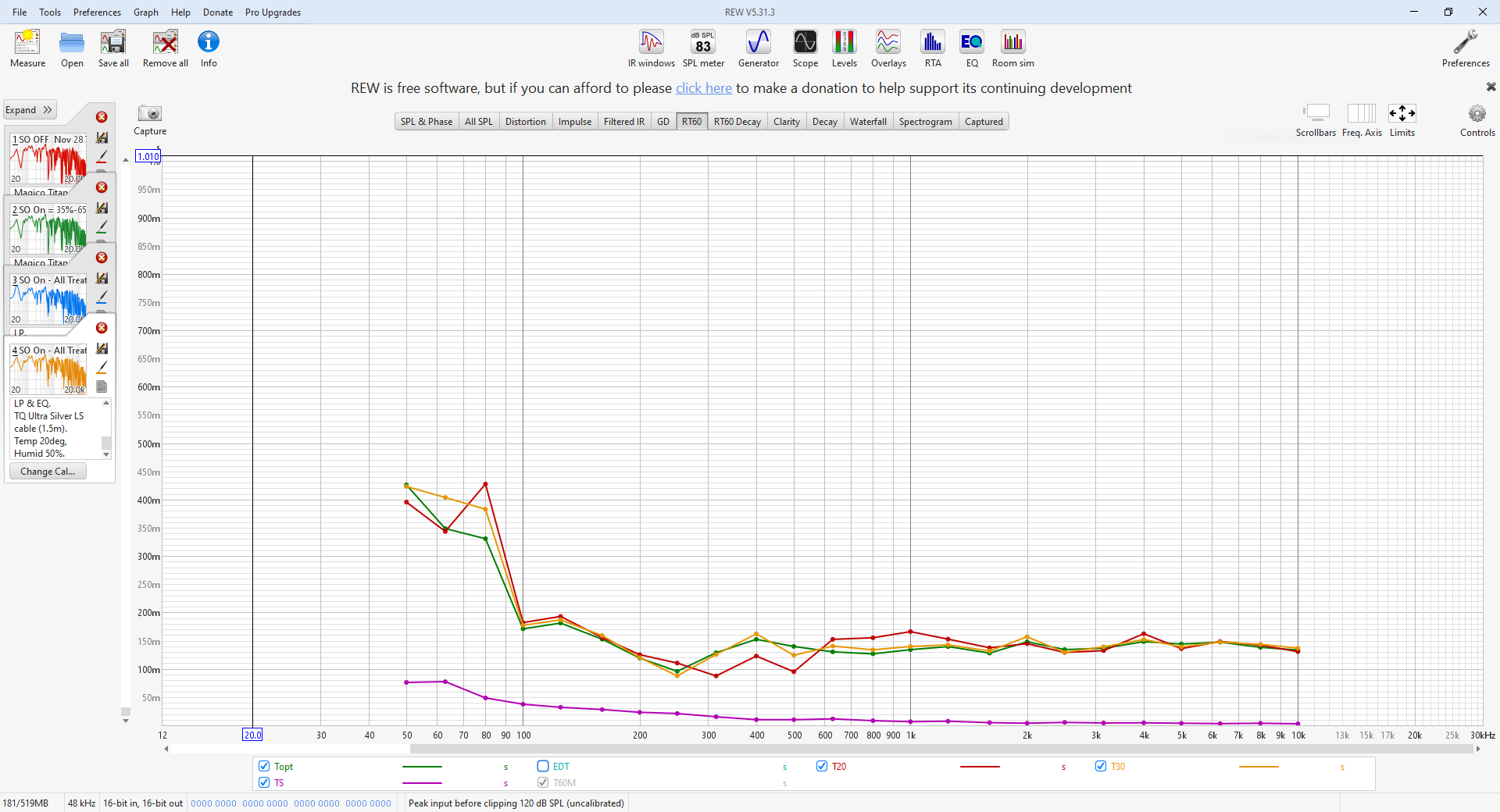
Image Credit: REW and Author
Spectrogram…
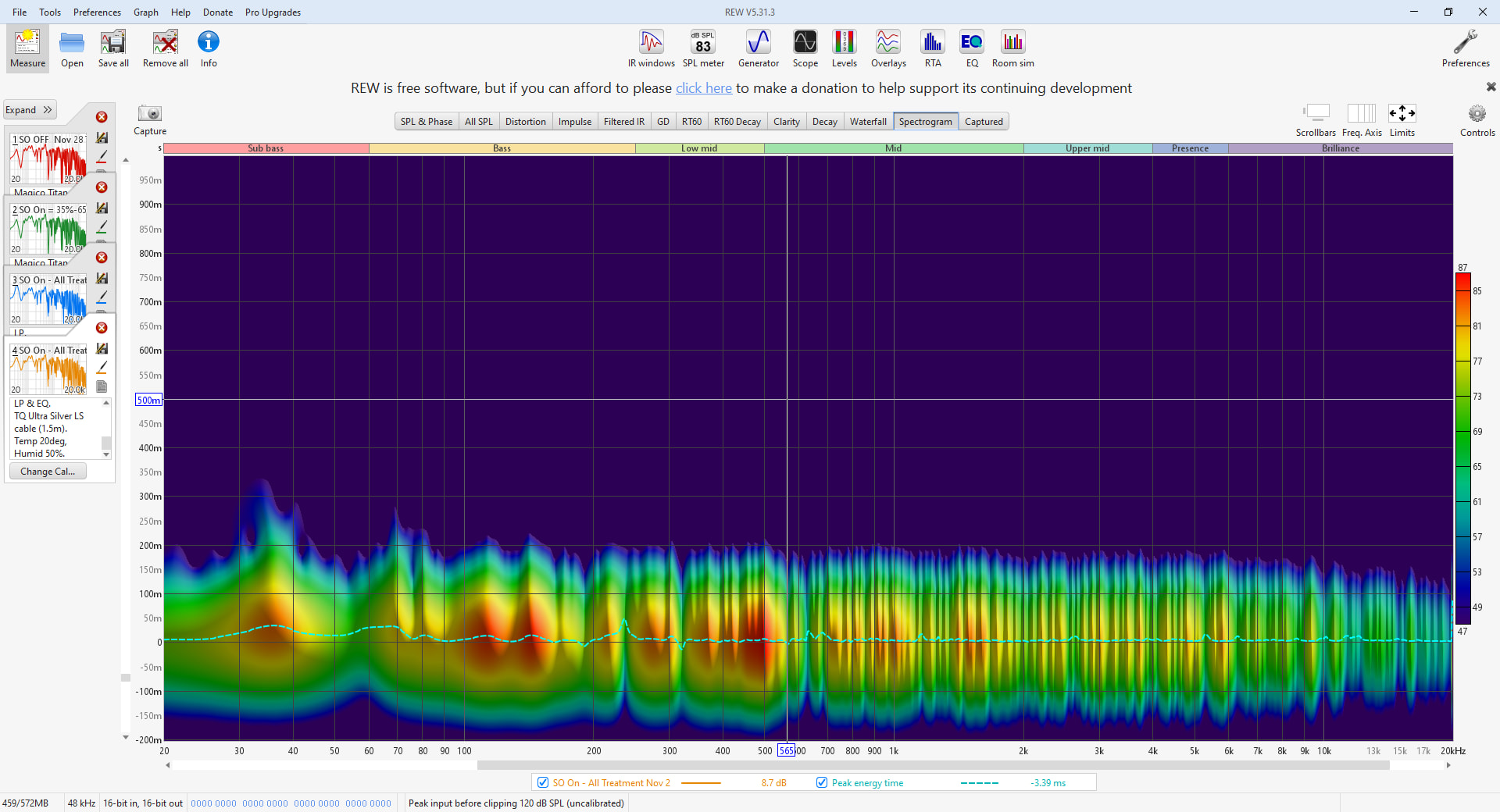
Image Credit: REW and Author
The observant will have noticed that I still have issues in the lower regions!
Which is why I am expecting to add the following GIK Acoustics products, then go back to tuning the Magico Sub Bass integration…
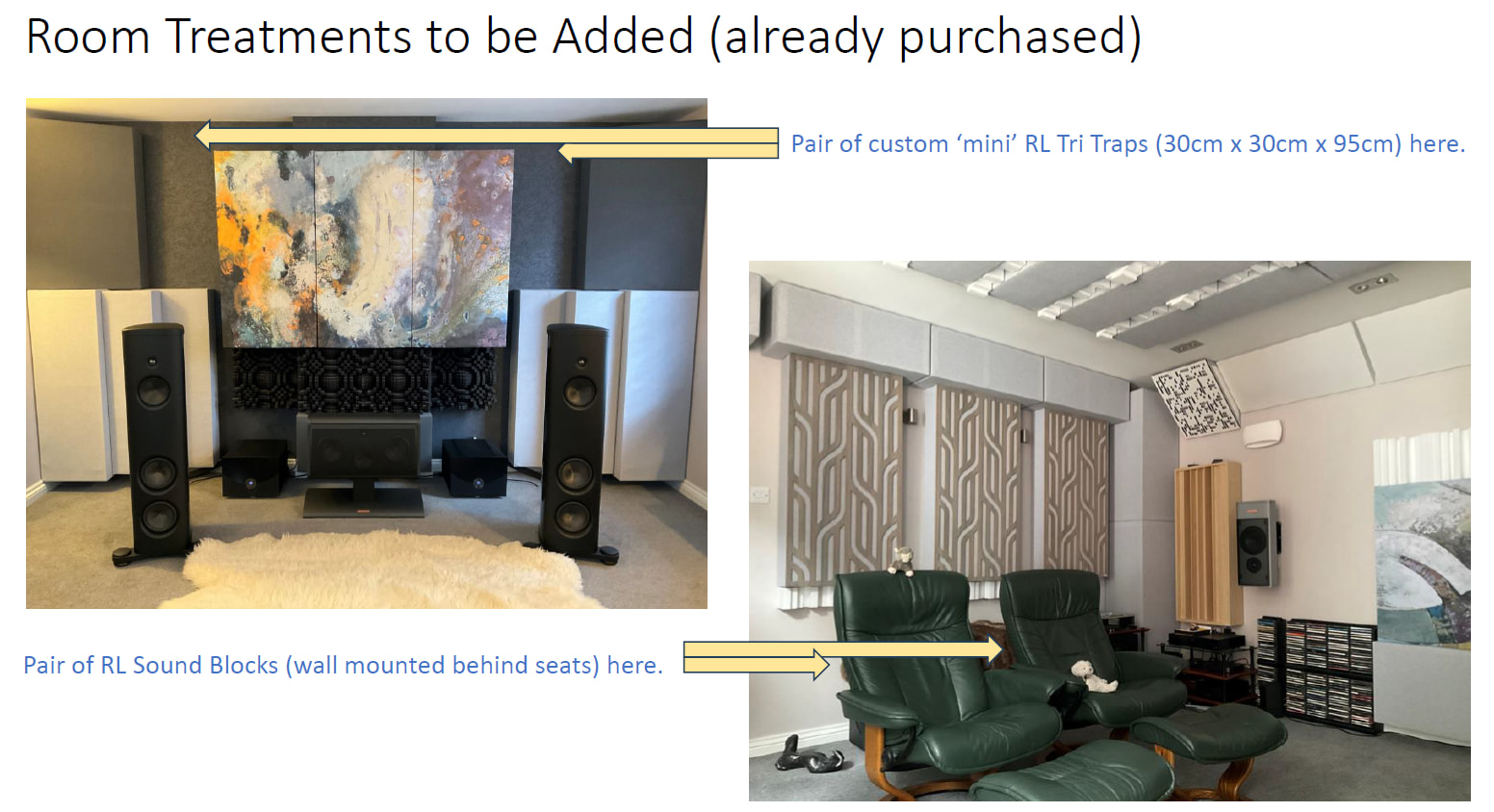
Original Image: Author provided, no reuse.
PS: There are many other view modes available in REW. In this posting I have not used the Overlay presentation tab - but that can be very helpful as indicated in the earlier posting by Mikebu here.
4 Likes
Thanks for posting those @Edmund-of-Essex. I concur with the approval of GIK’s art printing - its the first time I’ve seen in practice, and the first time panels have actually looked nice, as opposed to just being tolerable in appearance (at best!).
To put these in context, these measurements were with Linn SO on? And it wasn’t you who uses Avaa active bass traps was it?
1 Like
Very many thanks for your kind words on the GIK Acoustics Art Panels. In my art design concept (in 2018) I had initially selected two (or possibly three) ‘abstract’ forms - there were millions (well thousands at least) from which to make a selection. However there are certain limitations - some of the images do not scale correctly to fit the panel size one might choose. Then the image quality in the database(s) may be too low a resolution to be suitable for printing at such scale. I spent days (weeks even?) on this task. At one point I even tried to get a licence for a Kandinsky!
The Tryptic set covering the TV were initially designed for the left wall, with the other image (now on the left wall) intended for the sliding panel design to cover the TV. Initially, I only ordered the Tryptic wall set in 242 (2 inch) panel thickness with the specific abstract artwork. From an acoustic point of view - the panels should really have been the maximum thickness available (4" or even 6") to hang on the left wall.
However this ‘error’ later turned out to be serendipitous as the TV screen I desired and ordered was too big to continue with the sliding panel concept. Fortunately I could move these 242s to hang on the TV and remain within the weight limit of the electric mount. At that point I went back to my GIK Acoustics account to recover the abstract art for the original (centre split) TV cover design and implement it as a single thick panel for left wall first reflection placement.
Previous posting and discussion: Media Room - Art Concept design and development.
Re your question about the measurements: All the charts shown above have the Linn Space Optimisation feature turned ON. If I used the Overlays presentation mode in REW I could show the effect of Linn SO for these set of four measurements as the first measurement has SO OFF.
However (I think I mentioned elsewhere), since moving my loudspeakers and sub bass more towards the centre of the room, Linn SO has decided it does not need to do much.
You may recall that my recent focus has been the evaluation of the products I borrowed over the Christmas period: the Acustica Applicata DaaD and in particular the Chord DAVE DAC.
2 Likes
And your conclusion is still awaited!
1 Like
I’m no expert but those are some impressive looking waterfall & RT charts, very uniform! Looks like you average ~150ms RT, with area’s being as low as ~100ms. How do you like the sound of this? With some quick searching in the past, I’ve tried to figure out what is the ideal level, but I didn’t seem to get a straight forward answer. Looks like in general, the smaller the room, the lower you can go with RT’s & seems around the 200-300ms range was generally recommended for 2ch listening in a smaller sized room. That’s ~ where I’m currently sitting.
1 Like
That’s approximately my understanding too.
1 Like
Hi daren,
The various acoustic design consultancies and companies have ‘targets’ in mind for RT60 - depending on the usage of the space intended to be fitted out. For ‘musicality’, say in a living room space, a higher level of reverberation would be recommended, say 600ms to 800ms - however the important thing is to have the decay very evenly distributed across the frequency ranges, from ‘sub bass’ up to ‘brilliance’.
I started to realise the art of the possible whist planning my room. I have used a very helpful online tool - search online for AMROC room mode calculator - which enables one to visually see and predict the room modes of a rectangular room.
Below is a screenshot from a presentation for my media room where I have added text to point to the AMROC predicted room modes. If you look very carefully at the bottom of the screenshot image, you will see the words ‘EBU Listening Room’, together with an associated recommended RT60 time. The tool permits selection of other types of specification, e.g. ‘ITU Listening Room’ has 0.19 seconds as the recommendation. ‘DIN 18014 - Music’ is another selection possibility, for that the RT60 is recommended as 0.8 seconds.
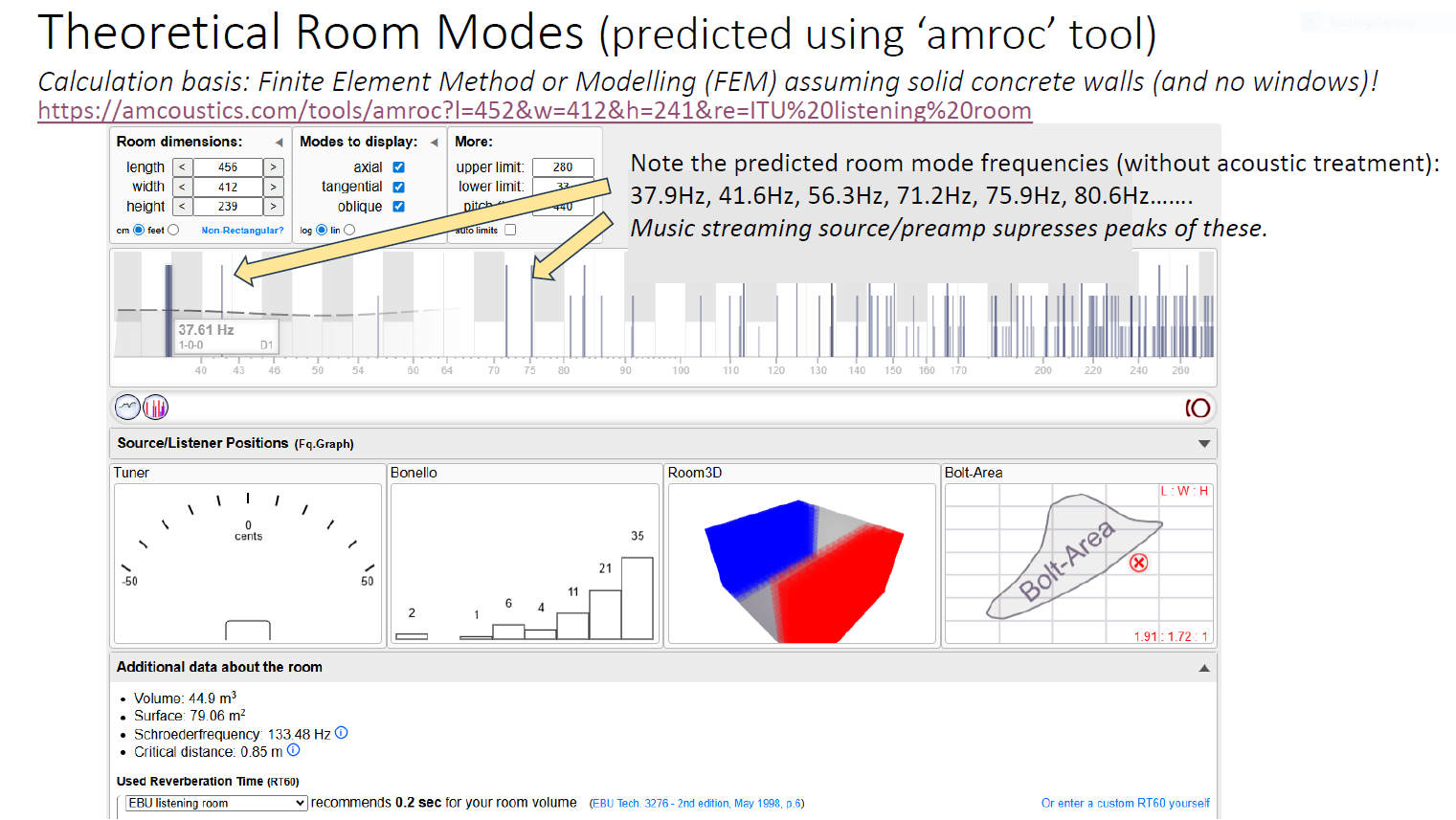
Original Image: AMROC and Author provided.
My selection of targeting the hyper-short RT60 was because it was fun to do (and I wanted it super ‘tight’ for the Cinema experience). In my subsequent listening experience any live album or classical recorded music just sound the best as what you hear is the music in the acoustic of the original recording space and not your own room!
Of course everyone has their own preference.
PS: You can also begin to see why there is nearly always some ‘suck out’ low down for smaller rectangular or box shaped rooms.
2 Likes
I have used the AMROC calculator previously but wasn’t aware of RT recomendations, I’ll have to check that out again 
What I find interesting with your posted chart, is that the room mode ~55hz don’t look that bad on the calculator but seems to be the worst offender in real life (understand the calculator is just theoretical & may not necessarily correlate to the real world as there are countless things it doesn’t account for). From my understanding, the typical worst offenders would show up as multiple room modes that all overlap/are grouped close together in the calculator, which doesn’t appear to be the case ~55hz.
1 Like
Hi daren,
Good questions:- the important thing to be aware of is that this simulator does NOT show how the loudspeakers are driving the room modes. One can control the level of stimulation of a given room mode by changing the position and toe-in of loudspeakers. The ‘point’ measurement of a single microphone (not spatially averaged) is a source of error for very low frequencies (particularly for tangential modes), oh, and don’t forget SBIR! Then of course there is the effect of the no-linear perception of sound (by a human listener) at the listening position.
If you or others on the forum want to play around with the AMROC tool, the Room3D view (third box from the left above in diagram) dynamically shows the pressure peaks (in colour) for the given mode (which you select by moving the cursor over the ‘keyboard’) and is a handy indicator to know what and where to place treatment once you get going in adding room treatment.
PS: Linn Space Optimisation attempts to mitigate the problems of microphone measurements and partially accounts for SBIR - but I think this discussion is going to get very deep very quickly and I already have set of (complex?) postings for those interested starting here.
Results now published here.
The new acoustic treatments have been fitted (left and right tri-traps on ceiling above TV)…
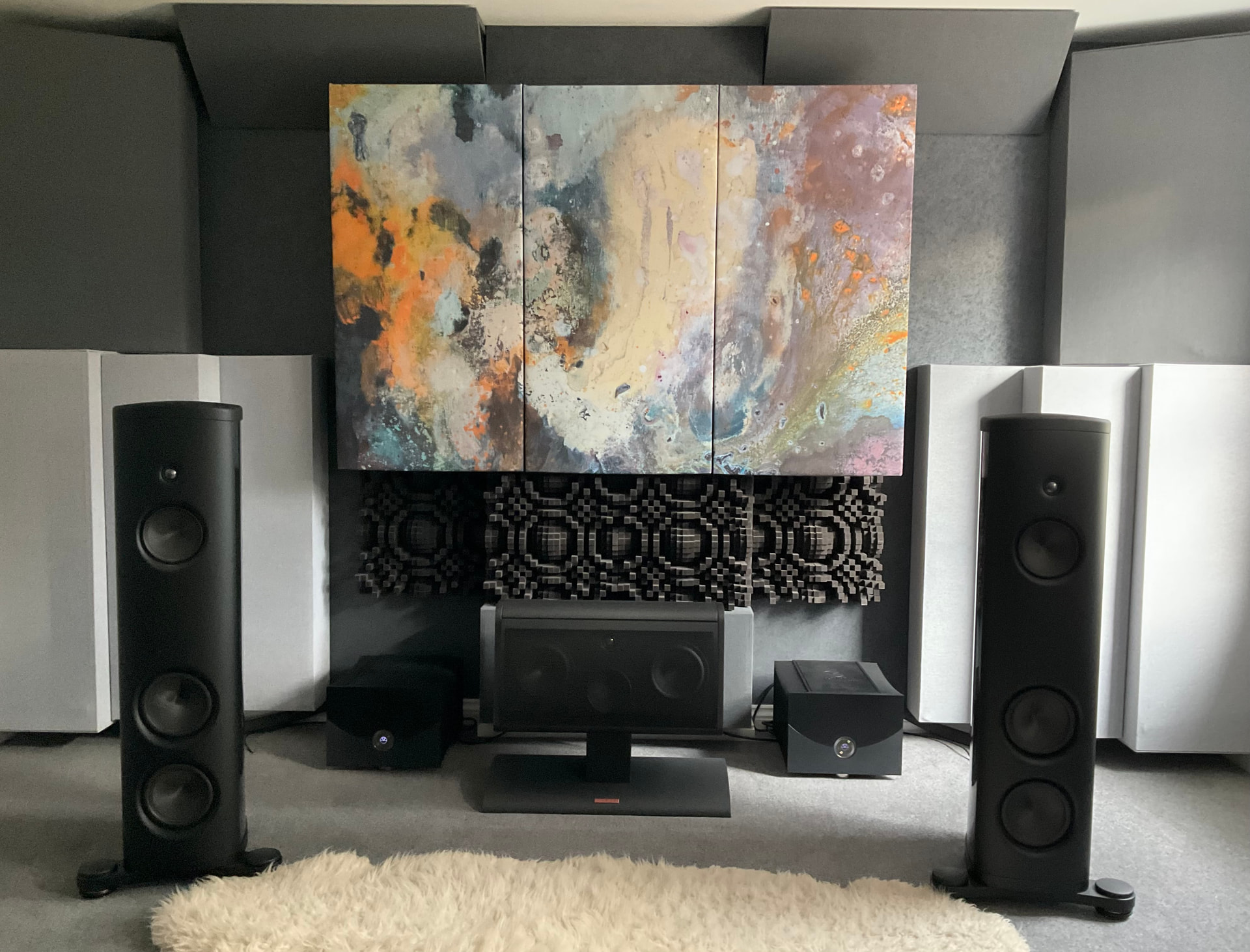
Original Image: Author provided, no reuse.
Linn Space Optimisation Room Model updated…
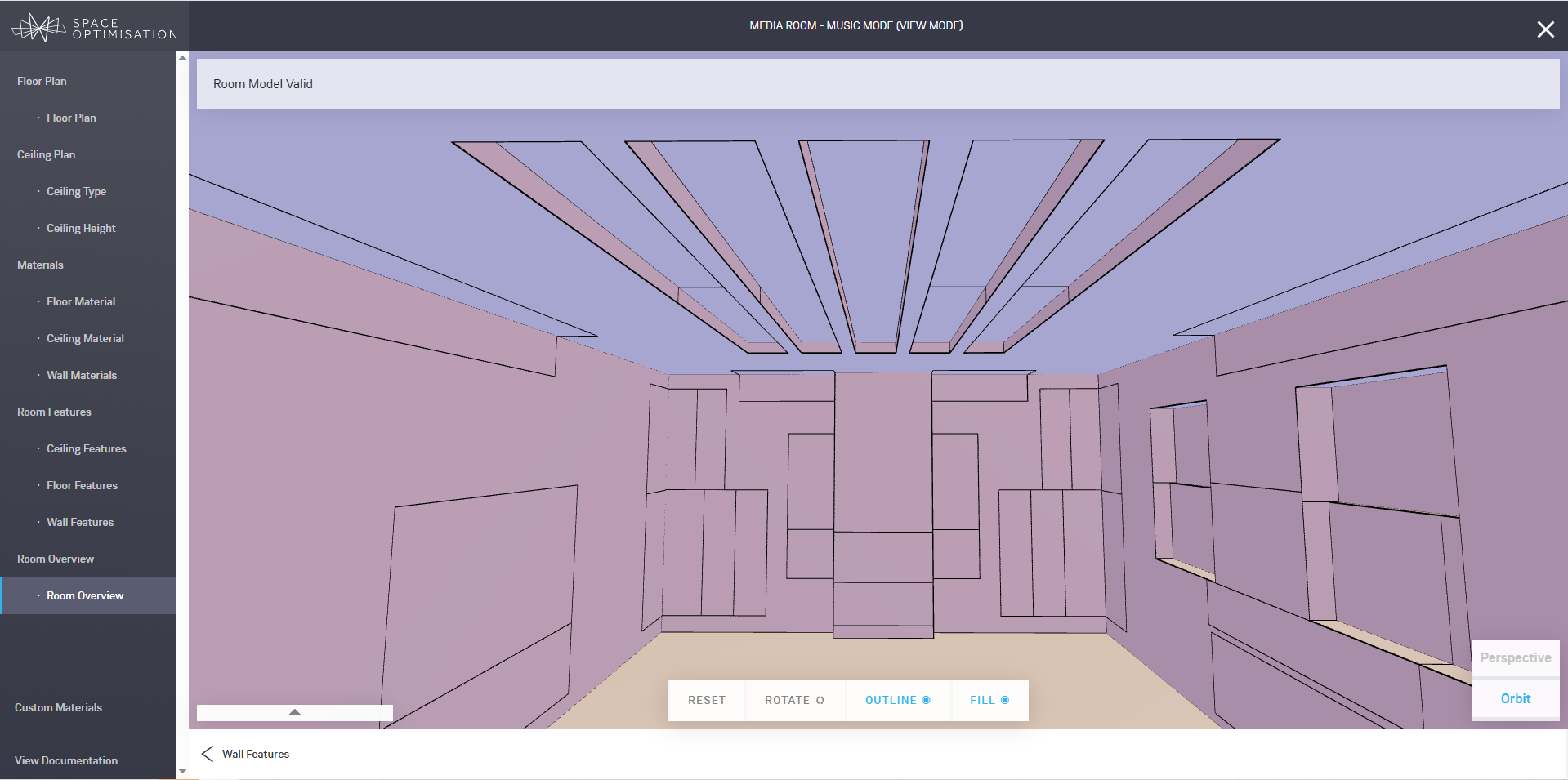
Original Image: Author provided, no reuse.
Some measurements taken…
One particular set of curves to study is the acoustic distortion at listening position…
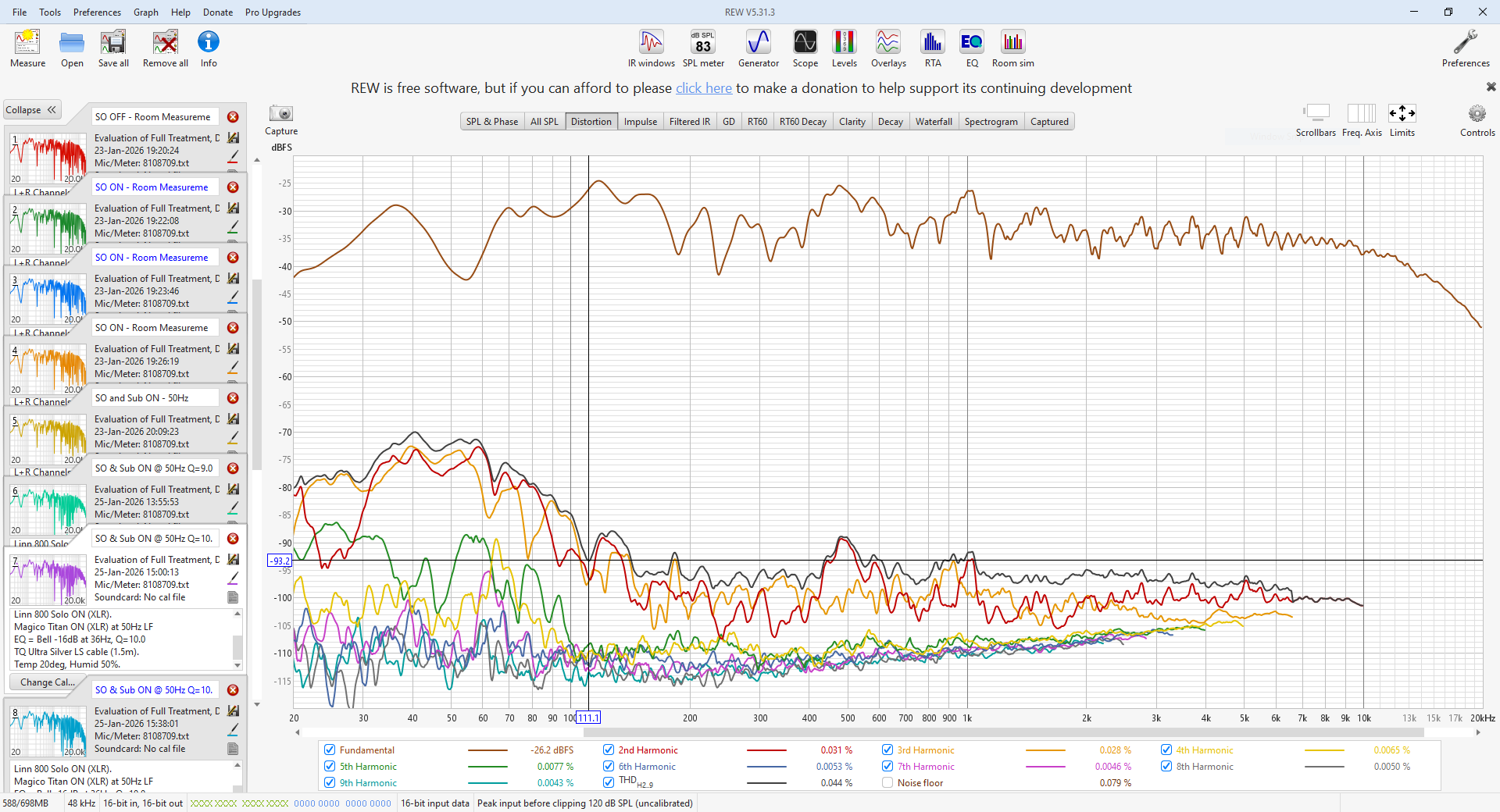
Original Image: Author provided, no reuse.
RT60 Data (note: data indicated in orange and italicised in the table are not reliable).
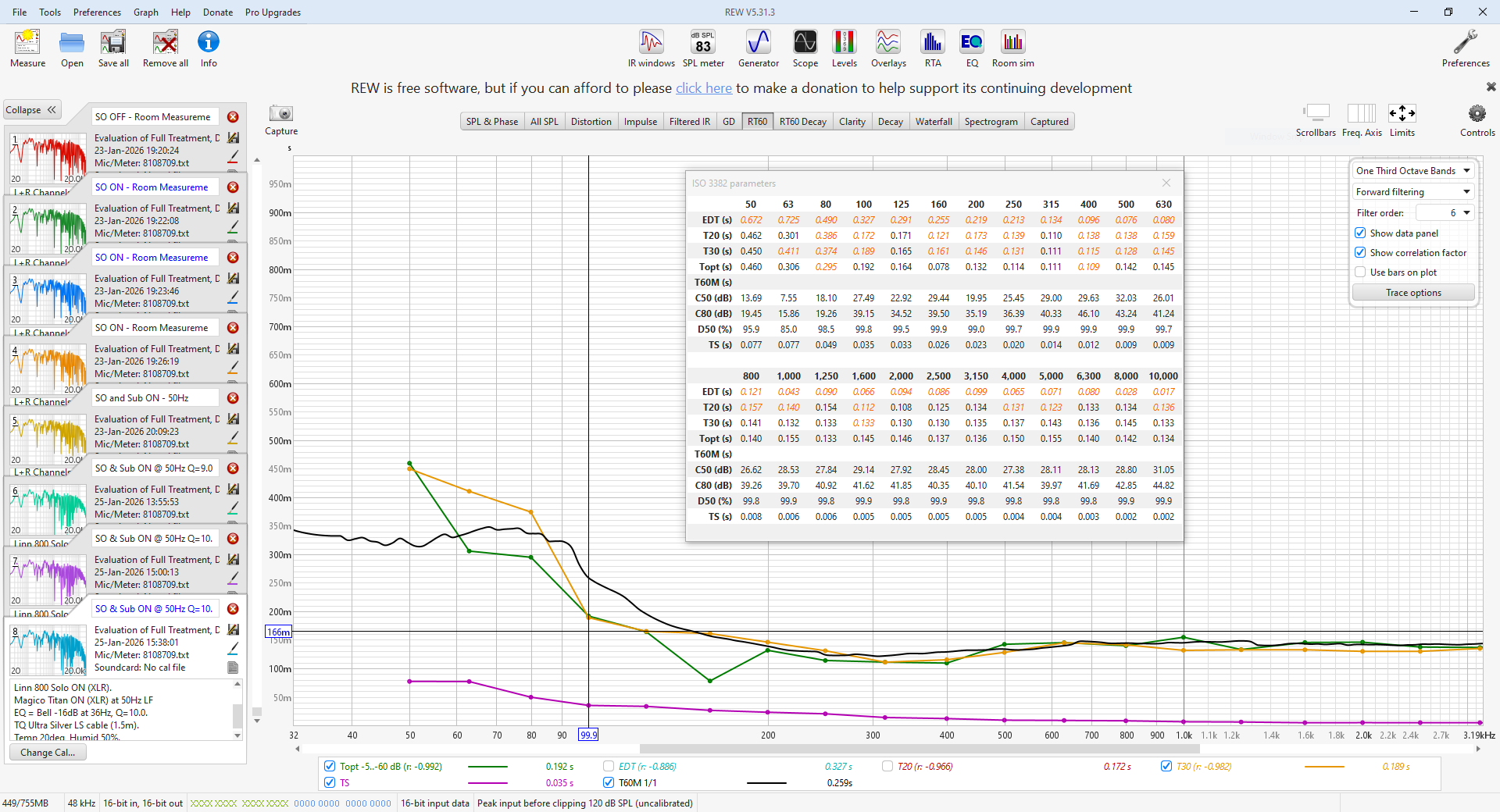
Original Image: Author provided, no reuse.
Filtered Impulse response (note: cursor is placed to indicate the second reflection from the front wall at time 26.1ms and 26dB down in amplitude after the direct music path).
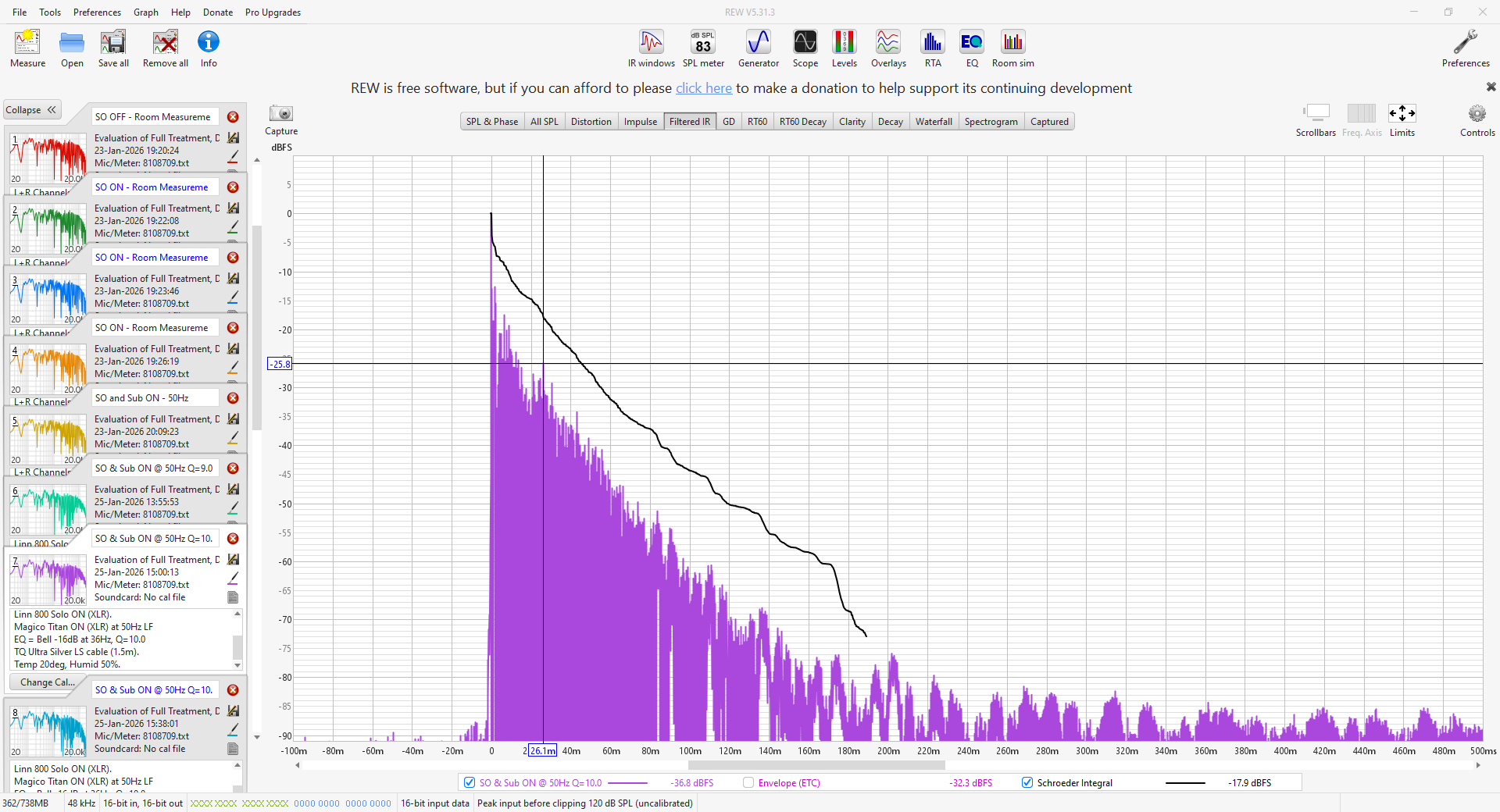
Original Image: Author provided, no reuse.
Waterfall chart (1/6 smoothing applied).
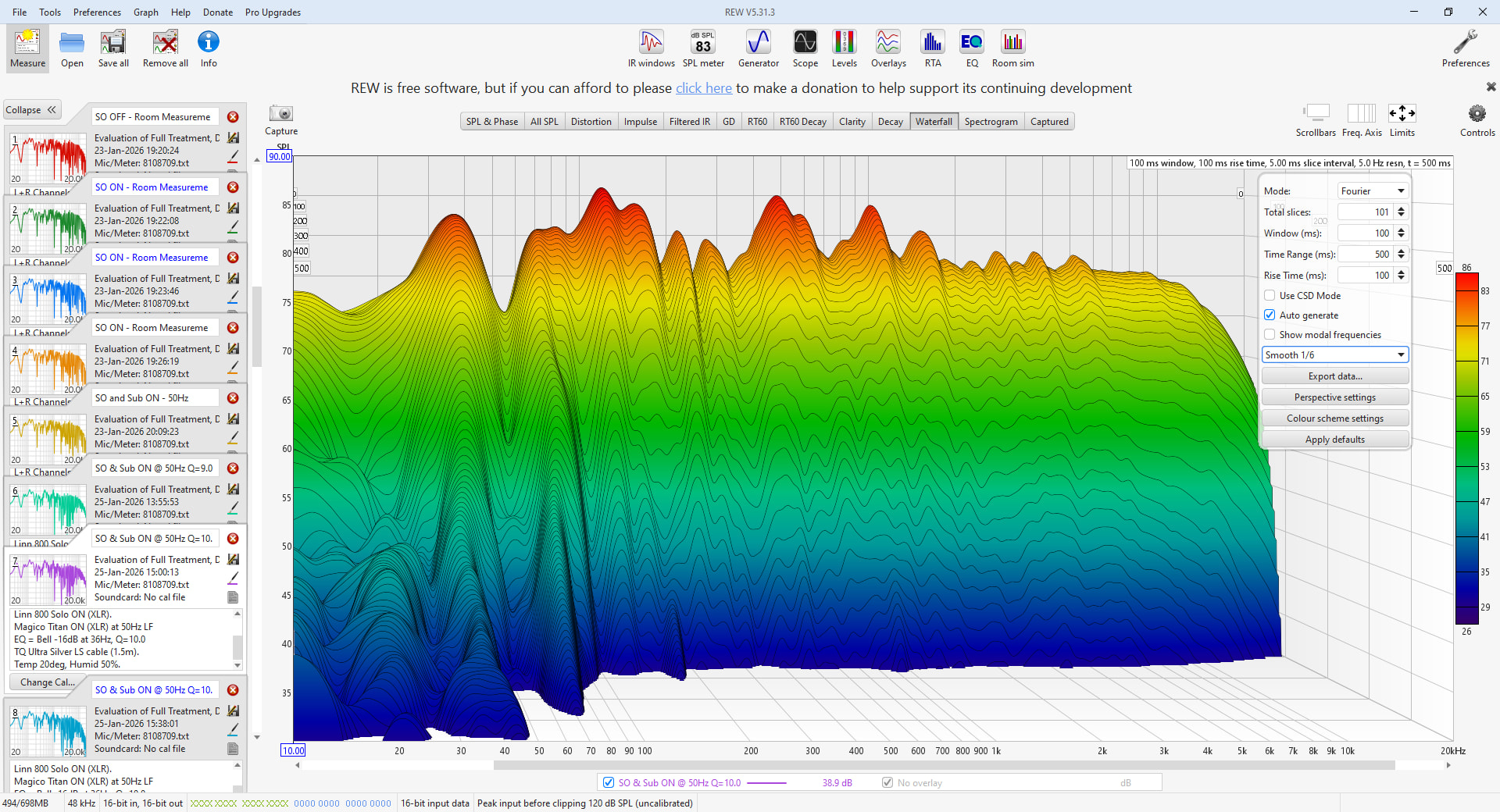
Original Image: Author provided, no reuse.
PS: The above represents work in progress.
4 Likes