Kudos to the Naim Engineers! As a Linn NG KDSM owner, I am deeply disappointed by Linn in this respect, Linn have been mumb on this very important feature. 
1 Like
I don’t want Naim to stand still. If they do they will gradually become uncompetitive and ultimately die! That is a fact of commercial life.
Naim must update their products to include the latest facilities. That currently means facilitating access to the latest streaming providers at the highest possible resolution, to provide us end-users with the best possible audio experience. Naim’s competitors will certainly continue to keep ahead and push digital boundaries.
OK, we are learning that changes to firmware required to provide us with the latest streaming resources can affect SQ. I would say this is the area where Naim need to be a little more diligent and responsive.
Not developing Naim’s streaming products and services in order to ‘maintain (restrain) the SQ to the same as the product you bought’ is a recipe for uncompetitiveness, and ultimate decline IMHO.
There may or may not (depending on your personal opinion) be a setback in the SQ from FW versions 3.8 to 3.10. Whatever your view I am certain Naim will sort it with subsequent FW releases. Such a setback is certainly no reason to cease the introduction of future functionality, and future efforts to improve SQ.
Just my thoughts.
16 Likes
Same here. I hope this means the new FW is very near.
1 Like
Have I missed something? My new Linn Klimax seems to sound good. Have Linn managed to stuff up their latest update?
Yes, you do. Linn DSM devices are not currently compatible to Qobuz Connect. So what is the Qobuz Connect, the following is a fragment from Qobuz FAQ:
“ Qobuz Connect is a feature that allows you to control music playback remotely. From the Qobuz app, you can start and manage playback on a compatible device connected to the same network (speaker, amplifier, streamer..) without relying on another app or using Bluetooth. This ensures the highest audio quality and allows you to take full advantage of all the features Qobuz as to offer. “
To me, this is the most significant feature, and that would FREE me from using Roon (hopefully), even I am an early Roon user and a Roon lifer since 2016. I bought a lifetime Roon subscription out of some sympathetic and some practical reasons, not because I liked Roon that much.
3 Likes
Apologies for diverting from the thread topic, that is all from me about Qobuz Connect and Linn.
I really agree with you here.
We should remember Naim has (like most I would say) normally done an awesome job. Slow, yes, but they seem to get there. And adding new features normally don’t affect other features - you don’t add code like e big hairball, you do it in separate modules, and you don’t execute all code all the time. You don’t listen to radio and Qobuz at the same time. Code you don’t execute don’t cause problems.
In this case some say it was changes in the a lower level common code they didn’t write in-house. No matter what the problem was/is this is often is a bad thing. You need to assign someone to adopt this code internally and not just accept it. This is code that must co-exist with how your internal code was architected to deal with noise levels etc. Add to this that management often believe code you buy in can be treated as a black box.
The trouble (or advantage really) with a music streamer is most data don’t need to be encrypted when you move it around - that is the actual music bits.
I have no idea how Naim architect their code and honestly don’t really care about their internal politics vs. Focal. I am retiring and happy to leave all that kind of sh*t to a new generation. There are so many ways to solve just the noise/emi issues. But don’t make it worse by adding more testing-levels or adding end-users into this more than as judges of the end result (I’ve seen that kind of demands earlier in the thread) . In fact software problems in these kind of environments are often better solved by removing people from the project.
10 Likes
I read elsewhere that people are playing with Connect to Linn… But no verification on it.
I was given info that yesterday’s roll out of Qobuz Connect was a soft launch and that the official release (incl press) is planned somewhat later.
I guess that High End Munich 2025 is the most logical and ideal moment. And it would probably be an ideal moment for Naim to roll out new firmware as well. But all just thoughts from my pondering mind.
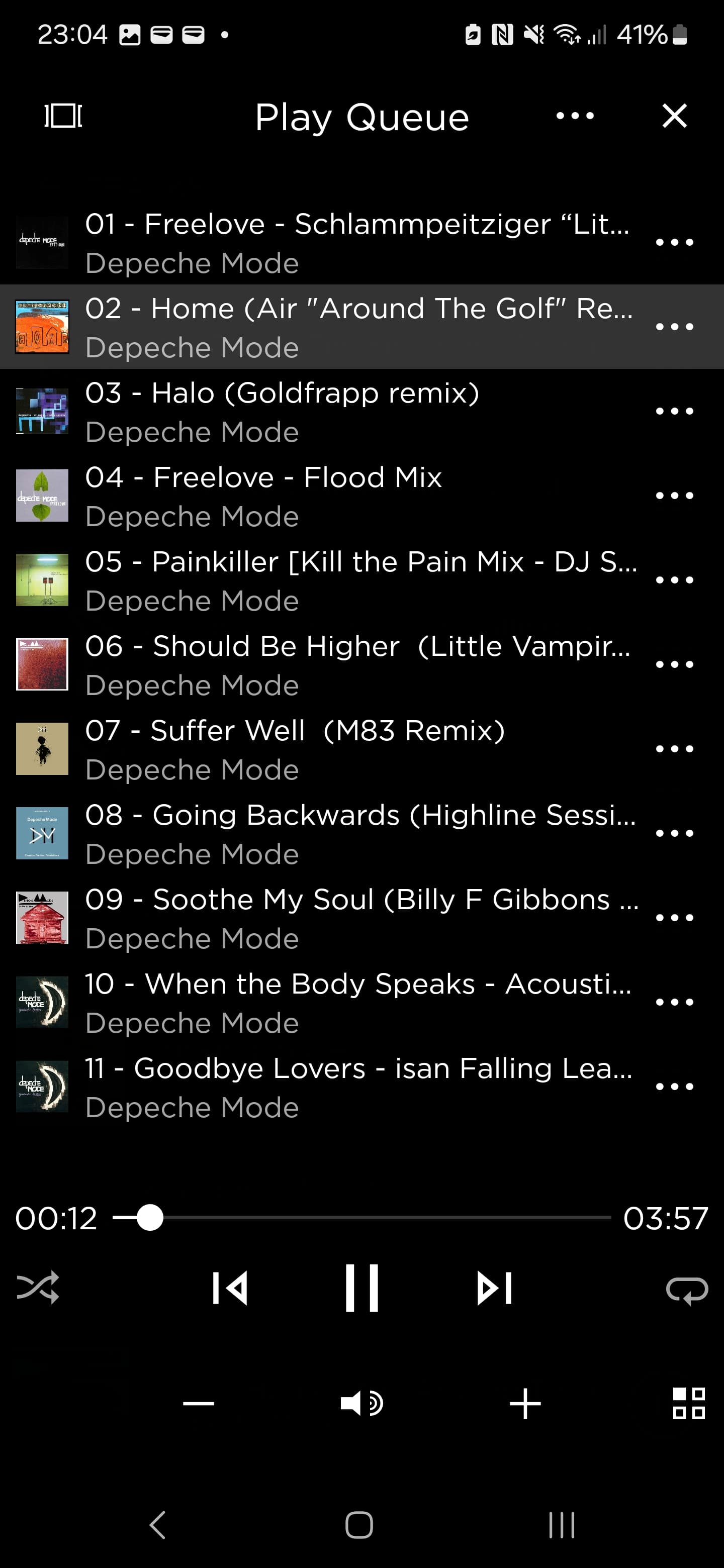
Very much reminds me of London Grammar, D…which is no bad thing!
DM retain a dark gothic edge which sets them apart. DG is a great front man…one of the very best bands both live and in the studio, although @Cohen1263 , my fellow Canuck Neil Young also takes some beating👍. Unfortunately never saw him in his Yorkville days but the Psychedelic Pill tour gigs were awesome.
Sorry for the thread diversion folks,…back to being Unhappy!
PS: A few more to try D…
2 Likes
Thanks so much. Looks like the sound software is good, just that the new app feature does not mesh with Linn. I’m happy with the Linn app’s interface with Qobuz so all is well. Sorry all for thread diversion.
3 Likes
I think that this is a point which is really important (it might have been made already, but I’ve only been dipping in and out of the ~5500 posts, because while my ND555 is maybe missing a bit of the sparkle it had at its best, it’s still really enjoyable to listen to. And I can’t but help that maybe what I’m hearing in sound signature is me subconsciously buying into the collective hysteria. Or more likely that it’s not been very sunny recently, so the blinds have been up, and the room is a bit more reflective sound-wise.
Anyways, back to the point. We know that Naim uses core stream code from the streaming board provider. And we “know” (believe?) that the “tuning” for sound signature relies on tweaking some of the processes that run across the entire streamer. One of the downsides of providing a device that relies on computing is that you have to keep it up to date - either to address vulnerabilities and bugs, or to provide new features.
I suspect that Naim is stuck between a rock and a hard place on this - they have to upgrade the streaming board core code, because the old ones are becoming deprecated (unsupported), and they have to maintain feature parity with competitors, because otherwise no one will buy the product.
And in doing so, they move away from the parameters that have allowed for the sound signature to be tweaked.
I love my Naim system, and are somewhat fond of the company (having been a customer since my first system in '96), but I very much don’t envy the job that the product and software teams have at the moment.
8 Likes
I am not sure how to read that chart correctly, but it looks like the new firmware (@ 44.1k) has an even phase, while the older firmware goes lower the higher the frequency gets?
So does this mean the older firmware rolls off at the very high frequencies?
This would be some extraordinary difference for just streamer board firmware.
1 Like
True. Connect is a significant and beneficial feature. Eager to use it. But Qobuz could improve its app to make this even better. My No. 1 gripe: When you view “albums” by a particular artist, you are greeted with a mishmash of listings, including many separate tracks, a.k.a. singles. And very often there is no discernible hierarchy in the so-called albums they present. IMHO.
5 Likes
Hello Agisthos,
The amplitudes are pretty linear in both new and old FW, there is no roll-off in amplitudes. There is only difference in the phase/frequency at 44.1 sampling rate (in the remaining sampling rates there is no difference). Whether new phase and old phase are both linear is hard to say from this frequency log scale. They are just different. However in the group delay graph you can see that the new one is more linear than the old one.
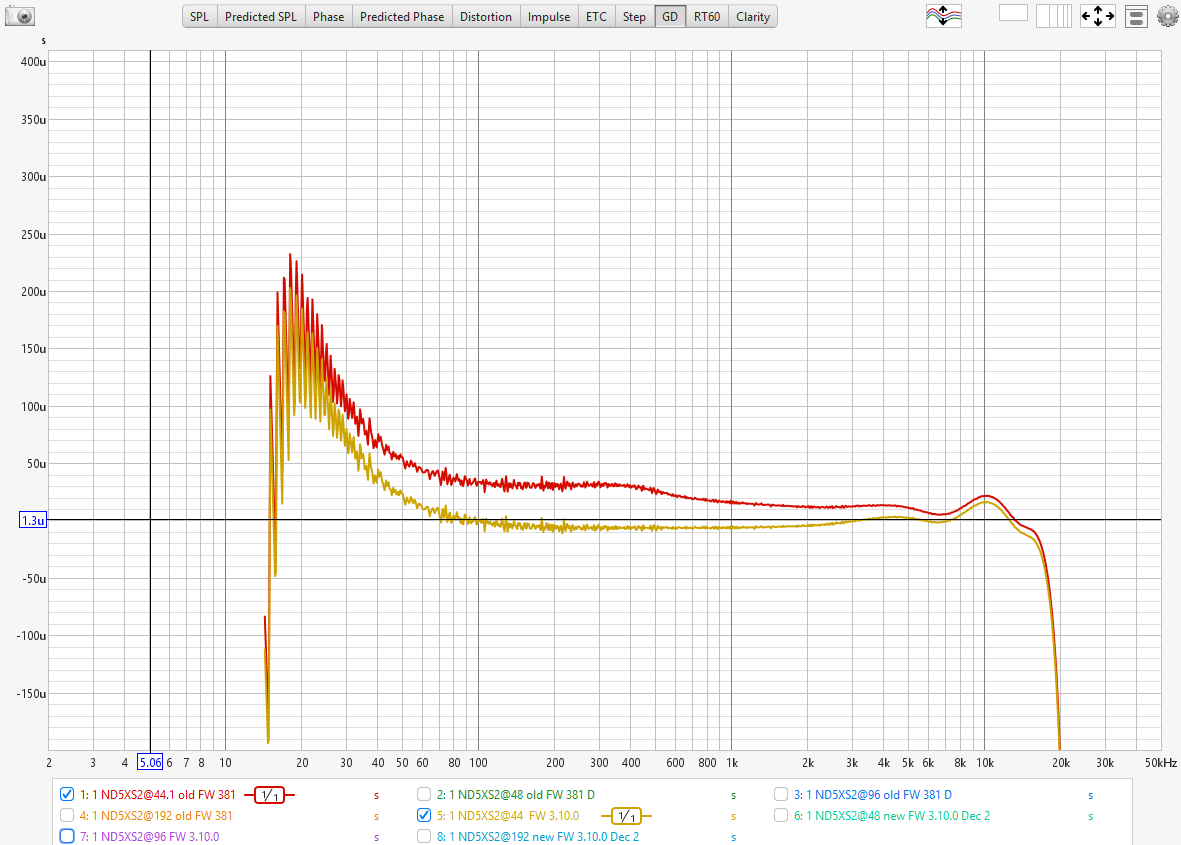
In the pre-update group delay the mid was leading , now the HF zone is marginally leading. I personally think this is the reason for the different experience among different users and if that is indeed the reason, there will not be any fit-all solution, but to leave the option for users to use one or the other FW.
There is also a moral hazard here. Most of us spend a lot of efforts to combine all the different elements of a hi-end system, that together fit well and then an update changes something that effects the overall SQ.
6 Likes
think miss-interpreted the changes, but bottom line is the same. …
Thank you for all your measurements and analysis. Very interesting and much appreciated. By modifying the relative phase of the mid and high frequency drivers, wouldn’t that change the acoustic center? Steering it up or down vertically, assuming the drivers are stacked vertically?
I would tend to think that, in an attempt to render the music natural, the midrange should be leading, as the great majority of the music is there.
If the high frequencies are a bit leading, it’s like pushing them. This often causes sharpness and shrillness.
1 Like
Whatever the ‘problem’ is I think the difficulty they have is that it’s not what we’d conventionally consider a software bug which can potentially be identified and corrected but something much more nuanced and unpredictable.
As for communication I bet many in the software/development teams are itching to be more open but they are probably not in a position to do so simply due to current corporate policies. I suspect most of us here would just prefer ‘warts and all’ honest communications but there may be very good reasons for companies not to do so in this day and age.
They equally can’t promise something which doesn’t have a straightforward timescale for resolution, though personally I think the priority should have been on getting disgruntled users back to a preferred sonic signature. It’s a difficult call though as software development resources are probably finite and if there are new features requiring implementation to stay competitive (desirable though not essential I suppose for existing customers) it would be wasteful of resources and beta testing time to have several releases when ultimately a more substantial one is needed, especially if a release to address sound signature is then messed up by adding new features.
10 Likes
You have it in a nutshell Alley Cat
2 Likes