And if you do, it’s cloudy and yellow. Quite horid!
As Richard said, normal as just read it in the manual
Also i did think ripping CD’s was a boar, well i think cleaning records beats it, thats enough for me tonight, but surprised how much some records turn the fluid brown, going forward i think i will clean all my popular albums and then just clean the rest as i want to play them.
Also invested in some nagaoka anti static sleeves, got to say the shape of these are much nicer to use than the mofi ones that just crease up when you try and put them in the album cover
2 Likes
Told you so 
2 Likes
Thats why i tried some, great advice thanks
How nice. Glad it was helpful!
Are they the U shaped anti static sleeves?
Yes, swapped over my mofi ones for these now, obviously cleaned the records first
1 Like
I bought an AT 6012. Seems to work reasonably well (although I can’t compare to a proper cleaning machine). Main issue I have is that I figured I’d do a record when needed, yet the fluid evaporates, so I’ve ended up using a ‘dose’ per record.
Thinking of buying a machine to just do more at once, and be done with it. But, my first thought was ultrasonic yet they seem unpopular in this thread. Did anyone consider an ultrasonic? Or why did you go with a Vacuum type?
I have an Audiodeske and a third share in a Prodigy. The latter, because I was not willing to pay the stupid sum for the Audiodeske 7 inch adaptor and I have more 10 inch than 7.
The other shares are relatives with a large collections of 7 inch.
The Audiodeske is expensive, has a small footprint and you can put a record in and walk away. It is noisy, definitely not a clean one as you listen to one that I have seen some write about. I bought it when I bought a Transfiguration Axia and the leaflet with the cartridge seemed to suggest at least a doubling of stylus life. The sonic results were obvious and in all but a couple of cases the removal of static is a bonus.
I find the Prodigy fiddly, possibly not helped by arthritic fingers, the need to put the rubber locking collar on, manually apply the liquid, spread it, place the arm, stand and watch because on about 15% of records it seems to skip or need the nozzle adjusting, get too much liquid on and it gets flung off the edges. Some records, depending on the way the edge is finished, liquid runs under the edge so needs blotting before putting in the sleeve. Perhaps I am sensitive, I don’t find it particularly quiet.
Bottom line? They both work, I would not be without a wet cleaner. It may be that as I bought a beta Prodigy current production is better. The Audiodeske wins for me because I was in a position to afford it, does both sides at once and I have not found any of the alleged deposits because the bath is reused.
For anyone else, it depends on budget and priorities.
3 Likes
I have a cheap Chinese one from the bay, from Douk Audio. Basically a regular commercial ultrasonic tank with a spindle & motor assembly screwed on top. I find it great and posted about it in the “Ultrasonic Record Cleaners” thread. I need to base clean my whole collection and its ability to clean 6 in one cycle is great, together with the lockdowns I made great progress and already did 800 or so, 200 to go.
Once this is done, a quick clean is what I need, so a short while ago I pledged for the HumminGuru ultrasonic on Kickstarter, which was a big success and made 3 times the limit. Should become available in summer/autumn. See the “Ultrasonic Record Cleaners” thread and/or google for HumminGuru.
A friend has an OkkiNokki and I much prefer the way ultrasonics work but there is much angst about ultrasonic on this forum
I was indeed looking at the Chinese ones like that, from AlieX. Thanks for the endorsement.
I saw the Humminguru, but too late. Pledging had already closed, so will have to consider once available at which point I think cost might be inhibitive when considering shipping and duties and taxes. We’ll see.
If you get a Chinese one, get the slightly better tank with a temperature dial and a drain valve a the bottom. Makes life a lot easier.
I spent hundreds of hours inahling fumes on a knackered Keith Monks machine cleanibg thousands of LPs for customers. Never again.
And yet even after reading this thread, I’m still none the wiser on how to deal with 150 LPs coming my way that need 50 years of muck removed from them without buying a large or expensive machine. Do the $100 hand crank cleaners actually manage to shift mold and cacked dust without a vacuum thread arm?
1 Like
I looked at them, the likes of the spindisc cleaners, for me the fact that they all spin in the same dirty water and then having to put them on a stand to dry, was enough for me to look elsewhere.
I wanted a system that i could use and straight away play the album, plus the fact that that these suck he crap up.
1 Like
Thanks Dunc. So, with just 150 discs, but in bad shape, unless I’m of a mind to spend a lot on a machine that I don’t have the space for anyway, I’m basically up the creek is what I’m hearing.
I’d assumed wrongly that I could drop these off at a dealer and and get them professionally cleaned. Since that was so common in the UK. Sadly it is not at all common here. Nearest place is 700 miles away and looks shady.
Well you could try getting some good cleaning fluid and brush, give them a good scrub and then spray them down afterwards, this might work ok, as its not much different apart from the vacuum cleaner sucking up all the water?
One other thing to mention, since cleaning the record, it hasn’t even tried to lift my felt mat on the P10, that alone is a bonus as this was a pain and was starting to look into different mats, that i dont really want to do
1 Like
Hows your DIY skills? I made my own, it was dead easy, 4 sides from MDF/plywood, a base of similar and a perspex top with some bracing underneath to stop sagging. An old vacuum motor, a 12RPM motor and finally I got a machinist to turn a simple clamp for the records. The suction arm is simply some 3/4" waste pipe, some bends a slot and a replaceable pad of velvet to contact the record, a few bits of flexible pipe for a drain. Total cost about £40 and about 4 hours work.
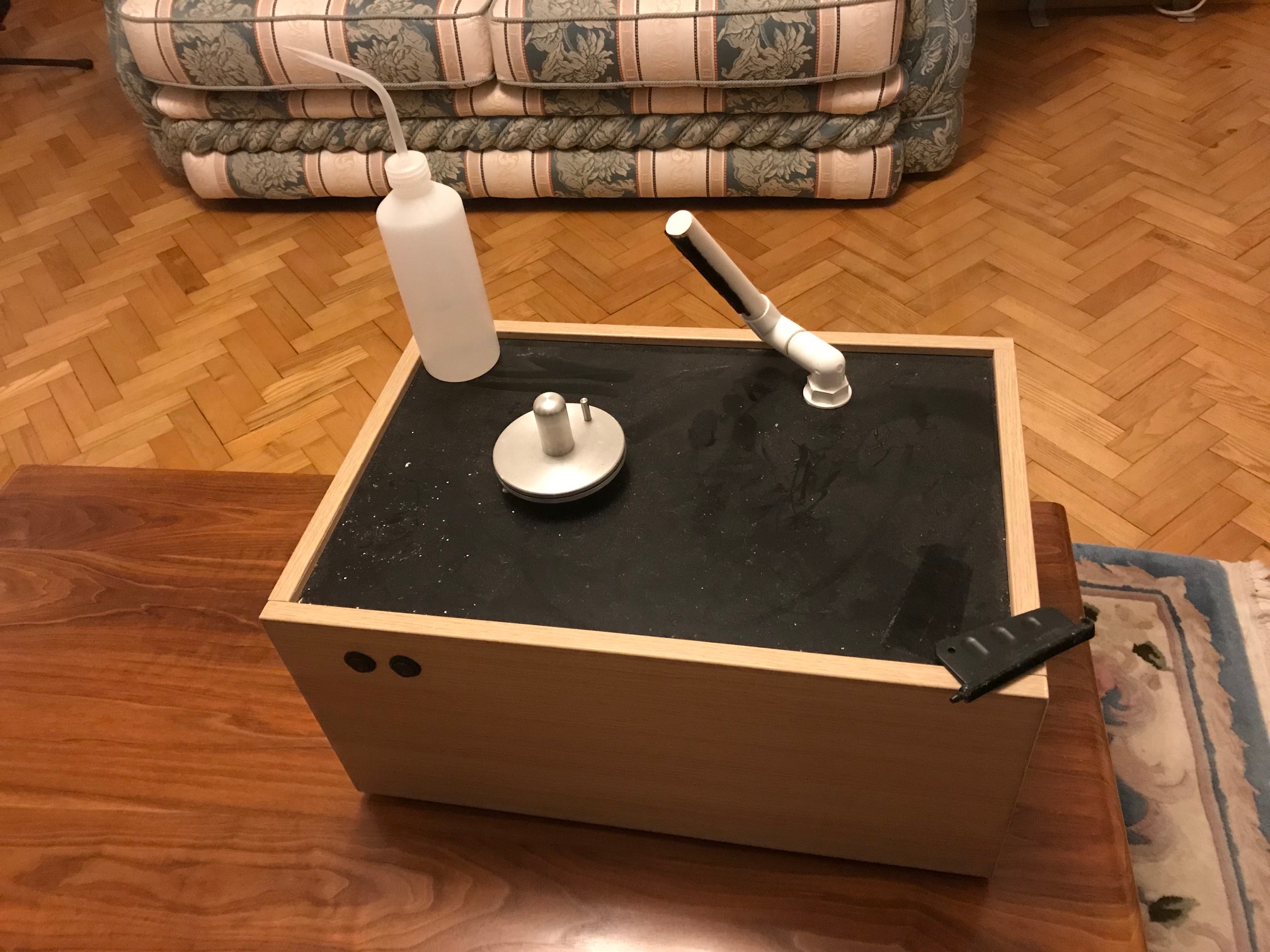
12 Likes
A source of very good water for RCMs are shops selling marine aquaria, they require perfect water at 0 TDS, it’s made by passing through filters, a reverse osmosis membrane and finally through deionising resin. It’s way better than distilled or what usually passes for deionised water. I have my own RO/DI filter for my fish tanks but they only cost about £100
Unless it is related to wiring and soldering, they’re rubbish Colin. Rubbish. That up there looks like 40 hrs of work to me and about of $300 worth of tools I don’t have.
1 Like
Get someone to cut the wood, screw it/nail it together, the rest is just cosmetics, gaps can be sealed with silicone, the important thing is function. If I remember the cost of mine was about £30 but that was 10 years ago, the wood and perspex I found for free. The only tools you’d need would be a screwdriver, file, and a drill