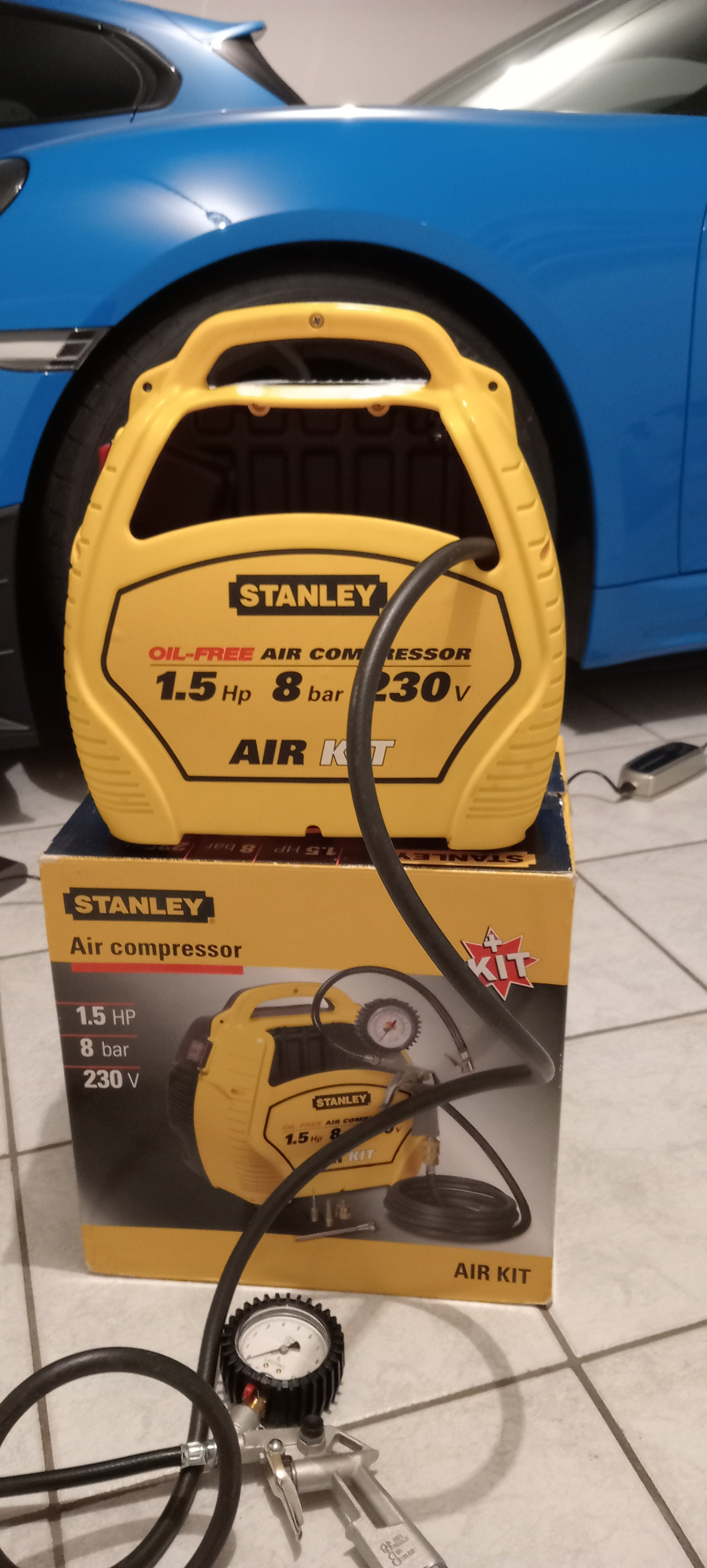
I have a £26 electric pump I bought on Amazon that does the job a lot quicker than my old foot pump. Keep it in the boot but also carry a separate pressure gauge as I don’t trust the ones on the pump.
Halfords £12 foot pump with separate pressure gauge for me. Works a treat !
I have the Makita one. I already have a rake of their cordless kit so it made sense.
It lives in the boot of my car, being pressed into service roughly every month to check all three vehicles. There are four leds on the batteries (activated by a button) and when one goes out I swap for a fully charged battery. As said they really hold their charge well.
Our son has an inflatable kayak and, with a suitable adapter, has used the Makita to inflate that.
Willy.


I have just jumped back into my employers company car scheme, which needs to be an EV, been driving EV’s for a few years now so comfortable with that. The car I have chosen has been given a build date of April 2026. In the meantime the company that administer the scheme has to provide me with a like for like car to the one I’ve ordered, I have ordered a Mercedes EQE. They emailed me saying they don’t have anything available similar, would I be ok if I could use an Audi RS GT e-tron for 5-6 months. After around 12 seconds of deliberation I accepted  . It’s being delivered on 1st Dec. Library photo off the net

21 Likes
Hold on to your hat! The RS GT is an incredibly powerful car and, I imagine, quite addictive!
Peter
1 Like
Hi Peter
I’m thinking I may not want to hand it back when my ordered car is built.
3 Likes
Remember the manufacturers recommended pressure is at 20C tyre temp. I allow 0.1bar per 10C temperature change so for example, if the recommended pressure is 2.2bar but it’s 0C, inflate to 2.0bar. If its 30C, inflate to 2.3bar
There are accurate calculations to get the exact pressures vs temps but since neither my thermostat nor my pressure gauge are calibrated accurately, and the manufacturers number is a ball park number anyway, I find that is close enough and it’s easy to remember.
1 Like
I rarely have to put air in any of my tyres (and one set of tyres is 20 years old  ).
Are people losing pressure on, presumably, modern rims without an obvious reason?
Thanks for the comments.
Yes, we are sure it was the drop in temperature. I know that I did a tyre check a week before the event, so the tyres were at 33 psi on a Dunlop gauge. Dearly beloved had actually written in her diary “wow, November and 15⁰”. We had gone to a garden centre in a valley on top of the Cotswolds, the car said it was 2⁰ as we pulled away, dropping to 0⁰ when we got to the top above Nailsworth. Strangely the pressure sensor tends to activate after about 2 miles into a journey, hence saying that an inflator has to be portable.
We used to have a Lidl plug in, but found it to very slow and the instruction were clear, a duty cycle on two minutes on, ten minutes off. At two minutes it was too hot to touch comfortably.
The reviews of generic relabelled plug ins, on line seemed to variable ranging from best thing since… to burned out the first time, when the pictures appeared to show identical units, hence looking for known names.
I would agree that a foot pump and guage are good, sadly the knee and hips are not and to complete the picture, dearly beloved has rheumatoid arthritis.
The only item in stock locally when I posted was a Ryobi at £69 for the bare unit then £169 for a battery and charger.
I have now been offered a Guild to try tomorrow. I think that is Argos own brand, the only thing I do know is that there is a little Guild drill driver in the shed, it has given good enough service that I would be happy if that works.
As regards the rims, yes, mine are alloy. The morning after, I also checked dearly beloved’s, they were lower than the week before, expected because of temperature, hers are steel rims. My tyres, Continentals, hers Hankook.
Do the car sensors match the Dunlop gauge? If so 7psi is a leak unless it’s a year perhaps.
I don’t entirely trust the sensors, they said 28 on all four tyres, one was, but the others 30.
Then I know from experience that if I pump up to 33 on the gauge then drive, they will not reset, I have to put 34/35 in, drive about 4 miles to get the reset, then let a little air out to get 33.
I’ve had the garage check, they reckon all is OK. They did also point out that the specs have two options, comfort and ECO, then 1-2 passengers or loaded, that having 35 psi is OK.
2 Likes
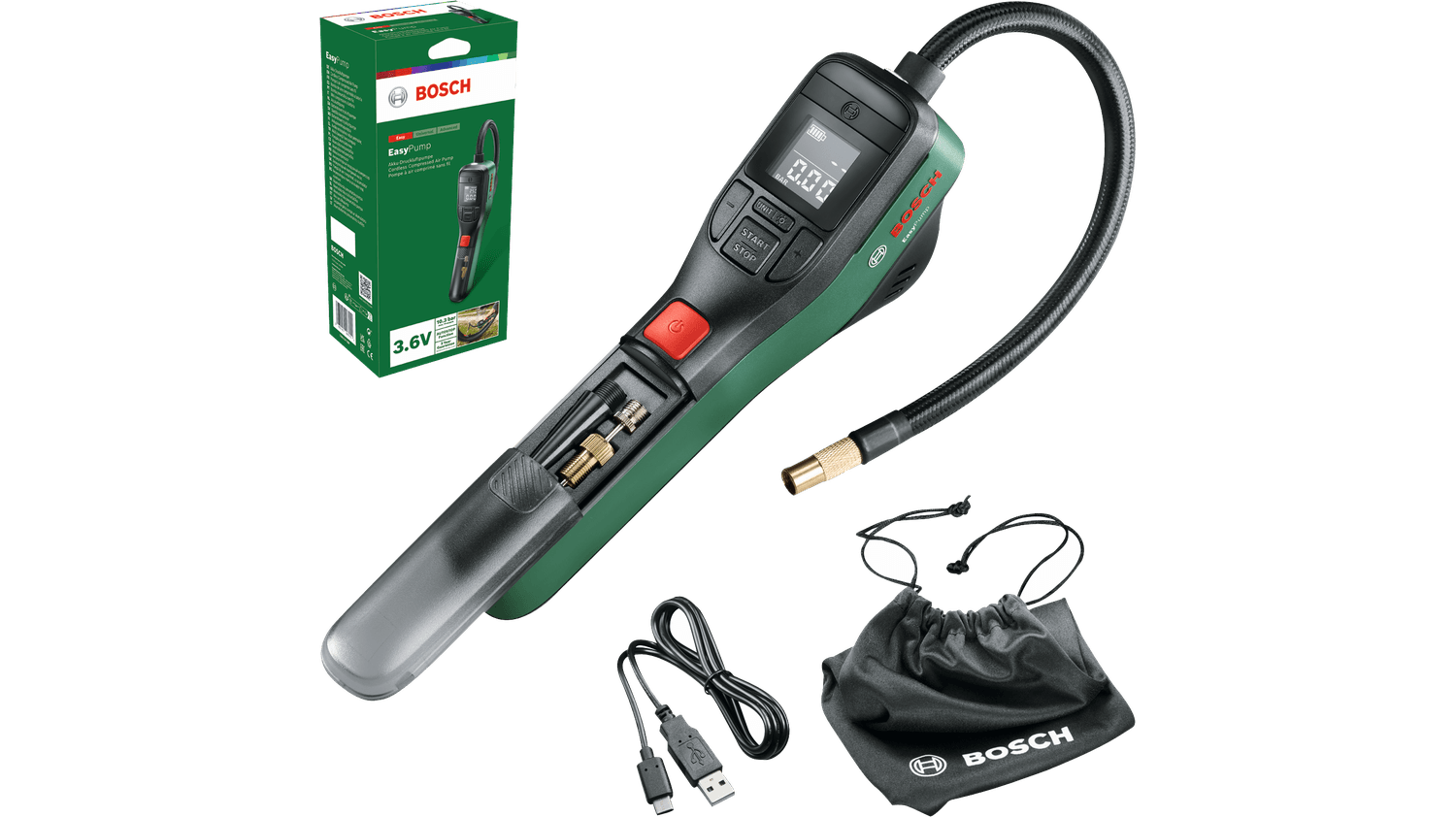
That looks like an option, the hose connection to the body looks a little more robust than the Guild
And this is part of the problem with new cars. My missus’ Jeep has non-standard wheels and the TMPS has been turned off.
My concern is how often yourself and other people are putting air in their tyres - unless there is a fault six months should be fine without adding air. And with these little compressors you are adding water vapour too that never gets out each time you ‘top up’.

A 2025 Mazda CX-5. We liked so much our 2019 car that we chose to replace it just before they change the model in a few months. The 2026 CX -5 is going to be wider and longer, a size not appealing to us. We traded in our old Mazda in a pristine shape and with the generous incentives of the company the deal was easy to make. Tomorrow we shall start a 2000 miles trip to the east coast which will hopefully be a smooth break-in process to the new machine.
9 Likes
You should be checking tyres cold, before driving anywhere. That way the internal temperature is about the same as the ambient temperature, so you can calculate the appropriate offset from the 20C standard. There will be inconsistencies otherwise, as you won’t know by how much the tyres have heated up and therefore by how much that has raised the pressure. If you’re checking and setting pressures after driving and your next check is after being parked up for some time, you will likely see low pressures.
It’s normal for TPMS to not register the pressure until you have driven a short way, over a certain speed, but that wouldn’t normally be so far/fast that you will have significantly increased the tyre temps and therefore pressures. The exception is when resetting the TPMS, as that can take much longer before you get a reading, but you don’t need to reset every time you adjust pressures. If it’s taking 4 miles, that sounds like TPMS resetting.
A difference between gauge and TMPS readings is normal, not many are accurately calibrated. Unless you feel that one results in an overly firm or loose/vague feeling, just pick one or split the difference, it will be close enough. What is important for consistency is to check them cold, ideally in the morning, before driving.
On my bike without TPMS I check before every ride. On the bike and cars with TPMS, I rely on TPMS to show a change and adjust as/if necessary. On the sports car, I might drop a little pressure before a “spirited” outing on a hot summers day. On track, pressures are critical and may be checked and adjusted several times in the same day. On the 4x4 without TPMS, I air up/down depending on what Im doing with it i.e. on/off road. I also check when swapping between winter & summer wheels. So, I’m checking quite often and have learned the differences between what the various TPMS read, what my gauge/inflator reads and what a couple of simple gauges read.
1 Like
Yes, and it rotates 360° so you can’t twist it.
Nitrogen instead of regular air improves proper maintenance of tire pressure (less fluctuation).