My network consists of a patch lead from the router to wallplate, 20m Cat5e or Cat6e to wallplate, chord c stream from wallplate to streaming bridge.
Do I need a switch or filters.
My network consists of a patch lead from the router to wallplate, 20m Cat5e or Cat6e to wallplate, chord c stream from wallplate to streaming bridge.
Do I need a switch or filters.
I was also more than hesitant… but after I heared the vodka cable, I began to believe. I have some Ethernet cables, from cheap to 2k (diamond and sigma). All sound completely different by a margin with the more expensive ones much better than the cheaper ones. All digital… can i explain. No - who cares 
Bigger is not always better - take for example audiophile switches using the lower data stream.
Oh dear … there we go again. Let them know better - we do hear better 
Sorry - that’s pure ignorance coming from you. A cable is more as connectors and a specification. The upgrade of the predecessor of the rip-off cable was in my system in the range of a box upgrade. And I am no easy believer …
But something tells me that your psychoacoustic theory will maintain.
I am no technical person. I have a pair of ears, I trust my ears, I tried many ethernet cables from mass to highest tier , and the result ? There’s a huge difference , hence the purchase of the Valhalla 2. Please go try and experience the cables and you will be convinced that there’s a difference . Not some snake oil products.
Edit.. I am getting 2 more in time to comes to “purify” the signal more before reaching my dac 

I have just fixed the transition bolts to the nds. So I know that they are in the correct place and I will not loose them
Sterilise would be an alternative word you could use.
Goggle: Beyond the Sound Waves Emilian Kalchev . A lot of things will be explained about why some new HiFi component sounds better. It is a medical scientific article. It mostly deals with “Burn in”, but its conclusions can be applied across the field. I have pasted a few extracts that explain things better than I can.
The Placebo Effect: Belief as a Powerful Modulator
One of the most researched cognitive biases in medicine and psychology, the placebo effect, holds relevance in the auditory domain as well. In essence, the placebo effect emerges when belief in a treatment’s efficacy (even if the treatment is inert) leads to tangible physiological changes or perceived benefits. Translating this to the realm of burn-in, if an audiophile believes that their headphones will attain optimal sound quality after, say, 50 hours of play, this very belief might induce genuine perceptual changes in how they experience the sound, even if there is no measurable alteration in the device’s output. The placebo
effect underscores the brain’s capacity to modify sensory experiences based on belief alone.
Furthermore, the very act of investing in new audio equipment might come with an emotional charge excitement, anticipation, or even skepticism. These emotions, whether they stem from the expectation of enhanced sound quality post burn-in or from other sources, can act as filters, subtly modifying the auditory experience. If, for instance, an individual feels immense satisfaction from their new purchase, this positive emotional state might amplify the perceived benefits of burn-in, even if the actual acoustic differences are minimal or non-existent. Conversely, a listener skeptical about burn-in might unconsciously seek flaws or remain
indifferent to potential enhancements in sound quality
The human propensity for forming communities around shared interests has been a foundational cornerstone of societal structures. One such community that has garnered both enthusiasm and skepticism in equal measure is the audiophile community. At its heart, this community is united by a profound passion for sound quality, but like any other social construct, it is subject to the influences of shared narratives, influential members, and collective memories
These online platforms, ranging from discussion boards to dedicated websites and social media groups, serve as hubs where audiophiles share experiences, discuss equipment, and seek advice. Over time, certain norms, terminologies, and beliefs take root, with “burn-in” being one such widely discussed phenomenon.
If this paper does not help, Google this:
Top Ten Signs an Audio Cable Vendor is Selling You Snake Oil
It might throw up an interesting conversation between an Electronics engineer, and Audioquest.
Or maybe we can just take these words into account when we find very expensive Hi Fi accessories:
It’s easier to fool someone than to convince them that they’ve been fooled.
I know this setup and have been investigating similar ones for ages. A switch would help but demands a proper power supply and thus further investment. What I would recommend in advance of a switch (and what is a completely passive solution) is an Ethernet filter. Try a Network Acoustics ENO2 (which is 60 days free) just before your streaming bridge. You will be amazed.
Sure you could start with an iFi LAN iSilencer for 80,- to see things make a difference but the ENO2 is on a totally different level.
You are happy, so you do not “need” one 
I did Google Emilian Kalchev: h-index 2 and 27 scientific citations in total. He has a looooong way to go on his road to scientific recognition and visibility. And what he writes is nonsense. He puts critical listening into the realm of UFO sightings and alien abduction 
But the paper seems pretty plausible. He is not the fist person to investigate psychoacoustics. I am sure you will find similar findings in the papers he references. As I understand it psychoacoustics is a concept accepted by the scientific community.
Even non experts know that our eyes and hearing are processed and interpreted in the brain. Our eyes correct the perspective distortion when we look at a building for example. I have learnt to avoid simultaneous testing of my headphones, as one will sound awful listened to at a short time span from the other. Our ears get used to a headphones tuning.
Maybe you could explain why Kalchev’s paper is nonsense, with some citations to back your opinion up.
Many things get mixed up here and I don’t have the time to untie all of this and to address a random Google post in detail. Sorry, if this sounds arrogant @Nigel1957 .
So basically you cannot tell me why his paper is nonsense.
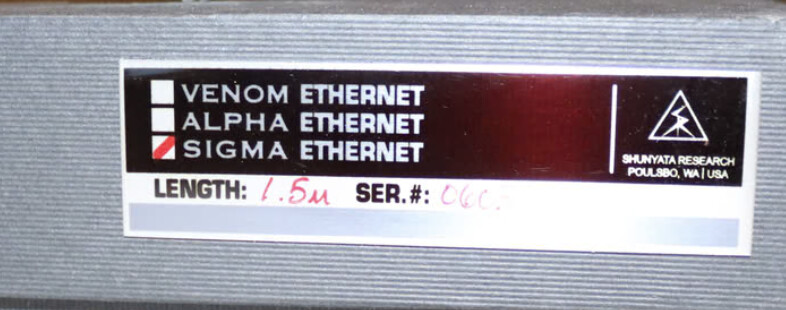
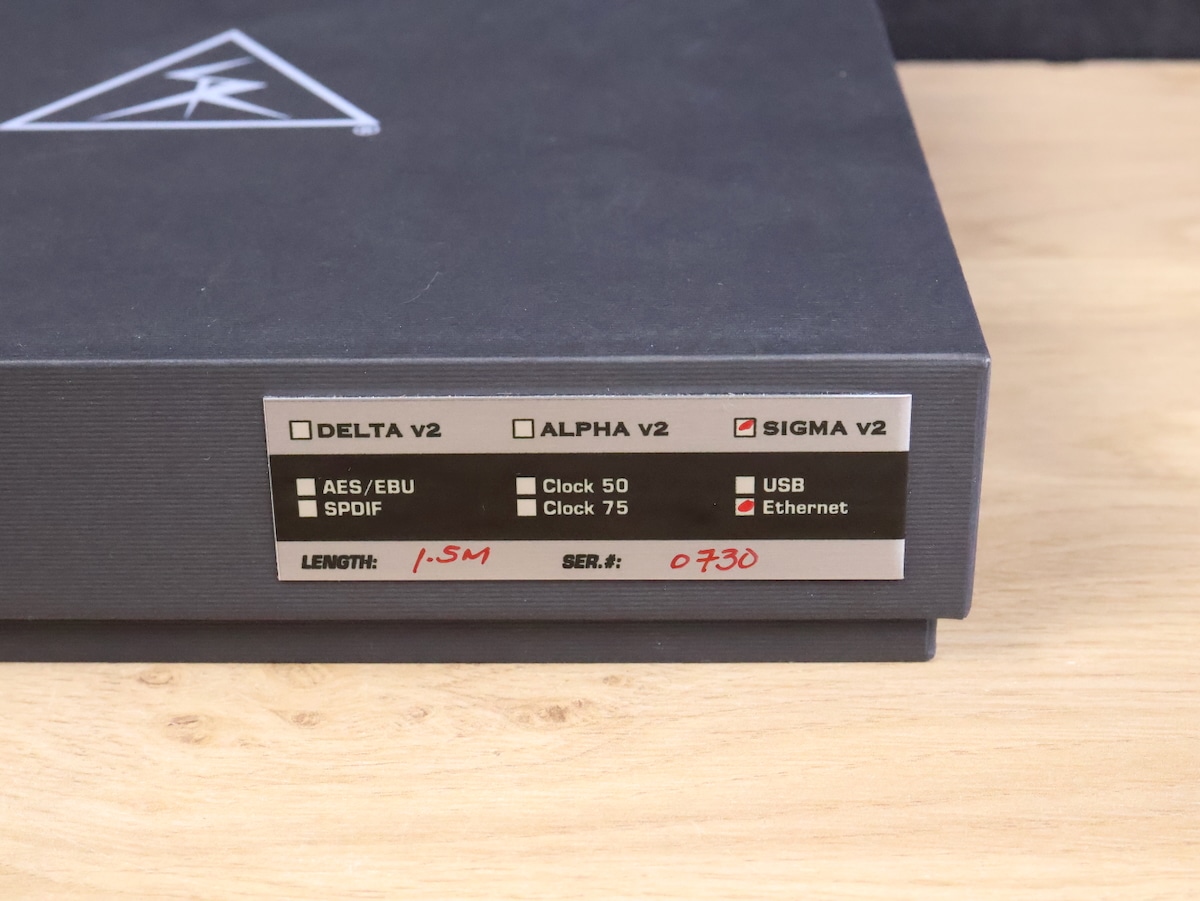
@drago @geko and others with Sigma. Does your packaging say V2 or just “Sigma”. Are there a V1 and V2 of Sigma and then the new Sigma X or just V2 and Sigma X?
They are different, with the v2 using a different cable and filters i believe if I remember right. I also think the cable will have v2 on it. But the filter cartridges are a different shape I think.
The x is again different again.
The omega cable didn’t get the v2 treatment, but has since had the x upgrade
I can’t be 100% sure but I think there was only V2 Sigma made. I don’t have the box any more, so can’t confirm what was on there. I seem to remember my dealer saying that V2 was the only one ever available to him.
I’ll send Shunyata an email to confirm 
Original Sigma Ethernet: This model featured ArNi wire, CMode filters, the PMZ (Precision Matched Z) concept to minimize jitter, and KPIP processing. It typically used full metal Telegartner connectors.
Sigma v2 Ethernet: The V2 version introduced dual CMode filters and utilized ArNi VTX, OFE, and OCC conductors. It was a development over the original Sigma, offering further refinements in noise reduction. This model is now discontinued.
Sigma-X Ethernet: This is the current model, positioned as a notable step up from the previous Sigma version. It incorporates the newer, smaller TAPc technology (Transverse Axial Polarizer) along with CMode filters into a single hybrid module to further lower the noise floor and improve timing. It also uses KPIP v2 processing and Ohno single-crystal copper conductors.
There you go