• But I don’t want to break any forum rules,.so leave this work to any knowledgeable and educated person.
Then that person can manufacture a cable,.which connects with a contact from where you removed the previous cable,and to your LPS.
No,.as I just said,the SMPS is removed from the Cisco.
I used/tried this Voltcraft,.because I had three at home,which I bought earlier to use for other things.
I have this LPS to a Cisco WS-C2960-8TC-L,.it’s at 12V 550 mA.
Cisco 2960PD,.is at 48V 300 mA.
My knowledgeable friend says,.that this Voltcraft is of good quality,but that it does not contain any audiophile components,.but it is well quite obvious.
I haven’t checked,.but it definitely has to be cheaper than an audio LPS.
When we test this,.we connected this LPS in this way…
Router > LPS/Cisco1 > Cisco 2 > Nas/Streamer.
So we had,.in other words,a regular Cisco with SMPS closest to the streamer.
Yet,.we had this very positive effect in soundquality.
It will be exciting to see,.what effect in soundquality we get,when we assemble an LPS even on the Cisco closest to the streamer.
Yes - it is a totally different beast. Sounds much better - only had mine a day and it is still running-in and the sound is changing but the baseline is a lot more detail - better definition of bass and smoother top-end and silky mid-band.
But the detail retrieved - subtle drumming riffs I never knew were on recordings I know well - and very ‘live’ and lively-faster presentation. Resolution of the darkness between notes (less smear - louder in a good dynamic way) - very impressive.
This is with the standard SM supply it is shipped with, so more upgrades possible, but I’m getting more impressed with this the longer I’ve had it - and that is only one day.
@Darkebear,..This description you make,.so I would also describe the difference to the better,when we connected an LPS in a dual-Cisco solution to the first Cisco.
Okay,.I forgot,we also had this powercable connected in this LPS…
When the time and opportunity are given,.we will also test this ER.
But it feels like it is possible to go quite far,.in trying to optimizing an LPS-solution to a Cisco as well.
Especially in a dual-Cisco solution with dual LPS.
And as I’ve told you before,.another friend has for just over a year,developed an incredibly competent powersupply to a Cisco.
When he thinks it meets all his requirements,.he’s going to make one for me.
Or,.now it will be two,with this dual-Cisco solution .
Is it your Cisco WS-C2960-8TC-L,.that you have compared to this ER,or is it your dual-Cisco solution with 2960/2940 you have compared to this ER.
There are quite some changes during Burn-in of the EtherRegen switch. Just wait as it gets better & better during this time.
I am 4-weeks with the EtherRegen (& 2-weeks since the firmware upgrade) and I have so much more detail on every track played. The detail was there before, as the same recordings/files, but now it is just there - whether it is that the noise floor has dropped so making the fine details more audible or is the signal timing more accurate allowing the micro-detail to come into better focus. It is equivalent to a source upgrade, a better cartridge, change in DAC technology etc. Whatever it is and why, it is excellent.
NAS and ROCK server are upstairs connected to a GS108 as data backplane for main and backup NAS units, with port priority given to the playback stream between main NAS, NUC running ROCK and downstream connection. The Wireless AP, and a switch (GS105) for IoT devices are on different ports on the firewall router, with Virgin Media’s Router being in Modem-only mode.
The EtherRegen is downstairs with the isolated ‘B’ port to NDS with Chord Sarum Tuned streaming cable. The A ports of the EtherRegen have the upstream connection (AQ Vodka), a UltraRendu running the SonoreUPnP Bridge (Chord Anthem), a RPi2 running Asset R6.4 UPnP server (AQ Vodka) and an AppleTV (AQ Cinnamon).
All switches, including EtherRegen, powered by LPS.
NAS and ROCK server also on LPS.
I have tried to ensure network optimization for the playback stream, from NAS to Network player, so the EtherRegen is the final piece of this approach with the ”moat” isolating the stream to the NDS.
Simon.
No and I have to say that I am very happy with my Ansuz so far. It’s also almost impossible to compare always everything, so you have to also make sometimes a step forward and don’t look back. I also haven’t got the base model, so just went one step up…
Hi Michaelb and DB.
I came to the ER by different route to most on here. About 4 years ago I tried one of the paul pang switches before switches were being talked about then upgraded to the ocxo clock and bespoke power supply.When the forum began talking of the Cisco,I bought one, and got Sean Jacobs to lend me a 48v supply (all singing and dancing DC3) but it wasnt anywhere near the Paul pang. I now have 2 doubles of the latest PP with a dc3 on each. I have just added the er in place of one of them again with the dc3 and really impressed in the few weeks of running in. Just sounds more open, more musical and beautiful bass tunes going on.
I have had no option but to stuff the 2960 PD’s SMPS and its cables under my peripherals rack.
I too am interested in changing over the power supply to the PD to PoE, and would be interested to hear if you make any progress with a power injector.
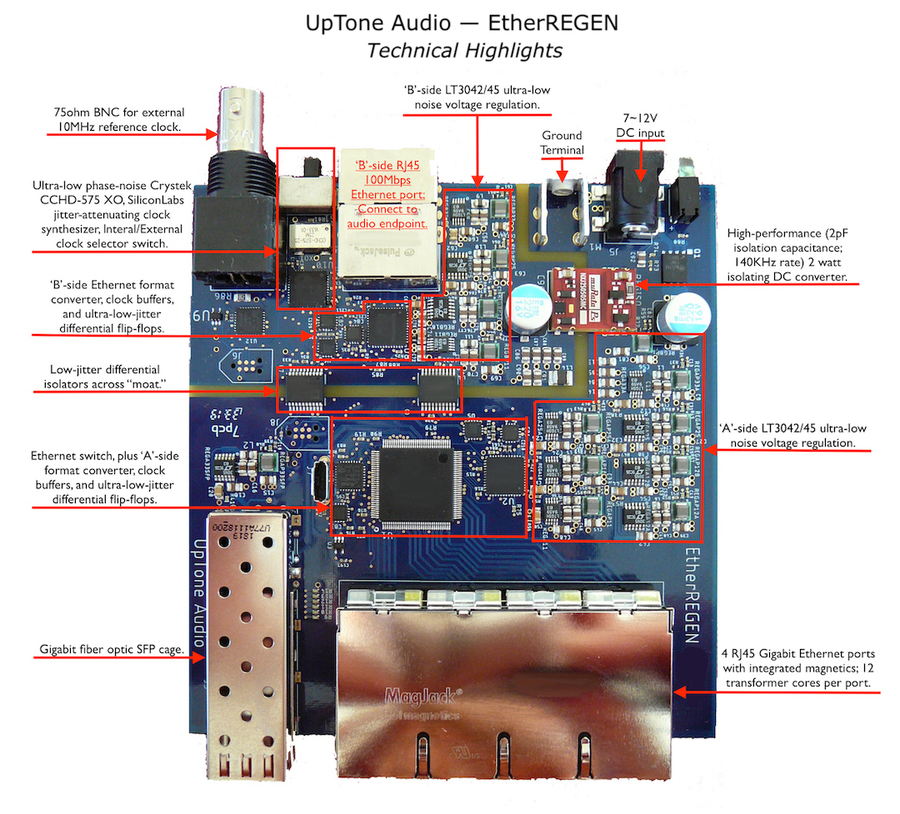
Yes, there is improved galvanic isolation on the A ports, by using parts with better transformers than any switch, but the B port is a full isolation from anything else - power, clocks.
From Uptone Audio
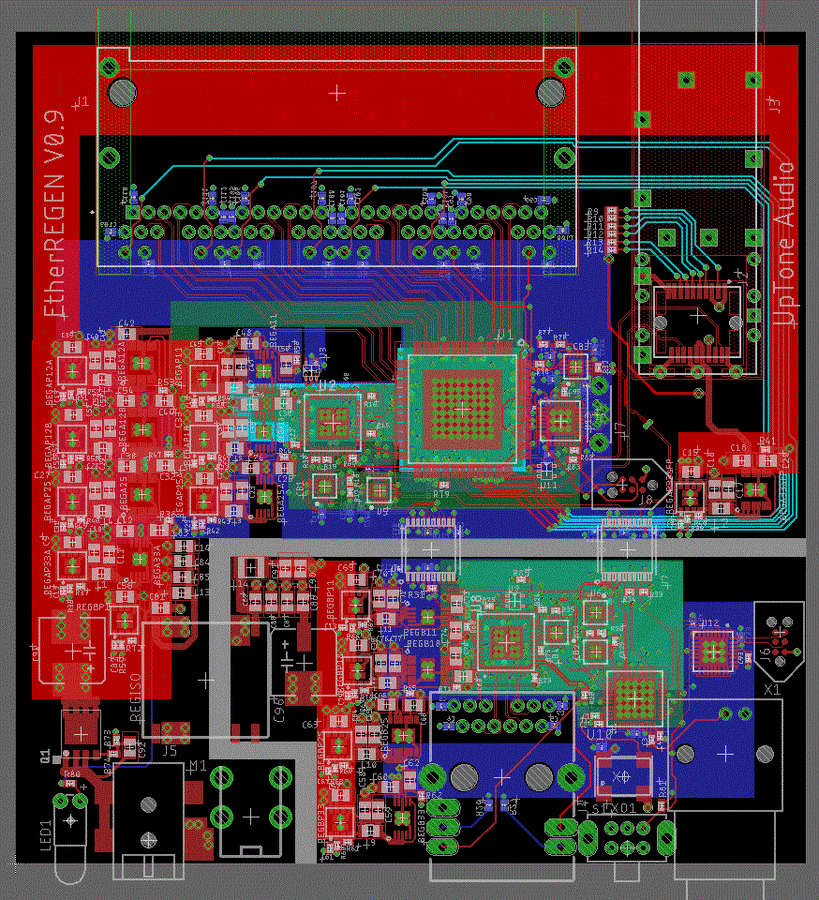
“Going from port-to-port on the ‘A’ side of EtherREGEN is already better than most any other switch, but crossing our A ctive D ifferential I solation M oat (“ ADIM”)—to its ‘B’ side—brings an unmatched level of Ethernet performance for audio. On the circuit board photos you can see the EtherREGEN’s “moat,” across which sit the differential digital isolators.”
So check out the top section of the PCB, is completely separate on the multi-layer PCB.
The B port is designed for the streamer or Ethernet driven DAC (streamer/DAC aka Network player).
Found the image of the PCB where the extend of the isolation is clear.
Really difficult to remember. I do remember the iFi iPower making a difference on the Netgear Prosafe GS105 switch I originally used it for (very subtle improvement in clarity and micro-detail retrieval IIRC), but the BT Hub’s SMPS could be superior (less noisy) to that of the Gs105’s. I reused the iPower, because I had it.
No sure if I would buy a iPower especially for a router, unless you can be sure to find the right adapter. I also recall that some on here have suffered failures with the iFi iPower. Mine however has worked flawlessly for years.
There’s a very interesting review and subsequent debate if you search for etherregen ethernet switch, dated 4th December.
A bloke, whose credentials seem pretty good, tests it (i.e. measures it) against a cheap TP-Link. Not a scrap of difference measurement wise. He listened to it and couldn’t detect a sonic difference either.
There follows the usual snake-oil barrage, which I mostly skipped, and then towards the end an owner chips in with “well I can hear a big difference”. He’s then challenged to blind test it, which he does with the result that neither he nor his audiophile friend can reliable tell when it’s in the signal path or not. Unless he looks, at which point he can tell it sounds better!
I make no judgement, being neither technically qualified at that level nor in a position to test the sonics myself.
 @anon77199223,…
 When we test this,.we connected this LPS in this way…


 .
.
 ”)—to its ‘B’ side—brings an unmatched level of Ethernet performance for audio. On the circuit board photos you can see the EtherREGEN’s “moat,” across which sit the differential digital isolators.”