The Octopus site talks about 20% reserve for power cuts. Also note that they do not recommend surplus going to immersions and EV chargers. If I bought a Zappi I would not set that up, but if for some reason the symmetry changed it would be useful.
The power cut reserve is a shame. We recently have had a few power cuts and it is really annoying. We have been told they have replaced components but fear that it is an underground cable fault which are difficult to locate…we have been told to expect a few more months of this. So for me that off grid supply would be important……at the moment.
Hi Phil,
Our Powerwall capacity reserve is set at 20%, presumably by Tesla now. Until the tariff switch, we had full control over the reserved capacity level.
The Zappi 2 went in a year before the Powerwall eventually arrived, so Tesla just has to swallow hard and get on with it.
Hi Gazza, if the Powerwall was down to the reserve (presumably because it was peak demand on the grid) then unfortunate. Presumably it won’t charge up from the grid until it is really cheap, but it should still charge from the Solar, and right now there is 500 watts/m2 incident power even at 7pm potentially (depends on shading). However, you can use electric from the grid at anytime for other reasons.
Phil,
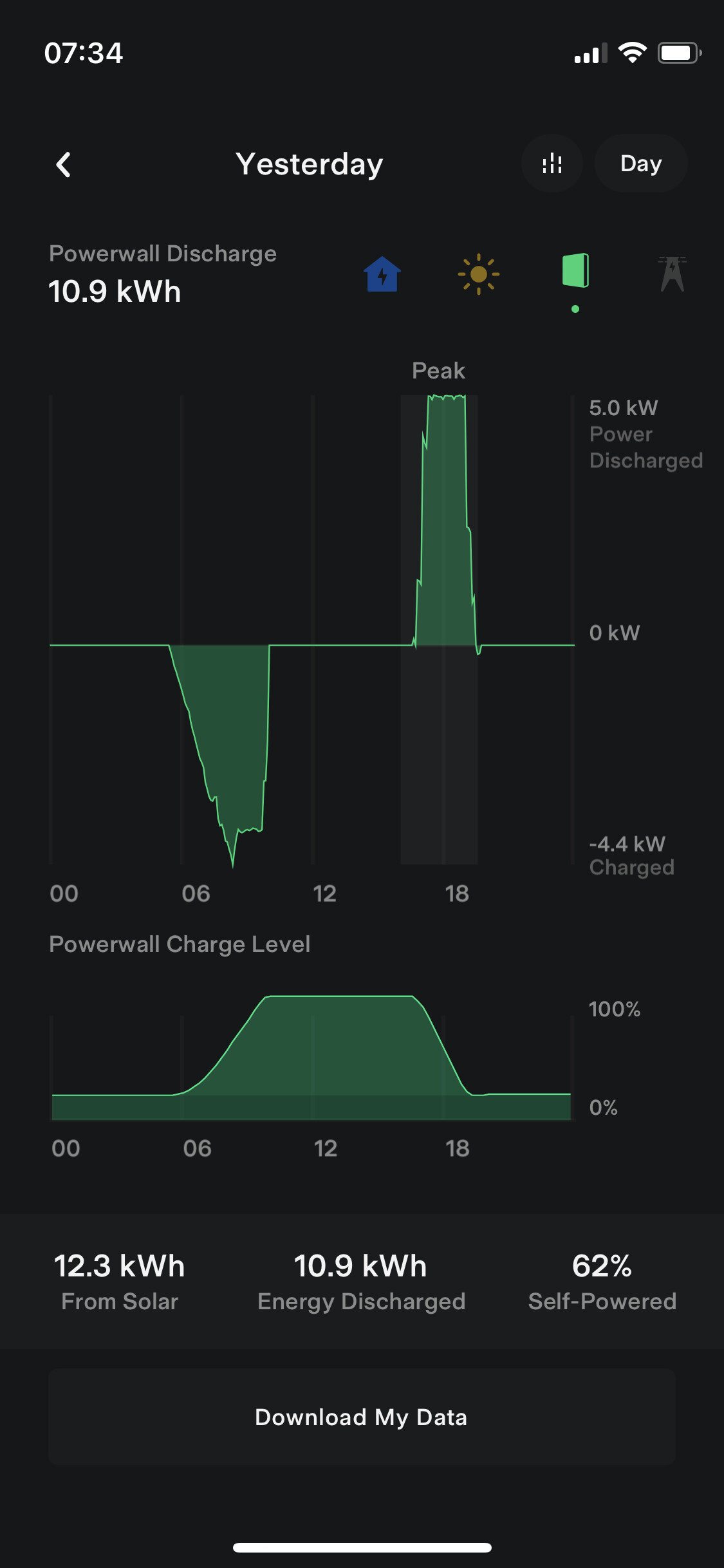
For those into such esoteric matters of Powerwall performance, here is a typical charge-discharge profile for our Powerwall at the moment. This is from yesterday:
The surplus solar charges the Powerwall from circa 6am here in the UK until it’s full at about 10am.
It stays full, with the house running on solar, until we hit the peak electricity price period at 4pm, then Tesla draws the maximum 5kW from the battery until it is down to the 20% reserve at about 7pm.
My understanding is that the 20% is a minimum - so it could be more. Or do Tesla / octopus empty the battery down to 20% every evening? For us the power outages tend to happen during the day or maybe early evening - but 2.7kWh (20% x 13.5 available) would not be enough for us with air source heat pump and electric range oven scoffing that before dawn every day, subject in our case to wind generation. My plan would be to have an alarm go off when it is supporting the house so I could turn everything off apart from lights and the internet to keep going
I can’t remember having lengthy power-cuts. It’s usually to do with diggers, but we are on the overhead. We are not in the country with trees and storms a risk, but a Powerwall isn’t a fix for that.
So come the winter, you will be drawing electricity. In my mind it defeats the object of having a battery, but of course the maths when taking account the lower tariff may well suggest otherwise. I guess it’s something only time will tell.
At least things like washing machine/dish washer etc can be used during the day. Can’t think of a way to store energy for the cooker though, although at the moment I am getting great joy in filling a flask full of hot water during the day to use in the evening and morning. I guess you could also pre-heat you oven up at 17:45, to keep some residual heat there reading for later on
You are quite right that we will draw electricity in the winter, but this is not a battery issue.
Fundamentally, we sized the solar array to provide an excess in the summer and a shortfall in the winter.
Smoothing out this supply vs our demand over a 12 month cycle is not a job for a Powerwall or any other battery. Batteries are for short-term energy balancing, i.e. a few hours, not for weeks or months. Long term storage requires very different technologies.
Tesla is using the battery for daily peak lopping/electricity price arbitrage, which is why we pay such a low price per unit. We are still helping to relieve the grid during the evening peak, while importing it at other times of the day during the winter.
In the summer, Tesla has worked out that we have sufficient surplus solar to recharge the Powerwall in the morning. It will be interesting to see when Tesla decides to recharge the battery in the winter months. I am expecting the early hours of the morning but we’ll have to wait & see.
The way I look at it is that the grid is an extension of the battery. My solar production will be reducing my net electric consumption 100% and my consumption cost is 11.24p/kWh.
V2H and Octopus Go might be marginally cheaper depending on the export rate, but there is a limit to how much energy can be stored in 4 hours that depends on the V2H charger and the efficiency is not 100%. So the ASHP may need 20kWh/day in cold weather and our house averages 14kWh/day.
This is something I’ve been thinking about, though we don’t have our solar installed for another 2 weeks yet. My best guess at the moment is that adding a battery at a cost of around $20K will save $1K off our annual power bill, mostly as the buy back rate is reasonably good - meaning that exporting to the grid and buying back is effectively using the grid as a battery, and this reduces the financial benefit. We’ll see how the real world data looks after a few months of going solar.
It’s a very interesting thread, and so many varied combinations of solutions. I think in my mind it’s like Solar Panels is a bit like putting money into a building society account with a low, but guaranteed interest rate. Then adding batteries is like putting money into high risk shares - i.e. it may or may not do well, but hopefully over a long time it will. Hopefully when(if) the battery prices half, it will all become a no brainer that doesn’t need a degree in Math to make that move.
Batteries are definitely an option here as we have very low return revenue and they now want to increase the price they charge you for using the wires to send it back. This plus pricing that is increasingly expensive makes it worth considering.
So, after a few weeks of dialogue with my power retailer about an unexpected increase in rates, I’ve established that they applied higher rates after we had our solar import/export meter installed.
Basically, they have attractive buy back rates for solar export, but increase your import (buy) rates if you export power. This wasn’t apparent on their web site when we changed suppliers, so not very transparent, almost dishonest. We aren’t even on solar yet and they are charging higher rates from when the meter was changed.
I agree on this - 15 to 20 years to payback- too long for me, and whilst I welcome the environmental benefits - the return period needs to improve significantly
Interesting with our 9kw solar system installed a couple of months back - and now in the winter period, solar production is very low- about 8kw per day, so on that basis the battery would only really be of any benefit say October to April - doesn’t work for me