It’s always been my understanding that heat pumps won’t work with microbore pipes but it seems it’s not that straightforward. While not ideal they can work with a few system tweaks. So thanks for pointing it out, I’ve learned something today. We have standard pipes and our heat pump works brilliantly, and so much better than the previous gas boiler.
Our installer stripped out the small amount of microbore left in our heating system, but it was 8mm. He said that if it had been 10mm he would probably have left it. The microbore was in two lengths of approximately 8 metres and it worked perfectly well feeding the largest radiator in the house even though all the others were on 15mm pipe.
There are apparently some people within the industry who believe that microbore piping should not be replaced when heat pumps are installed in older houses. It would make installation quicker and cheaper and the disruption is a deterrent for some people.
We’ve a 100 years old house with microbore. When the temp is higher than zero, the heat pump does manage at a low flow temperature. Now it’s freezing -5 celcius, the flow temperature has gone up and the efficiency simply drops.
I’ve just ignited the fireplace to help.
1 Like
Microbore is used because it is cheaper to buy and easier to install. There are no other benefits.
1 Like
That’s really good to know, and I’m so pleased to read real experiences of it working; I was convinced it wouldn’t. It just proves that I should take more care to check things out. As I understand it, microbore reduces the flow rate, making it harder for the lower temperature radiators to heat the house. It’s been really cold here and the pump has been chomping through the electricity, but the temperature has risen today. The downside is that we have no sun, so the solar production has gone down. That’s January for you.
1 Like
Exactly. The smaller stuff used to come on a drum. It was a cheap and a not so cheerful solution. Easy and cheapish to install. No other benefits. The right answer is 15 or even 22mm.
A CH system whether it’s gas, oil or ASHP fed is little more than basic heat transfer. Bigger pipework allows higher mass flow rates, more kgs/s. Another answer is to increase the pressure drop across the feed pump and whilst this could deliver higher kg/s of flow, the system pressure increase would likely fail the pipework. So the real answer is bigger pipes ( less flow resistance) and lower system pressures.
So Mr Salesman who turns up to a house with microbore system is faced with the real answer or the one that is more likely to get a sale. And dont forget Mr Salesman is there just to get the sale rather than ongoing support. That becomes the poor installation technicians job.
The stories you hear in some installations is sad. But the customer needs to be informed better. And a knowledge of fluid mechanics and thermodynamics wouldn’t go a miss either !
2 Likes
Thank you David , I will order it .
I am very grateful to the paramedics who attended to me with my little “incident” in May , especially with the seizures
2 Likes
A couple of days late posting this, I went to the matinee of Othello at the Theatre Royal Haymarket (West End of London). It’s had mixed reviews, I really enjoyed it. For me Othello lives or dies by how plausible you find Othello falling for Iago’s plots, I’ve seen a few productions where all I felt was frustration that he believed such a clear set of lies. I thought David Harewood was excellent as the lead, the confidence of a major leader, and Toby Jones’s Iago might well be the best I’ve ever seen, his scheming was credible and I could see how the lies could be believed (as I said reviews were mixed, others didn’t like it). Caitlin Fitzgerald was also very good as Desdemona.
1 Like
Did you see the NT production a few years back? Adrian Lester played Othello and Rory Kinnear played Iago. Utterly brilliant and the best Iago I’ve seen although I haven’t seen your production yet
3 Likes
I missed that one sadly, I can imagine Kinnear being superb.
1 Like
Hi Nigel, out of curiosity, what sort of flow temperatures were you getting from the heat pump during the recent cold spell ?
Hi James. The flow temperature is determined by the heating curve and changes with the outside temperature. When it’s 0°C the flow temperature is 46°C.
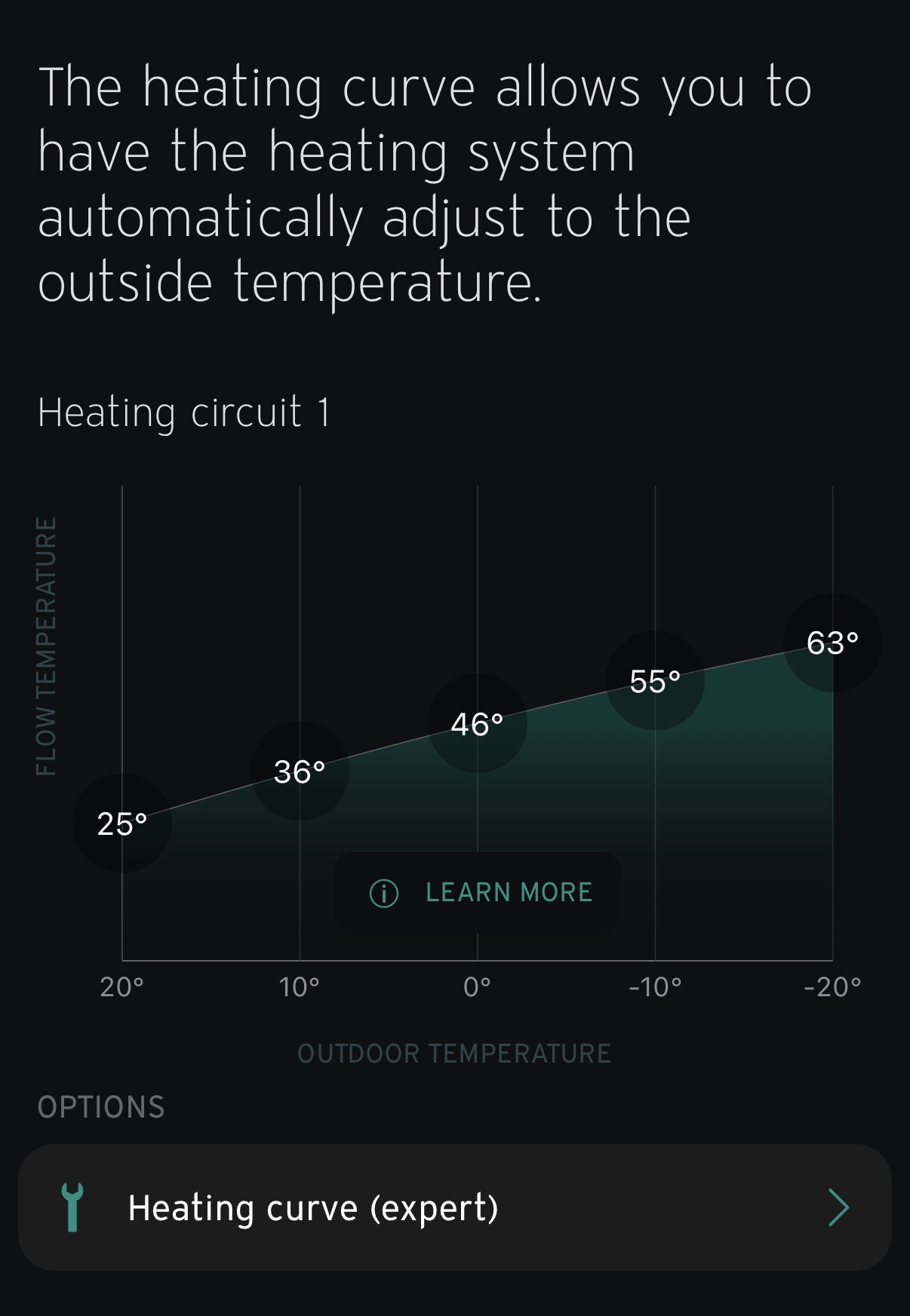
We don’t use an internal thermostat at all; with the pump operating according to the outside temperature and the required internal temperature. It’s surprising how it works. We have the internal temperature targeted at 18°C from 10am to 5pm. I’ve just checked and the temperature in the dining room - the coldest room - is 18.1°C.
2 Likes
Thanks Nigel - I remember you saying you were using the active mode on the controller rather than expanded which makes sense for the heat pump. If the weather compensated heat curve is matched to the heat loss of the house (looks like yours is set at 0.9) then it should maintain a comfortable temperature as set. Glad to hear it’s all going well with your move to the heat pump.
Isn’t the heat loss of an house also dependent on the amount of wind? I’ve a detached house and given the average level of insulation the house cools down much more with significant wind. I wonder how that works.
1 Like
Fairly straightfoward I would think. Warm air around the shell of the house is quickly replaced by cold air from the wind. Heat transfer from warm shell to cold air tries to keep up.
2 Likes
That’s the part I do understand, what I don’t understand is how the system calculates the right temperature. There must be some sensor either measuring wind speed, which or get that from the internet or so.
1 Like
That’s a fair point. For us wind direction would be critical too, as we are well sheltered from the prevailing SW winds but very much exposed to Northerlies. Not something an online information source could easily factor in.
If you’re back in London theatre then I can absolutely recommend Kenrex which is on at The Other Palace Theatre in Victoria. It’s a one man show cowritten and acted by Jack Holden. He plays all 19 characters of what is a true crime drama from 1981. However, several reviews describe it as an American small town version of Under Milk Wood. Just back from seeing it and it is one of the most exhilarating pieces of theatre I’ve ever seen. Finishes at the end of January
1 Like
Thanks, I’ll try to get a ticket.
1 Like
You are correct. If the system measures outside temperature and drives the circulating water temperature to match heat loss, that is fine. However, there will be increased heat loss when it is windy, and hence the requirement to increase circulating water temperature to compensate and ensure the home stays at a given temperature. I doubt the ASHP measures or is aware of wind, more it just recognises that the temperature it is driving to is not being met ( due to the wind). What id expect it does is to increase the circulating water temperature. However, there will be quite a lag and could lead to temperature overshoot. Even worse if the wind then drops.