It sounds like your ISP and supplied router is a bit crap.
If I have no internet all devices on the network can still communicate with each other. Roon still works, Plex still works etc.
A router is just a door way between one network and another. A decent router will ensure the network in your house (LAN - Local Area Network) still functions even if the internet (WAN - Wide Area Network) is not working.
I did have my internet connection go down last year but I could still stream locally from my Core using WiFi to control it.
Switching over to use the 4g from my phone I could stream from the internet. My internet provider gave me 20gb of date to carry me over till the service was restored later that day.
That’s exactly how it should be of course, and how mine is. All the Naim stuff just carries on as if nothing has happened.
As an example for FR of how you can have a network without internet: when we do our WemsFest concerts, the sound techs set up a little wireless network in the hall using an AirPort express. That lets them control the levels on the mixing desk using an app on their iPad. They stand in the middle while the band are on stage for the soundcheck and adjust everything so that the band and us are all happy. No internet. No wires. Not even any mobile phone signal in some places. A local area network as simple as can be.
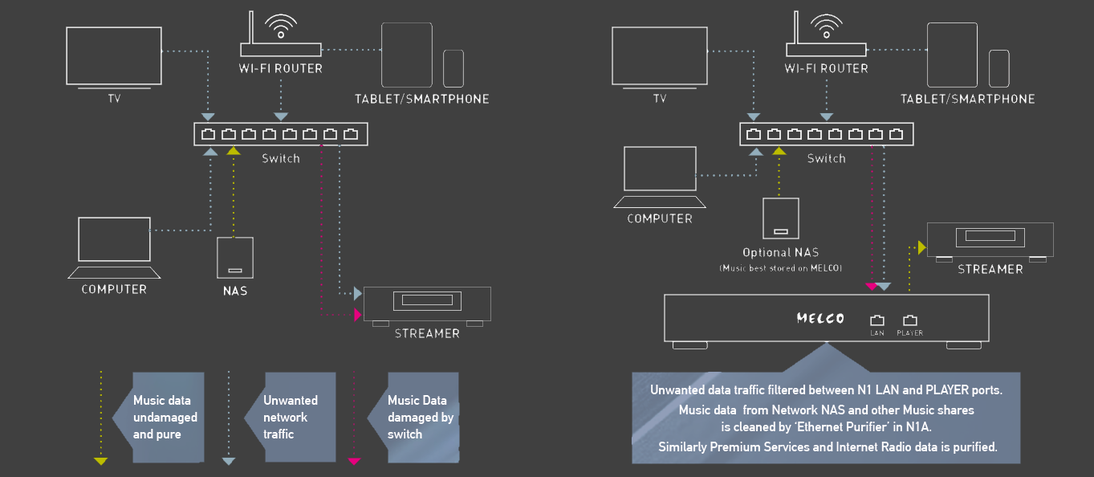
It is not that you cannot choose it, it is just that you are not able to do so. What you write suggests that you do not know how to log into your router and control its functionalities. That’s not a problem because there is no reason for you at this point to switch off your internet connection or to change your setup. It is just that it’s useful to keep in mind that you do not need any internet connection for local streaming. The image
makes it clear. The internet is what is above the router (not shown in the picture) and it is completely irrelevant for streaming from/to LAN (what is depicted in the picture) devices.
As a side remark: I consider the picture that I have posted above marketing crap. Still, it is useful to illustrate the difference between a LAN (what is depicted) and the internet that is, what is beyond (above) the router and not depicted in the illustration.
Think of an office telephone system. If somebody cuts the phone line outside the building you can still telephone your colleagues in the office.
You can ring someone at the desk next to yours. This is like your device connecting to a server on your local area network (LAN). This requires only a LAN to connect your device and server and doesn’t need the internet.
You can ring someone in another country. This of course requires an external phone line. This is like your device connecting to TIDAL or another streaming service and requires your LAN to be connected to the internet.
I’ve never heard of a router (which is the unit that manages a LAN) that must be connected to the internet for the LAN to work. Some routers have an inbuilt modem (which connects to the internet) but even those will happily maintain the LAN even if not connected to the internet.
A router that broke the LAN due to no internet would be a piece of junk deserving of replacement.
I discovered something. I didn’t knew that before. I made some researches and read how to create a local network without internet. It’s, at least for me, not so easy. But I didn’t tried. However I don’t see the interest for me to do that, but I know now that’s possible.
Thanks you all, Znai, Chrissu, David, Nbph, Garyi…
Hello FR–I suspect you are not alone. Add me to the list that did not really know this. Not planning on doing a local network, but its good to know. Thanks
Well, every time you turn on the hotspot of your mobile phone, you are in fact creating a local network and using your phone as a router. That’s actually very simple and very handy in many practical situations. For instance, when the internet provider of your home router has a failure and you need to make a video conference!
Your Local Area Network (LAN) is likely to be much faster than your internet connection and much, much faster that what it takes to stream high-resolution music data.
For example, my internet connection is max. 63,7 Mbit/s (download) and 12.7 Mbit/s (upload). The wireless connection between my router and my laptop is, where I am sitting just now, about 600 Mbit/s (both upload and download). Streaming a 24/192 music files requires max. about 4 Mbit/s: I can stream 24/192 music files from an RPi wired to the router to any other device (Allo Digione Signature, Chromecast Audio, TV, Oppo 203, etc.) over the wireless without any problem.
I am not sure that I understand your second question. Streams from internet providers like Qobuz, Netflix, etc. have anyway to go through your (wired or wireless) LAN in order to be consumed, e.g. by a streamer or a TV.
Nbph says it’s possible to stream local files when internet is down. But as I said, I am just curious, because I didn’t know it’s possible. But my curiosity stops here. I have no intention to try, even if self isolation begins here on Friday